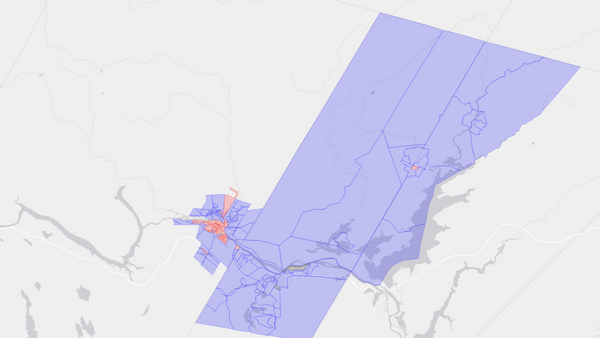
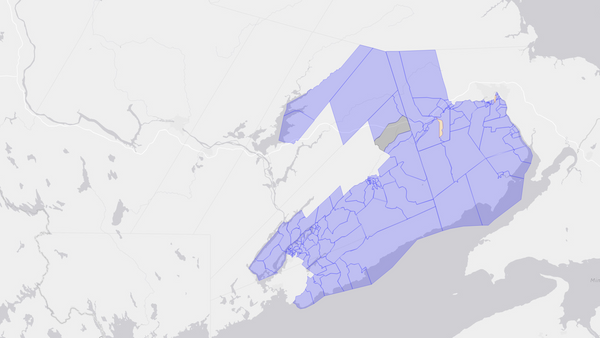
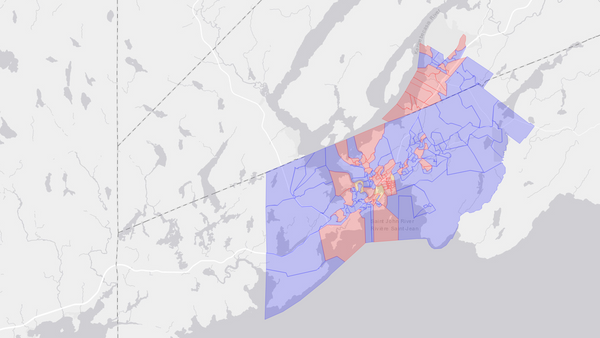
Tobique—Mactaquac, NB — 2008 Federal Election Results Map
Tobique—Mactaquac — 2008 Election Results
📌 The Canadian federal electoral district of Tobique—Mactaquac was contested in the 2008 election.
🏆 Mike Allen, the Conservative candidate, won the riding with 18,071 votes (57.4% of the vote).
🥈 The runner-up was Sally McGrath (Liberal) with 6,773 votes (21.5%), defeated by a margin of 11,298 votes.
📊 Other notable candidates: Alice Finnamore (NDP-New Democratic Party, 15%) and Mark Glass (Green Party, 6%).
Riding information
Auto generated. Flag an issue.Tobique—Mactaquac
Potatoes underwrite this riding. Tobique—Mactaquac spans Carleton and Victoria counties and the York County countryside beyond Fredericton, some 15,100 square kilometres of upper Saint John River valley and interior forest holding about 68,000 people, fewer than five to the square kilometre. Woodstock, Hartland, Florenceville-Bristol, Perth-Andover and Grand Falls string along the river; Nackawic and Millville sit downstream toward the Mactaquac headpond; Stanley and Boiestown lie in the woods behind; and the First Nations communities at Tobique and Woodstock fall inside the boundaries. The population is overwhelmingly anglophone.
Candidates
Mike Allen (Conservative) — Allen held the seat, having taken it from Liberal Andy Savoy in January 2006 after losing to the same opponent in 2004. Born in Fredericton in November 1960, he worked as a management consultant before entering politics.
Sally McGrath (Liberal) — McGrath was a high school teacher from Taymouth, at the riding's York County end, and carried the Liberal nomination in a seat her party had held until 2006.
Alice Finnamore (NDP) — Finnamore, a psychologist from Scotch Settlement, had been the New Democratic candidate here in 2006 and returned for a second campaign.
Mark Glass (Green Party) — Glass, a pharmacist from Sisson Ridge in Victoria County, represented the Green Party.
About the Riding
The valley between Woodstock and Grand Falls is New Brunswick's potato country, and the business that grew out of it went global. Harrison and Wallace McCain opened their first frozen-food plant at Florenceville in 1957; a half-century on, McCain Foods was the world's largest producer of frozen potato products, turning out about a quarter of the frozen french fries made anywhere, and still ran the company from the same small community, which merged with neighbouring Bristol on 1 July 2008 to become the town of Florenceville-Bristol. Growing, storing, processing and hauling potatoes accounts for a large share of employment across Carleton and Victoria counties, which makes farm income, crop insurance and access to the American market concrete federal matters here.
Forestry fills in much of the rest. Nackawic exists because of a mill: the town was laid out in the late 1960s to resettle families displaced as the Mactaquac headpond flooded the river valley above Fredericton, and the kraft pulp plant beside it was built between 1967 and 1970. When St. Anne-Nackawic collapsed on 14 September 2004, owing $101.2 million to creditors and putting more than 400 people out of work, the shock ran through the whole southern end of the riding. The province brokered a rescue with India's Aditya Birla Group and Quebec-based Tembec, and the plant made its first pulp again on 27 January 2006 as AV Nackawic. A conversion followed, and by 2008 the mill was moving to dissolving pulp for the textile trade instead of paper-grade kraft — a rare piece of good news in a provincial forest sector that was otherwise shedding capacity.
Other landmarks anchor the visitor economy. NB Power's hydroelectric station and headpond at Mactaquac sit just upstream of Fredericton, and the Hartland bridge, built in 1901 and 391 metres from bank to bank, is the longest covered span in the world. Woodstock and Grand Falls serve as the commercial centres of the southern and northern halves, with Perth-Andover between them on the river.
Distance is the constant. Delivering services, transport links and broadband across a riding of this size was a running federal concern, alongside employment insurance for seasonal farm and woods work, the terms of the softwood lumber agreement, and the question of how a rural economy dependent on trucking and processing would fare under a national carbon tax.