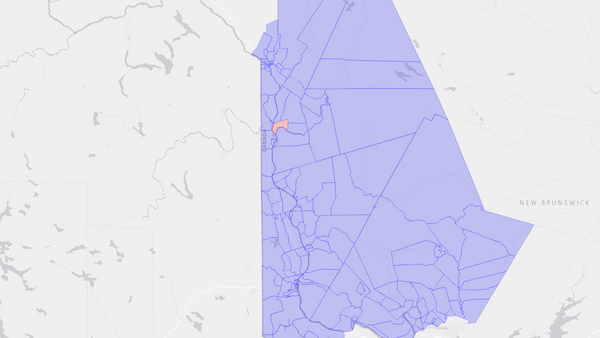
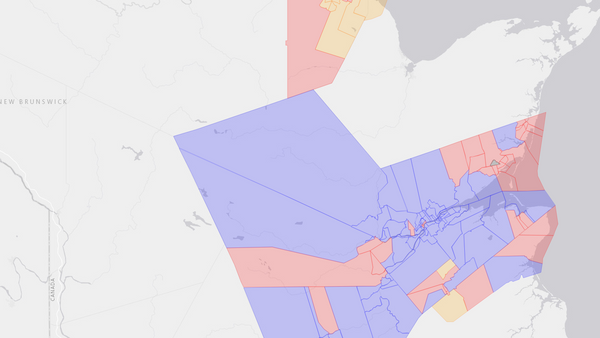
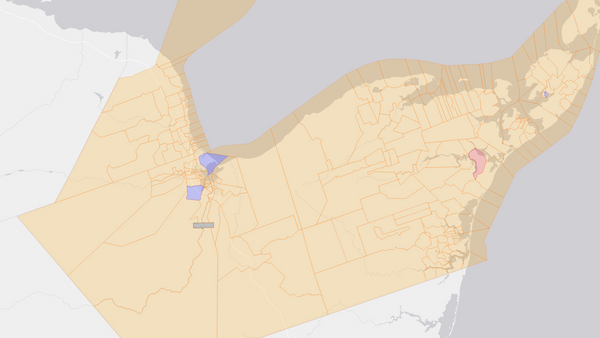
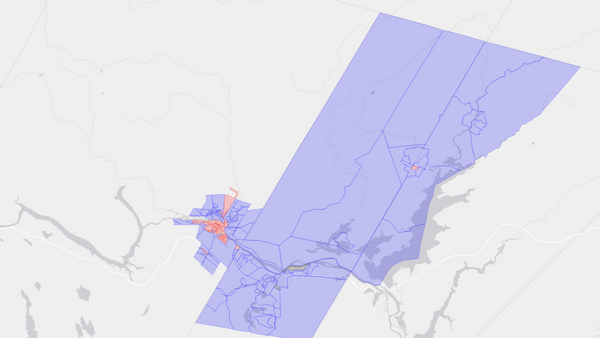
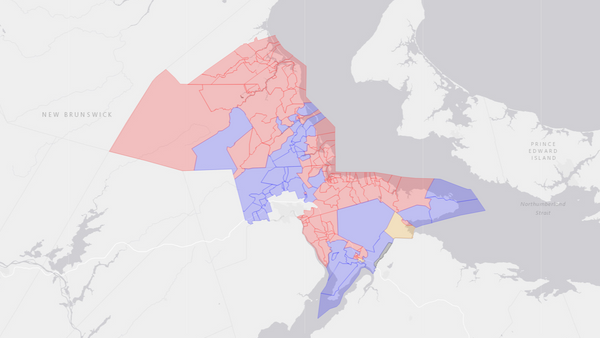
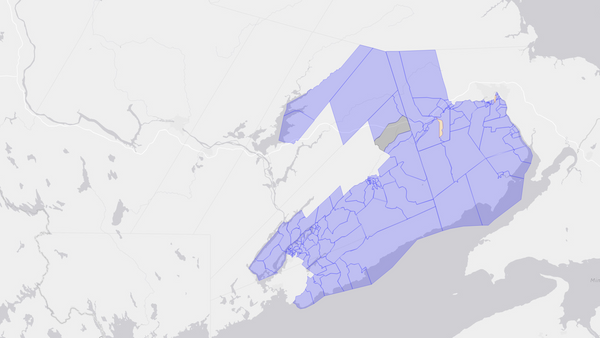
Madawaska—Restigouche, NB — 2008 Federal Election Results Map
Madawaska—Restigouche — 2008 Election Results
📌 The Canadian federal electoral district of Madawaska—Restigouche was contested in the 2008 election.
🏆 Jean-Claude JC D'Amours, the Liberal candidate, won the riding with 16,266 votes (47.4% of the vote).
🥈 The runner-up was Jean-Pierre Ouellet (Conservative) with 11,402 votes (33.2%), defeated by a margin of 4,864 votes.
📊 Other notable candidates: Thérèse Tremblay-Philippe (NDP-New Democratic Party, 16%).
Riding information
Auto generated. Flag an issue.Madawaska—Restigouche
Pulp and paper built the towns of this riding, and in 2008 the industry was taking one of them apart. Madawaska—Restigouche covers Madawaska County and all of Restigouche County but its extreme eastern end, some 11,700 square kilometres holding about five people to the square kilometre. Edmundston sits at the southern corner where the Madawaska River meets the Saint John on the Maine boundary; Campbellton, Atholville, Dalhousie and Balmoral line the Restigouche and Chaleur Bay to the northeast; Saint-Quentin and Kedgwick lie in the forest between them. French is the working language nearly everywhere. Residents of the Madawaska district call themselves Brayons rather than Acadians, a distinction rooted in nineteenth-century settlement out of Quebec.
Candidates
Jean-Claude D'Amours (Liberal) — D'Amours held the seat going into the campaign, having won it in 2004 and defended it in 2006. Born in Edmundston on 19 December 1972, he worked as an account executive, development manager and financial adviser before sitting on Edmundston city council from 1998 to 2004. In the Commons he sat on the human resources and official languages committees, and pressed for changes to employment insurance, the relocation of federal jobs to rural regions, a community development fund and a national forum on the forest industry.
Jean-Pierre Ouellet (Conservative) — Ouellet returned for a rematch, having contested the riding against D'Amours in 2006. Born at Saint-Éleuthère, Quebec, in August 1946, he taught before winning Madawaska-les-Lacs for the Progressive Conservatives in 1974. He sat three terms in the legislature, holding the youth portfolio from 1974 to 1982 and education from 1985 to 1987 under Premier Richard Hatfield, and lost his seat in the 1987 Liberal sweep. He worked afterwards as a business and government-relations consultant.
Thérèse Tremblay-Philippe (NDP) — A library assistant from Dalhousie, Tremblay-Philippe campaigned out of the town hardest hit by the closures of the previous year.
André Arpin (Green Party) — Arpin, from Kedgwick River in the forested interior, carried the Green nomination.
About the Riding
Edmundston, with about 16,600 residents and the highest share of French speakers of any city in the province at roughly 95%, is a mill town in the most literal sense. Pulp made on the New Brunswick side is pushed as slurry through a high-pressure line under the Saint John River to the paper machines at Madawaska, Maine — an arrangement dating to the 1920s that has kept the two communities working as a single industrial unit across an international border. The city is also the commercial centre for a large rural hinterland and hosts a campus of the Université de Moncton.
The northeast was in far worse shape. AbitibiBowater announced on 29 November 2007 that it would close the newsprint mill at Dalhousie, and the machines stopped on 31 January 2008, ending about 330 jobs. Built in 1928 by a New Brunswick subsidiary of International Paper and once among the largest newsprint operations in the world, the plant was still turning out 640 tonnes a day when it shut. Two months later Olin Corporation closed two chemical plants in the same town, eliminating roughly another hundred positions. Campbellton and the mill at neighbouring Atholville carried what was left of the region's forest employment, and the sector across the north was contending with collapsing paper demand and the constraints of the softwood lumber agreement.
That left a campaign revolving around the questions that follow mill closures: employment insurance rules for seasonal and displaced workers, the standing demand that Ottawa move federal offices into rural regions, retraining, transfer payments and the durability of French-language federal services. The financial crisis that broke in the final month raised the stakes on all of it.