Trump Has Carney on a Leash
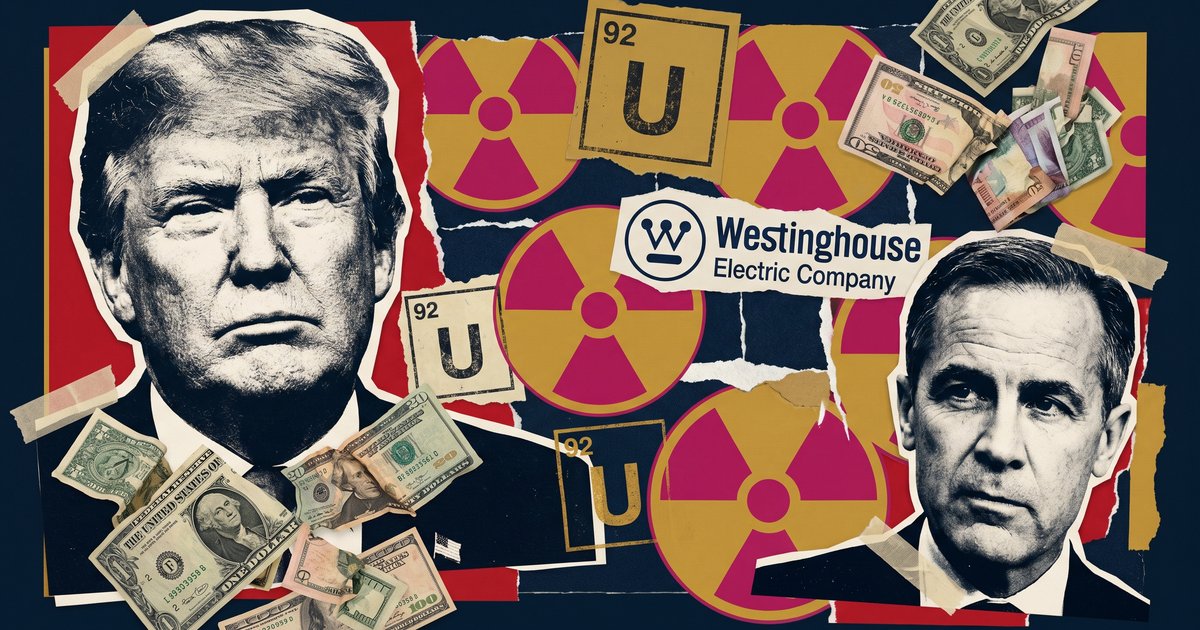
I have written extensively about Mark Carney's conflict-of-interest arrangements. The relevant background: what Carney's ethics screen actually says, how Brookfield's subsidiaries lobby Ottawa, which policy decisions touch Brookfield's portfolio, and the electricity strategy that consolidates it all.
Mark Carney was elected to stand up to Donald Trump. That was the mandate. Canadians chose him in April 2025 because he projected strength against an American president who had slapped 25% tariffs on Canadian goods, mused openly about annexing Canada as the 51st state, and treated the country's sovereignty as a negotiating chip. Carney was supposed to be the man who would not blink.
But, there's a problem. Donald Trump controls the policy environment that determines the future value of Mark Carney's largest financial interest. The American president can, with executive action alone, make Carney tens of millions of dollars richer — or wipe that value out entirely. The man elected to defend Canada against Trump is financially beholden to Trump's goodwill. And the CUSMA trade review deadline is July 1, 2026 — weeks away.
For deeper analysis and exclusive posts, subscribe to my Substack.
Whose interests will Carney defend at that table? He may not know the answer himself.
How Donald Trump's leverage works
It's fairly straightforward.
Carney retains carried interest in Brookfield Global Transition Fund I, vesting in 2032. The crown jewel of BGTF I is Westinghouse Electric Company — 51% owned by Brookfield, 49% by Cameco, acquired in November 2023 for approximately $8.2 billion. The plausible gross value of Carney's carry is US$30–100 million.
Westinghouse's future profitability depends on the US nuclear buildout. In October 2025, the US government, Brookfield, and Cameco announced a strategic partnership to build at least $80 billion worth of new Westinghouse AP1000 reactors in the United States. President Trump's May 2025 executive orders called for 10 new large reactors under construction by 2030. Energy Secretary Chris Wright said the first five or ten would "almost certainly" receive DOE loan-office support.
The US government inserted itself into the deal as a future profit participant. Under the partnership terms, the government receives 20% of cash distributions after Westinghouse has paid out $17.5 billion to Brookfield and Cameco. If a final investment decision is made by January 2029 and an IPO is expected above a $30 billion valuation, the government can require the IPO and purchase warrants for a 20% equity stake. The United States government is a future shareholder in the fund that pays Mark Carney.
Every element of this — the $80 billion partnership, the DOE loan guarantees, the NRC regulatory streamlining, the IPO pathway, the reactor orders — exists because of Trump's executive action. What Trump created by executive order, Trump can rescind by executive order. This is not theoretical leverage. It is written into executive orders and a binding partnership agreement controlled by the President of the United States.
Trump gives Carney's leash a yank
In March 2026, it was reported that the Trump administration, frustrated with Brookfield's pace in finalizing binding agreements, had begun courting Westinghouse's competitors. The Department of Energy held talks with GE Vernova Hitachi Nuclear Energy and Korean diplomats representing Korea Electric Power Corp about financing alternative reactor designs. Cameco stock dropped 6.4% on the day the news broke.
A shot across the bow. The $80 billion commitment is not guaranteed. Trump can redirect the nuclear buildout to rival reactor designs, collapsing Westinghouse's order book and, with it, the net asset value of BGTF I. Carney's carried interest evaporates. Whether or not the Trump administration intended it — it was demonstrated that the leash has a choke chain attached.
This week, Reuters reported that the DOE is considering billions in financing for long-lead-time components needed for large reactors, including AP1000 units. The money taps are still on, but it's clear to everyone who controls the valve.
Canada's economic future is at stake
Now put this in the context of CUSMA.
The trade review deadline is July 1, 2026. Under Article 34.7, all three governments must decide by that date whether to extend the agreement for sixteen more years. If any party declines, CUSMA enters annual reviews and, absent resolution, expires in 2036. This is the highest-stakes trade negotiation in Canadian history. We're in the thick of it now.
US tariffs on Canadian steel and aluminum sit at 50%. Automobiles at 25%. Copper at 50% on semi-finished products. The baseline global tariff on non-CUSMA-compliant goods is 10%. Carney himself described Trump's tariff regime as raising rates to levels last seen during the Great Depression. This is the trade war Carney was elected to fight.
So what is Canada's strongest card? It's energy. Canada is the world's largest foreign supplier of uranium to the United States — the largest single source of US uranium deliveries in 2024. Canada has the third-largest uranium reserves on Earth. Abundant natural gas. Massive hydro capacity. The Trump administration needs Canadian energy for its nuclear ambitions. It needs Canadian uranium for Westinghouse's reactors.
Carney's own Energy Minister, Tim Hodgson, told a Toronto business audience that energy and natural resources are "Canada's strongest cards in the CUSMA renegotiation."
Carney publicly rejected that framing. He told reporters: "I reject that characterization of, 'It's leverage.'" Canada would not use energy as a bargaining chip.
This happens to be exactly what the Americans want to hear. US Trade Representative Jamieson Greer told visiting Canadian politicians that Canada should not attempt to use its energy and natural resources as leverage. Carney obliged. His energy minister contradicted him. The question no one is asking: is Carney refusing to play Canada's strongest card because it is bad strategy, or because playing it would threaten the Brookfield-Westinghouse relationship with the US government — the relationship that underpins his personal financial future?
I don't know the answer. Neither does Carney's ethics screen. It has been raised roughly a dozen times in approximately one year and applied in only six. CUSMA, apparently, was not one of them. Why not?
Canada's nuclear dependency on the United States
Consider Carney's own nuclear ambitions for Canada.
"Powering Canada Strong" — Carney's National Electricity Strategy announced May 14, 2026 — proposes to double Canada's grid using, among other things, Westinghouse reactor technology. Westinghouse has MOUs for the AP1000 at Peace River, Alberta, the AP300 SMR for SaskPower, and is under consideration for Bruce C in Ontario — up to 4,800 MW of new nuclear capacity. During the 2025 leaders' debate, Carney praised Westinghouse by name — the company he acquired while at Brookfield.
Building American light-water reactors in Canada would make Canada dependent on the United States for reactor technology exports — which require US government approval — and for uranium enrichment. Canada has no domestic enrichment capability. Canadian uranium must be sent abroad for enrichment — primarily to the United States and France — before being returned for use as reactor fuel. Building domestic enrichment capacity would cost approximately $100 billion and take 20 years. The 2024 Fall Economic Statement announced a $500 million backstop to help utilities purchase enriched fuel from the US and allied countries — though Natural Resources Canada later deemed the program unnecessary and never initiated it. Either way, Canada has no plan to enrich its own uranium. At the end of the day, this country has an American dependency on enrichment.
A Natural Resources Canada briefing note obtained through access-to-information reveals what the Canadian government already knows: the United States considers Westinghouse a US strategic asset regardless of its Canadian ownership. Westinghouse also sustains the US nuclear weapons arsenal through tritium supply — a role that makes it a national security asset the Americans will never relinquish control over.
Carney's electricity strategy proposes to build Canada's energy future on technology controlled by the American president who says he wants to annex Canada, whether he's joking or not.
When foreign leaders hold the leash
Other leaders have found themselves in this position. When a head of government's financial interests depend on a foreign leader's policy decisions, the foreign leader gains leverage that does not need to be explicitly wielded.
The most instructive parallel is Silvio Berlusconi and Vladimir Putin. US diplomatic cables released by WikiLeaks alleged that Berlusconi may have profited from deals between Italian energy company ENI and Russia's Gazprom, including a percentage of profits from the South Stream pipeline. Berlusconi became one of NATO's most ardent advocates for cooperation with Russia. No one needed to produce a recording of Putin threatening Berlusconi. The financial alignment made the threat unnecessary. Berlusconi's Italy was structurally incapable of confronting Russia on energy policy because every confrontation would have cost its prime minister money.
Gerhard Schroeder championed the Nord Stream pipeline as German Chancellor, then became chairman of Nord Stream AG — a Gazprom subsidiary — shortly after leaving office. German journalists who investigated the Nord Stream deals called him Putin's "biggest useful idiot." The phenomenon was named: "Schroederization" — a foreign power gaining influence through the revolving door between government and business, creating dependencies that function as permanent leverage.
To be clear, Trump is not Putin. Putin invaded sovereign peaceful nations, assassinated political opponents, and used energy supply as a weapon of coercion against European democracies. But the structural leverage dynamic is the same between Trump and Carney. A leader's personal financial interests entangled with a foreign government's policy decisions. No explicit threats are required. Every decision shaped by a simple fact: confrontation with Trump costs Carney money.
The difference is that Berlusconi was not elected on a promise to confront Putin. Carney was elected specifically to confront Trump. Carney's mandate and Carney's financial exposure are diametrically opposed. When push comes to shove at the CUSMA table, which direction will he take?
The screen that cannot see
Carney's ethics screen was designed for domestic conflicts — preventing a prime minister from directing a procurement contract to a company he has a stake in. It was not designed for what is happening here.
The screen is administered by PMO Chief of Staff Marc-Andre Blanchard and Privy Council Clerk Michael Sabia. Sabia acknowledged under oath that he does not possess the list of investments in BGTF I — the fund that determines Carney's future pay. He is conveniently blind on the ethics screen. He himself held Brookfield shares until September 2025, selling them only after learning of the conflict.
The "general-application" carveout in section 2(1) of the Conflict of Interest Act permits Carney to participate in any decision that affects Brookfield "as a member of a broad class of persons." Trade negotiations with the United States affect every Canadian business. Energy policy affects every utility. Nuclear strategy affects every reactor vendor. By this logic, Carney is free to negotiate CUSMA, direct Canada's nuclear strategy, and set energy trade policy — all while his personal financial future depends on the goodwill of the man across the table. What a system!
The House of Commons ethics committee recommended that prime ministers be required to divest their investment portfolios. Carney has not divested. His carried interest vests in 2032. He has approximately six years of incentive to keep Trump happy.
Whose interests?
It's not likely that Carney is consciously selling out Canada to protect his Brookfield payday — at least not in the crude, transactional sense.
But it may not matter. Academic literature on state capture distinguishes between intentional and structural capture. Structural capture occurs when a leader's financial interests create an invisible bias that shapes every decision without requiring a single corrupt act. The leader does not need to consciously favour his financial interests. The interests shape the decision space itself — which options feel reasonable, which risks feel acceptable, which confrontations feel worth having.
Carney does not need to think about his carried interest when he refuses to use energy as trade leverage. He just needs to believe — sincerely — that cooperation with the United States on energy is better strategy than confrontation. That belief happens to align perfectly with his financial interests, with Brookfield's interests, and with the US government's stated preferences. The ethics screen was not built to detect this kind of conflict. The problem is a prime minister whose instincts, interests, and incentives all point in the same direction — toward accommodating the foreign leader he was elected to confront.
Canadians did appear to elect Mark Carney to defend their sovereignty against what they perceived to be a hostile American president. They got a prime minister whose largest financial interest is controlled by that president. Whose nuclear energy strategy would deepen Canada's technological dependence on that president. Who refuses to play Canada's strongest trade card because it might disturb the energy relationship that protects his portfolio.
Did Trump prefer Carney because he knew of this built-in leverage he could wield on his signature domestic policy — tariffs? Whether Carney knows it or not, Trump has him on a short leash.
For more, subscribe to the Substack.
Related Posts
Powering Canada Strong: A Trillion-Dollar Wish
The Carney government's National Electricity Strategy promises to double Canada's grid for a trillion dollars. The plan doesn't address why Canada can't build…
Where Brookfield sits in every room
Fourteen Carney-era policy decisions, mapped against Brookfield's portfolio. Some confirm the thesis. Some cut against it. Both matter.
How Brookfield lobbies Ottawa without Brookfield
Brookfield Corporation has filed zero lobbying communications since Carney became Prime Minister. Its subsidiaries have filed twenty-three. The federal…