Where Brookfield sits in every room
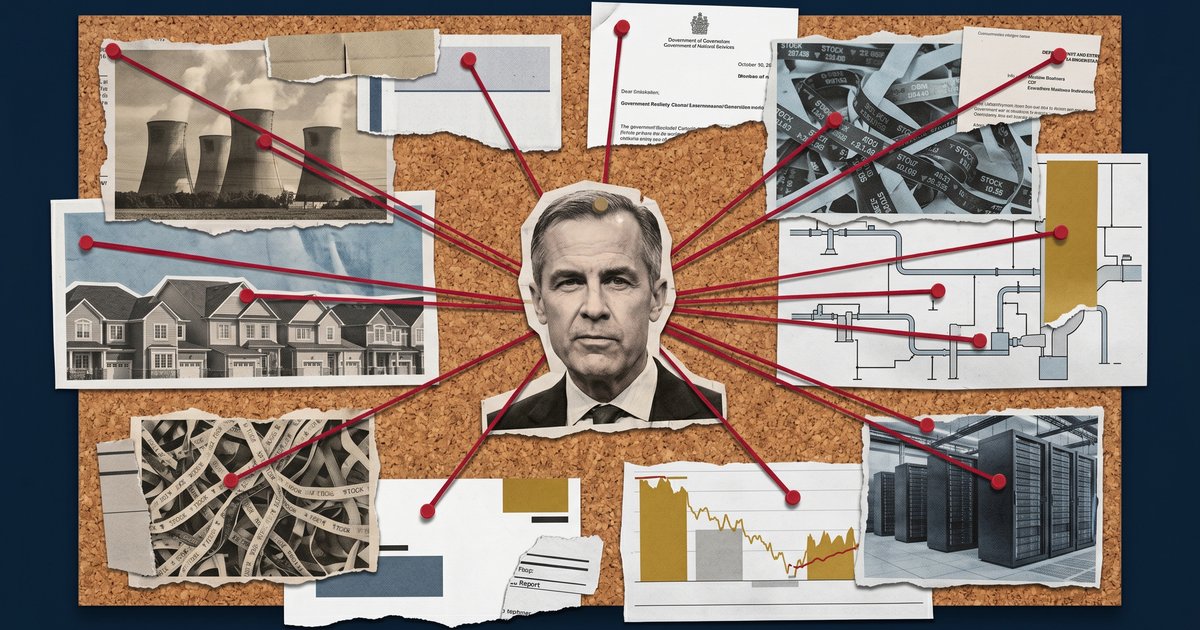
This is Part 3 of a five-part series on Prime Minister Mark Carney's conflict-of-interest arrangements. Part 1 examined the screen. Part 2 examined the lobbying data.
The structural question from Part 1 was whether the general-application carveout in Carney's ethics screen — the clause that lets him participate in decisions affecting Brookfield "as a member of a broad class" — makes the screen functionally useless for a Prime Minister whose former employer operates across virtually every sector the government touches.
The lobbying data in Part 2 showed which doors Brookfield's subsidiaries are knocking on. This post asks the next question: what happened when the government opened those doors? What did the Carney government actually decide in its first year, and where does Brookfield sit in each of those decisions?
For deeper analysis and exclusive posts, subscribe to my Substack.
The answer is a matrix of fourteen policy decisions, each mapped against Brookfield's portfolio exposure, fund-strategy exposure, and Carney's personal financial entitlements. Some support the concern that Carney's government is making decisions that benefit his former employer. Some cut the other way. Both kinds of evidence matter if the analysis is going to be honest.
Carney decisions that benefit Brookfield most
Westinghouse and Carney's nuclear energy strategy
Westinghouse Electric Company is 51% owned by Brookfield Renewable Partners through a joint acquisition with Cameco completed in October 2023. It is the single largest asset inside Brookfield Global Transition Fund I — the fund Carney chaired, and in which he retains carried interest that vests in 2032.
The Carney government has pursued nuclear energy acceleration on multiple fronts:
- The Darlington New Nuclear Project received CNSC construction licensing in April 2025 and Ontario provincial construction approval in May 2025
- $3 billion in federal-provincial equity was committed to the Darlington ecosystem in October 2025 ($2 billion from the Canada Growth Fund, $1 billion from the Building Ontario Fund)
- Darlington was designated a first-tranche Major Projects Office project in September 2025
- Westinghouse and Energy Alberta signed an AP1000 MOU for the Peace River project in October 2025
- Saskatchewan's eVinci microreactor project received $80 million in provincial funding
- Westinghouse and Tetra Tech signed an MOU for Ontario AP1000/AP300 deployment in January 2026
- Westinghouse expanded its Kitchener engineering hub in 2025
An important distinction: the specific reactor being built at Darlington is the BWRX-300, a GE Hitachi / GE Vernova design. Westinghouse has no direct supply role in that unit. Claims that Darlington construction flows federal dollars directly into Brookfield's Westinghouse are wrong. The Brookfield exposure runs through the AP1000 (Peace River), the AP300 and eVinci (Saskatchewan and Ontario MOUs), and the signalling effect of normalizing federal nuclear spending — which derisks the Westinghouse order book in the eyes of provincial utility counterparties and credit agencies.
That signalling effect is worth pausing on. Every federal dollar committed to Darlington, every Major Projects Office designation, every provincial MOU — these collectively tell the market that Canada is serious about nuclear fleet deployment. When the market believes that, the long-dated order book for AP1000 and AP300 reactors becomes more credible. When the project slate becomes more credible, the unrealized net asset value of Brookfield Global Transition Fund I goes up. When that NAV goes up, Carney's 2032 carried-interest vesting becomes more valuable.
The lobbying data from Part 2 reinforces this: Westinghouse's federal lobbying went from 3 communications to 16 after Carney took office, with two reaching directly into the PMO. Six Sussex Strategy Group consultants worked the file simultaneously. This is the single most concerning datapoint in the analysis — strong portfolio exposure, strong fund-strategy exposure, strong personal financial exposure, and an aggressive lobbying posture to match.
Sagen mortgage insurance and Carney's housing policy
Sagen Mortgage Insurance Company Canada is wholly owned (100% voting, 41% economic) by Brookfield. It is one of three companies in Canada's residential mortgage default insurance market. The other two are CMHC (a Crown corporation) and Canada Guaranty (private). Three firms. That is the entire market.
The Carney government has stacked first-time homebuyer measures that increase insured mortgage volume — the segment where Sagen operates:
- GST elimination for first-time homebuyers on homes under $1 million (announced March 20, 2025, one of Carney's first acts as PM)
- Reaffirmation of the 30-year amortization extension for first-time buyers and new builds (enacted under Trudeau in December 2024, kept by Carney)
- Insured mortgage cap raised to $1.5 million (also a Trudeau-era change, maintained)
Every one of these measures increases the pool of insured mortgages. Every insured mortgage flows through one of three firms. Sagen holds roughly 30% of the transactional market. CMHC holds about 50%. Canada Guaranty holds about 20%.
Carney's ethics screen permits him to participate in decisions that affect "a broad class of persons." Two other firms is a narrow class by any definition. The screen's own exception — "unless those interests are disproportionate to the other members of the class" — is hard to satisfy when the class has three members and one of them is owned by your former employer.
The GST first-time-buyer cut was a campaign pledge made during the Liberal leadership race, before Carney was sworn in. That matters for assessing intent. It doesn't change the main concern: the Prime Minister of Canada is making housing policy that flows revenue to a company wholly owned by the firm where he retains financial interests.
Capital gains tax reversal and the general-application defence
On March 21, 2025, one week after being sworn in, Carney cancelled the Trudeau-era proposal to raise the capital-gains inclusion rate from 50% to two-thirds on gains above $250,000.
Carried interest in Canada is taxed as capital gains. Carney's BGTF I and BGTF II carry vests in 2032 and 2034. The plausible gross value of that carry is in the range of US$30–100 million. The tax difference between a 50% inclusion rate and a two-thirds rate, applied to a carry realization of that size, is roughly $2.5 to $8.3 million in avoided personal tax.
This is the definitional general-application case. Capital-gains taxation affects every Canadian with investment income above the threshold. There is no world in which Carney would be required to recuse from a capital-gains tax decision. And the reversal was a campaign pledge, pre-committed before he took office.
But the scale matters. The median Canadian affected by the inclusion-rate increase would have seen a tax change measured in hundreds or low thousands of dollars. Carney's personal tax saving, if his carry vests as expected, is measured in millions. The general-application carveout treats these as the same kind of interest. The law does not distinguish between a dentist selling a practice and a former asset-management chairman collecting carried interest on a US$15 billion fund.
Transition finance taxonomy and Brookfield's climate funds
This one is structural rather than transactional. Carney co-founded the Glasgow Financial Alliance for Net Zero (GFANZ) and built much of the intellectual framework for what counts as "transition finance." Brookfield Global Transition Fund I ($15 billion) and BGTF II ($20 billion, final close in October 2025) are the world's largest transition-investing vehicles.
The Carney government committed seed funding in December 2025 for a made-in-Canada sustainable investment taxonomy, selecting the Canadian Climate Institute to develop the definitions. The taxonomy will determine which investments qualify as "transition finance" in Canada — and therefore which investments attract institutional capital, bank lending preferences, and pension fund allocations.
Carney is both the intellectual author of the broad-definition transition thesis and the largest financial beneficiary of it through BGTF I and BGTF II. The taxonomy development is arms-length — the Canadian Climate Institute leads, not the government. But the scope direction and seed funding come from federal decisions, and the intellectual climate in which the arms-length body operates was shaped, in significant part, by Carney himself.
AI infrastructure and Evolugen's federal funding
Brookfield announced its $100 billion AI Infrastructure Investment Fund (BAIIF) in November 2025, with NVIDIA and the Kuwait Investment Authority as founding partners. The federal Sovereign AI Compute Strategy — launched under Trudeau in December 2024 and continued under Carney — includes a federal MOU process for large-scale data centre projects. Brookfield is explicitly eligible for that process.
Evolugen — Brookfield's Canadian renewable energy subsidiary, operating 33 hydroelectric plants, 4 wind farms, and solar installations across Quebec, Ontario, and British Columbia — fits the power side of that strategy. Data centres need reliable, low-carbon electricity. Evolugen's hydro portfolio is the kind of "behind-the-meter power" that makes a data centre site viable.
Evolugen's lobbying registration discloses $5,519,000 in funding from Natural Resources Canada in the most recent fiscal year. That is direct federal money flowing to a wholly owned Brookfield subsidiary. The questions Part 2 raised still stand: what programs does that money flow through, and were any of those programs created or expanded under the Carney government?
In January 2026, Evolugen met with eight deputy ministers and senior officials, including the Deputy Minister of Finance. In February 2026, it logged its first contact with the Privy Council Office — the department that directly supports the Prime Minister and Cabinet, and where Clerk Michael Sabia, one of the two administrators of Carney's ethics screen, sits.
Carney decisions with no clear Brookfield benefit
Scrapping the EV mandate: no Brookfield connection
In February 2026, the Carney government replaced the binding EV sales mandate — 20% of new sales by 2026, 100% by 2035 — with tightened GHG emission standards, a declining purchase rebate, and a non-binding 75%-by-2035 target.
Brookfield's transition-fund thesis is built on the premise that clean energy displaces fossil fuels. A binding EV mandate would have accelerated electricity demand and grid-scale storage investment — both areas where Brookfield has portfolio exposure through BEP and BGTF. Scrapping the mandate is mildly negative for Brookfield's transition investment thesis.
This is the most important disconfirming row in the matrix. If Carney were systematically steering policy to benefit Brookfield, the EV mandate would have been strengthened, not weakened.
Defence procurement: no Brookfield link
The Carney government committed to NATO's 2% spending target and announced $9.3 billion in incremental defence spending. No Brookfield portfolio company has been identified with any defence supply-chain exposure. This is a major policy commitment with zero identified Brookfield benefit.
What Brookfield's stock price says about Carney's decisions
A standard event study — tracking Brookfield Asset Management's daily stock returns against a peer basket of Blackstone, KKR, Apollo, and Ares around eighteen Carney-era policy announcements — produced a mean excess return of approximately +0.45% across all events. That is essentially zero. The market does not, in aggregate, treat Carney policy announcements as BAM-positive events.
One announcement broke the pattern. The September 14, 2025 launch of Build Canada Homes produced a +3.14% one-day excess return for BAM versus its peer basket, extending to +6.46% over five days. Brookfield Business Partners owns Modulaire Group, the largest modular-housing operator in Europe. The program's emphasis on "off-site and prefabricated construction methods" maps to Modulaire's product line. As of April 2026, no Brookfield entity has won a Build Canada Homes procurement contract — but the market noticed the alignment before anyone else did.
Other notable results: the day Carney was sworn in, BAM actually underperformed its peer basket by 1.44%. The Major Projects Office launch produced a 1.90% underperformance. Budget 2025 was a wash. The Peace River AP1000 MOU generated a modest 1.44% excess return.
The event study matters because it keeps the argument honest. The market doesn't price Carney's decisions as Brookfield-positive.
Full matrix: fourteen Carney decisions and Brookfield exposure
Here are all fourteen rows, ranked by connection strength:
Strong (direct exposure, large, specific to Brookfield):
- Westinghouse / nuclear acceleration — anchor BGTF I asset, AP1000/AP300/eVinci pipeline acceleration, 5x lobbying surge, direct carry exposure for Carney
- AI / Data Centre strategy — Brookfield's $100 billion AI infrastructure program (BAIIF) maps directly onto Carney's Sovereign Cloud directive; federal MOU process explicitly open to Brookfield; Evolugen's hydro portfolio fits the "behind-the-meter power" thesis; Evolugen received $5.5 million in NRCan funding
- Sagen / mortgage insurance — 100% Brookfield-owned, three-firm oligopoly, first-time-buyer measures increase volume to Sagen's core segment
- Transition-finance taxonomy — Carney authored the thesis, Brookfield is the largest beneficiary, federal seed funding shapes the definitions
Moderate (real but classifiable as general-application):
- Major Projects Office (Bill C-5) — framework decision, but first-tranche projects include Brookfield-adjacent assets
- Energy corridor / pipeline streamlining — Inter Pipeline is a Brookfield asset; Inter Pipeline lobbying doubled in the Carney year
- Budget 2025 line items — broad ITC enrichment for clean energy, infrastructure, and housing benefits every investor in those sectors, including Brookfield
- Carbon tax redesign — retaining industrial carbon pricing underwrites BGTF's marketing thesis; consumer-tax kill is neutral
- Capital gains reversal — personally beneficial to Carney by millions of dollars, but general-application and pre-committed
- Build Canada Homes — strongest single-day BAM stock signal, but no Brookfield contracts awarded as of April 2026
Weak (context only):
- Investment Canada Act amendments — predate Carney; incumbent advantage only
- China trade reset — Brookfield's $23 billion Greater China AUM benefits atmospherically, no direct tariff line affected
None / Disconfirming:
- EV mandate scrap — mildly negative for Brookfield's transition thesis
- Defence procurement — no Brookfield exposure identified
What the Carney-Brookfield policy overlap shows
Four of these show strong connections between Carney-era policy decisions and Brookfield's portfolio. Six show moderate connections. Two show weak connections. Two show no connection or mild disconfirmation.
No single item constitutes a smoking gun. There is no procurement contract awarded to a Brookfield subsidiary. There is no Cabinet memo directing funds to a specific entity on the screen. The stock market does not price Carney's decisions as systematically beneficial to Brookfield.
But the pattern is cumulative. Nuclear acceleration benefits the anchor asset of the fund Carney chaired. Housing policy flows revenue to a mortgage insurer Brookfield owns outright in a three-firm market. A transition-finance taxonomy shapes the definitions that determine capital flows to Brookfield's flagship funds. An AI infrastructure strategy maps onto a $100 billion Brookfield program. And all of it passes through the general-application carveout because each decision, individually, affects "a broad class of persons."
The screen was designed to catch the specific. The pattern is systemic. The law does not have a tool for what happens when a Prime Minister's former employer is so large and so diversified that virtually every policy decision is both "of general application" and beneficial to the employer's portfolio.
That is a problem of institutional design, not necessarily individual corruption. The next two parts of this series examine how other democracies have handled the same problem — and what Canada's Ethics Commissioner can actually do about it.
Next: Part 4 — The Loophole That No Democracy Has Closed
For extra details, subscribe to the Substack.
Related Posts
Trump Has Carney on a Leash
Mark Carney was elected to stand up to Donald Trump. But Trump controls the policy levers that determine the value of Carney's largest financial interest. The…
Powering Canada Strong: A Trillion-Dollar Wish
The Carney government's National Electricity Strategy promises to double Canada's grid for a trillion dollars. The plan doesn't address why Canada can't build…
How Brookfield lobbies Ottawa without Brookfield
Brookfield Corporation has filed zero lobbying communications since Carney became Prime Minister. Its subsidiaries have filed twenty-three. The federal…