Powering Canada Strong: A Trillion-Dollar Wish
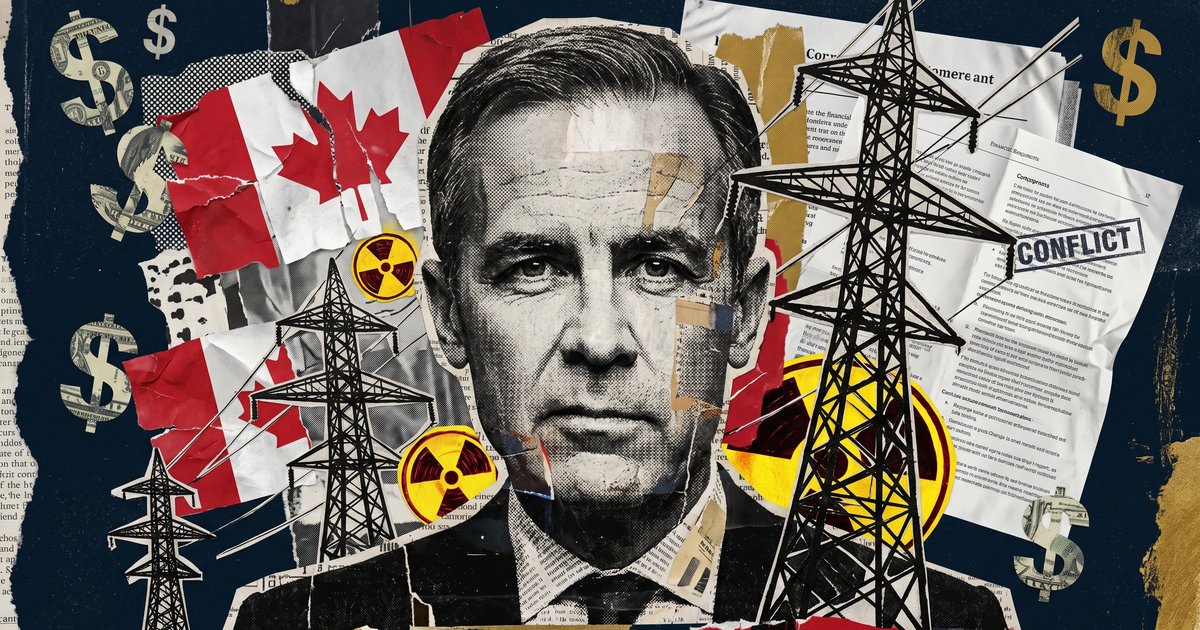
I have written extensively about Mark Carney's conflict-of-interest arrangements. The relevant background: what Mark Carney's ethics screen actually says, how Brookfield's subsidiaries lobby Ottawa, and which policy decisions touch Brookfield's portfolio.
Mark Carney announced a National Electricity Strategy today. It is called "Powering Canada Strong." It promises to double Canada's grid capacity by 2050 at a cost exceeding one trillion dollars. It has four pillars: infrastructure development, interprovincial grid connectivity, workforce expansion, and domestic manufacturing. Six ministers were quoted in the press release. Consultations will be launched.
The strategy does not explain how Canada went from electricity surplus to electricity scarcity under a decade of Liberal government. It does not explain why the institutions it proposes to use — the Canada Infrastructure Bank, the Canada Growth Fund, the Major Projects Office — have either failed to deploy capital or do not yet exist in functional form. And it does not mention that the Prime Minister who wrote it retains carried interest in a Brookfield fund whose anchor asset is a nuclear technology company that stands to benefit from every pillar of the plan.
For deeper analysis and exclusive posts, subscribe to my Substack.
Canada's electricity exports collapsed under Liberal government
Canadian electricity exports fell from 65 TWh in 2022 to roughly 36 TWh in 2024 — nearly half, gone in two years. Export revenues dropped from $5.8 billion to $2.6 billion. By late 2025, Canada was importing more electricity than it exported from the United States on a monthly basis — a country that for decades ran consistent surpluses. US imports hit 25.2 million MWh in 2025, the highest level on record since Statistics Canada redesigned its tracking series.
Hydro-Quebec and BC Hydro — for decades synonymous with cheap, abundant power — both slipped into net imports. Hydro-Quebec's heritage surplus pool is projected to hit 0.6 TWh by 2029. Effectively zero. Per capita electricity consumption has dropped from approximately 17 MWh in 2007 to roughly 14 MWh today — not because Canadians are using less, but because supply has not kept pace with population growth.
Canada has the world's third-largest uranium reserves. The second-largest land mass with massive hydro potential. Abundant natural gas. And it cannot produce enough electricity for its own needs. The Macdonald-Laurier Institute's March 2026 "Blackout" report calls this a transition from abundance to managed scarcity, arriving at precisely the wrong moment — as demand surges from electrification mandates, population growth, and the data centre boom.
This is the country that now proposes to double its grid. Consider how it arrived here.
A decade of Liberal energy policy delays
The Liberal government took office in November 2015 with a mandate to fight climate change. The climate file was supposed to be the centrepiece. Here is what a decade of Liberal government produced for electricity.
Draft Clean Electricity Regulations were not published until August 2023 — nearly eight years in. The regulations were finalized in December 2024 and came into force on January 1, 2025. By that point, Alberta had already negotiated a suspension, pushing its net-zero electricity target from 2035 to 2050. Saskatchewan rejected the regulations outright as unconstitutional. Two major fossil-fuel-dependent provinces opted out. The regulations that took eight years to write now apply to a country that has already fractured around them.
The investment tax credits followed the same pattern. Budget 2023 announced approximately $60 billion in clean energy tax credits as Canada's response to the American Inflation Reduction Act. The Clean Electricity ITC — the centrepiece — was not enacted until March 2026. Three years between announcement and legislation. Parliament's prorogation in January 2025 stalled drafted legislation. Legal analysts warned of persistent "change-of-law risk" — the possibility that promised credits might never materialize. Investment chilled at precisely the moment it needed to flow.
Meanwhile, the United States moved in the opposite direction. The Trump administration has embraced energy dominance — accelerating fossil fuel permitting, rolling back emissions regulations, and withdrawing from the Paris Agreement. Canada's largest trading partner and energy customer is building out production capacity while Canada layers on regulations that constrain its own. The result is a country increasingly out of sync with its continental partner — an unreliable energy exporter that cannot guarantee supply to its own provinces, let alone to American buyers who are finding alternatives.
The downstream signal to provinces was worse than silence. It was uncertainty. Would the carbon price survive a change in government? Would the Clean Electricity Regulations survive a court challenge? The Supreme Court had already ruled the Impact Assessment Act largely unconstitutional in October 2023. Would the ITCs actually be legislated? Every year of ambiguity was a year in which utilities, developers, and investors deferred decisions. The Macdonald-Laurier Institute argues that this policy instability — frequent changes to strategies, mandates, and regulations, often annually — is itself a primary cause of underinvestment.
This is the track record of the government that now promises a trillion-dollar buildout.
Ontario's Green Energy Act poisoned clean energy politics nationally
Ontario's Green Energy Act of 2009 did not fail only in Ontario. It poisoned clean energy politics across the country for a generation.
The GEA introduced feed-in tariffs that paid above-market rates for renewable energy. Small-scale solar contracts were priced at 80.2 cents per kWh — roughly forty times the market value of electricity. Forty times! The Global Adjustment surcharge — the mechanism that passed above-market contract costs to ratepayers — ballooned from roughly $700 million in 2006 to nearly $12 billion by 2017. Residential electricity costs in Ontario rose 71% during the decarbonization push, compared to 34% for the rest of Canada. The Ford government rightly cancelled 758 renewable energy contracts in 2018 — the damage was already done, but continuing them would have been worse. The Windstream Energy NAFTA arbitration cost Ontario $25 million, a price worth paying to stop the bleeding.
Every subsequent government that proposed clean energy investment anywhere in Canada faced the spectre of Ontario-style price hikes. The political cost of green energy became prohibitive. Provinces that might have expanded generation capacity chose inaction over voter backlash. Ontario's GEA was a policy failure so total that it made subsequent policy successes harder to achieve — not just in Ontario, but nationally.
Ontario is now pursuing the nuclear expansion it deferred for thirty-five years. The Darlington SMR project — four GE Hitachi BWRX-300 reactors — will cost $20.9 billion for 1,200 MW. That is $17.4 billion per GW — among the most expensive electricity generation options available. OPG is seeking a 72.6% increase in nuclear power rates. Nuclear payment amounts are projected to rise from ~$124/MWh in 2026 to ~$207/MWh by 2027. Ontarians absorbed one price shock under the GEA. They are about to absorb another.
Canada's construction productivity crisis
Carney's electricity strategy requires adding approximately 150 to 160 GW of new capacity by 2050. That means tripling Canada's current build rate to 6–7 GW per year, sustained for twenty-four years. Think about what that means in a country where construction productivity is at a near 30-year low.
Labour productivity in residential construction has declined cumulatively by 37.3% since 2001. The construction labour force has grown by 136% since 1997. Housing starts increased by 63%. More workers. Less output. It now takes 25 to 30% longer to build an equivalent project compared to five or six years ago. The construction sector has subtracted 0.5 percentage points from annual productivity growth since the pandemic.
Part of this is regulatory. All five orders of government authority — federal, provincial, territorial, municipal, and Indigenous — can be involved in electricity project approvals. Federal impact assessment, provincial environmental assessment, utility regulatory board approval, Crown land permits, municipal zoning, species-at-risk requirements, fisheries authorizations, navigable waters approvals, and the constitutional duty to consult under Section 35 combine to produce timelines that kill projects by making them unaffordable. Canada ranks second worst among 38 OECD countries for permitting pace. The average major energy project takes 18 years from conception to operation.
Stephen Harper tried to fix this. His Responsible Resource Development agenda in 2012 cut the number of federal agencies conducting reviews from 40 to 3, set firm timelines, and reduced annual federal assessments from roughly 5,000 to a few dozen. Trudeau tore it up. Bill C-69, the Impact Assessment Act, reversed Harper's streamlining, expanded the scope of reviews, and added new layers of process. The Supreme Court ruled it largely unconstitutional in October 2023. The Liberal government spent seven years replacing a working permitting framework with one the courts struck down — and Canada's project timelines got worse in every year between.
Part of it is constitutional. Section 92A of the Constitution Act gives provinces exclusive jurisdiction over electricity generation. There is no national grid operator. No coordinating body equivalent to Europe's ACER or Australia's AEMO. The C.D. Howe Institute observes that no one is responsible for optimizing Canada's grid as a whole. Canada's grids were built north-south — toward American markets — not east-west between provinces. The Canadian Climate Institute notes that interprovincial electricity trade is either limited or met with hostility. The Scandinavian countries integrated their grids through Nord Pool in 1995. Canada, thirty years later, is launching consultations, punctuated by what sound more and more like empty slogans from our Prime Minister.
And finally, part of it is that Canada has lost the institutional muscle for large-scale delivery. Consider the record.
Canada's graveyard of failed infrastructure projects
- Trans Mountain pipeline expansion: estimated at ~$5 billion in 2013. Completed at $34 billion. A 7x overrun. Finished only because the federal government purchased the project for $4.5 billion and absorbed the losses.
- Muskrat Falls: budgeted at $7.4 billion for 824 MW. Delivered at $13.5 billion — 82% over. Required a $5.2 billion federal bailout.
- Site C dam: budgeted at $8.8 billion for 1,100 MW. Delivered at $16 billion — 82% over.
- Atlantic Loop: would have connected Quebec hydro to Atlantic Canada, replacing coal. Costs tripled from $3 billion to $9 billion. Nova Scotia abandoned it in October 2023.
- Energy East: $15.7 billion pipeline. Cancelled in 2017 because the regulatory process made it uneconomic.
- Taltson Hydro Expansion: discussed for decades in the Northwest Territories. $48 million in federal funding since 2019. Construction not expected to begin until 2028.
This is Canada's infrastructure track record. Every major energy project in the past decade — cancelled, abandoned, bailed out, or delivered at double the price. If the $1 trillion estimate for "Powering Canada Strong" follows the established pattern of 50–100% cost overruns, actual costs reach $1.5 to $2 trillion.
I'm told we used to do big things in this country. No longer.
France, for comparison, built 56 nuclear reactors in fifteen years after the 1973 oil crisis. Consistent six-year construction timelines per unit. A single standardized reactor design. Pre-screened sites. Bulk ordering. Sustained political commitment across changes of government. Canada has none of these features — no design standardization, no pre-approved sites, no culture of intergovernmental cooperation, and no track record of sustaining infrastructure commitments across election cycles. The Liberal governments proposing big state-directed buildouts have spent a decade demonstrating they cannot deliver them. The CIB, the infrastructure plan, the clean energy tax credits — every vehicle has either stalled, underperformed, or arrived years late.
Liberals want us to trust their national buildout. They've shown no reason to suspect they are anything but completely incoherent on this file.
The Canada Infrastructure Bank cannot spend its own budget
The Carney government proposes to channel investment through familiar vehicles: the Canada Infrastructure Bank ($20 billion clean energy target within an expanded $45 billion envelope), the Canada Growth Fund, the Canada Strong Fund, and investment tax credits. Consider the CIB's track record before accepting these numbers.
The CIB was created in June 2017 with a $35 billion mandate. After four years it had deployed $1.23 billion — 3.5% of its mandate. The Parliamentary Budget Officer reports it is on track to deploy $14.9 billion by 2027-28 — more than $20 billion short of its target. It will not reach $35 billion until 2034-35, seven years past deadline. Only 18% of its Project Acceleration projects achieved financial close by end of 2024-25. The House of Commons transport committee recommended abolishing it in May 2022, citing lack of transparency and poor efficiency. The government's response was to increase its budget.
The Auditor General found that Infrastructure Canada could not show its Investing in Canada Plan was on track. Approximately $9 billion went unspent in the first three years. About a quarter of federal infrastructure funds go unspent annually.
Now consider the Canada Strong Fund — a $25 billion so-called "sovereign wealth fund" announced April 27, 2026, whose investment mandate covers infrastructure, advanced manufacturing, clean and conventional energy, critical minerals, and agriculture. The Hub described it as a deficit-financed subsidy in patriotic clothing. The Montreal Economic Institute warned it risks costing taxpayers dearly with limited returns. I called it what it is: borrowed money dressed up as national savings, announced by a government running a $78 billion deficit that spent a decade destroying the resource revenues a real sovereign wealth fund requires. The mandate of the fund reads like a Brookfield investor presentation — the same sectors, the same language, the same thesis. The difference is that this one is funded by the taxpayer and overseen by a government that has not demonstrated it can deploy a $35 billion infrastructure bank in eleven years.
Tim Hodgson, Goldman Sachs, and the people running Canada's energy strategy
Tim Hodgson is the Minister of Energy and Natural Resources and the lead minister on "Powering Canada Strong." He is a first-time politician — a rookie MP who went directly from Bay Street to a cabinet portfolio overseeing a trillion-dollar strategy. The Globe and Mail reports that ministry officials joke they need to send him term sheets, not briefing notes.
His career: two decades at Goldman Sachs, culminating as CEO of Goldman Sachs Canada from 2005 to 2010. At Goldman, his client roster included major Canadian institutional investors — and Brookfield Asset Management. He replaced Carney as the point person for TransAlta Corp on the Goldman team. When Carney became Governor of the Bank of Canada, Hodgson followed as Special Advisor to the Governor from 2010 to 2012. After Goldman, he became Managing Partner of Alignvest Management Corporation, where Brookfield was again among his selected clients. He then became Chair of the Board of Hydro One — Ontario's largest electricity transmission and distribution utility, 1.4 million customers — from August 2019 until he resigned to run for Parliament in April 2025. He also chaired the Investment Committee of PSP Investments.
That last point matters. PSP Investments' subsidiary now manages the Canada Growth Fund, which has committed $2 billion in equity to the Darlington New Nuclear SMR project. That project falls under Hodgson's ministerial portfolio. The man who chaired PSP's Investment Committee now oversees federal policy governing a project funded by PSP's subsidiary.
Hodgson resigned from his corporate positions before entering Parliament. That is the correct procedure, and he is not Carney — he was not a Brookfield executive, he did not hold carried interest in Brookfield funds, and his financial exposure to the companies he once served as a client is not comparable. But the pattern is worth stating plainly: Goldman Sachs, Bank of Canada advisor to Carney, Brookfield client at two firms, Hydro One chair, PSP Investment Committee chair, and now Energy Minister directing a trillion-dollar electricity strategy. These are not arm's-length relationships. The same people keep ending up in every chair in the room.
Brookfield's portfolio touches every pillar of the plan
I have documented previously how Brookfield's holdings touch virtually every major federal policy decision. The National Electricity Strategy is not a new revelation in that analysis. It is all of it consolidated into a single trillion-dollar document.
Westinghouse Electric Company — 51% owned by Brookfield Renewable Partners, 49% by Cameco, acquired in November 2023 at an enterprise value of approximately $8.2 billion. Westinghouse is the anchor asset inside Brookfield Global Transition Fund I — the fund Carney co-headed with Connor Teskey, and in which he retains carried interest vesting in 2032. The plausible gross value of that carry is in the range of US$30–100 million.
Westinghouse's Canadian pipeline: an MOU with Energy Alberta to deploy the AP1000 at Peace River. An MOU with SaskPower for the AP300 SMR, final investment decision expected 2029. Under consideration for Bruce C in Ontario — up to 4,800 MW of new nuclear. A PwC report commissioned by Westinghouse estimates four AP1000 units would generate over C$28.7 billion in GDP impact. During the 2025 leaders' debate, Carney praised Westinghouse by name — the company he acquired while at Brookfield.
The Darlington SMR is a GE Hitachi design, not a Westinghouse product. That distinction matters and I have noted it before. But the dynamic is broader: federal nuclear spending — the "Tier One Nuclear Nation" framing, the Nuclear Energy Strategy, the Major Projects Office referrals, the Canada Growth Fund equity — derisks the entire Westinghouse order book and raises BGTF I's net asset value. Every dollar of federal commitment to nuclear normalization makes Carney's 2032 carry more valuable.
Evolugen — Brookfield Renewable's Canadian operating arm. 61 renewable energy facilities: 33 hydroelectric plants, 4 wind farms, 24 solar sites. 1,912 MW of installed capacity. $5.5 million in NRCan funding. Evolugen met with with eight deputy ministers in January 2026 and logged its first Privy Council Office contact in February 2026. The PMO was listed among its target institutions.
NorthRiver Midstream — a Brookfield Infrastructure Partners subsidiary. 19 natural gas processing facilities, 3.3 Bcf/d capacity, across BC and Alberta. The electricity strategy embraces natural gas for reliability and flexibility. NorthRiver is proposing the NEBC Connector — 213 km of pipeline — and holds an active lobbying registration.
Every pillar of "Powering Canada Strong" — nuclear acceleration, renewable expansion, natural gas flexibility, grid infrastructure, the financial vehicles that will deploy capital — creates value across Brookfield's portfolio. Not in one line item. Across the entire holding structure.
Carney's ethics loophole covers a trillion-dollar strategy
Carney's ethics screen permits him to participate in any decision that affects screened entities "as a member of a broad class of persons." This is the general-application carveout in section 2(1) of the Conflict of Interest Act — the doctrine that originated with Howard Wilson's unreviewed 1995 ruling on Paul Martin's Canada Steamship Lines.
A trillion-dollar national electricity strategy affecting every utility, developer, manufacturer, and financial institution in the country is, by definition, a decision of general application. It affects Brookfield as a member of a broad class. The screen is not triggered. Carney can participate in creating the strategy, announcing the strategy, and directing the institutional apparatus — the CIB, the Canada Growth Fund, the Canada Strong Fund, the Major Projects Office — that will deploy capital under it. But does it pass your smell test?
The screen has been triggered six times in approximately one year. Six. Today's announcement alone touches nuclear (Westinghouse, BGTF I), renewables (Evolugen, BRP), natural gas (NorthRiver Midstream), infrastructure (BIP), and the financial vehicles that will channel public capital into those sectors. The House of Commons ethics committee has recommended that prime ministers be required to divest. Carney has not divested. As I've noted, his carried interest vests in 2032.
Powering Canada Strong is wishful thinking
The barriers to doubling Canada's grid are not technological. The costs are manageable. What is missing is governance, coordination, and sustained political commitment — the capacity to build.
"Powering Canada Strong" does not address this. It launches consultations to identify actions. It proposes a Transmission InterConnect Investment Strategy referred to the Major Projects Office — an institution with no completed projects that is still unwrapping its office furniture. It promises 130,000 workers in a country where over 80% of electricity employers already report difficulty attracting them and where the construction sector is at a 30-year productivity low. It promises to connect fragmented provincial grids without amending Section 92A of the Constitution.
The strategy requires doubling annual capital expenditure in the electricity sector — from roughly $25–30 billion to $40 billion per year — sustained for a quarter century. Under a Liberal government that cannot deploy a $35 billion infrastructure bank. That cannot build a pipeline without a 7x cost overrun. That created a permitting regime so broken Canada ranks second-worst in the OECD. That watched construction productivity decline for twenty years and did nothing. That has presided over every interprovincial electricity project of the past decade being cancelled, abandoned, or tripled in cost.
France built 56 reactors in fifteen years because it had the institutions to do it. Canada has announced a plan to consult on a plan — led by a prime minister from Goldman Sachs and Brookfield who retains financial interest in the companies that will benefit from the spending — but not necessarily the completion — overseen by an energy minister from Goldman Sachs and Hydro One whose career has tracked through every institution now positioned to receive the capital, and financed through vehicles whose established track record is failing to deploy money at their mandated scale.
The electricity crisis is real. The need to double Canada's grid is real. Canada does need to build — urgently. But this strategy does not diagnose why Canada stopped building in the first place. It does not reform the permitting regime, the constitutional fragmentation, or the institutional rot that produced the graveyard of cancelled projects. It announces targets on top of a broken system and asks Canadians to trust that this time, the money will arrive, the projects will be built, and the trillion dollars will flow to the public interest rather than to the portfolio of the man who wrote the plan.
Wishful thinking.
For more, subscribe to the Substack.
Related Posts
How Brookfield lobbies Ottawa without Brookfield
Brookfield Corporation has filed zero lobbying communications since Carney became Prime Minister. Its subsidiaries have filed twenty-three. The federal…
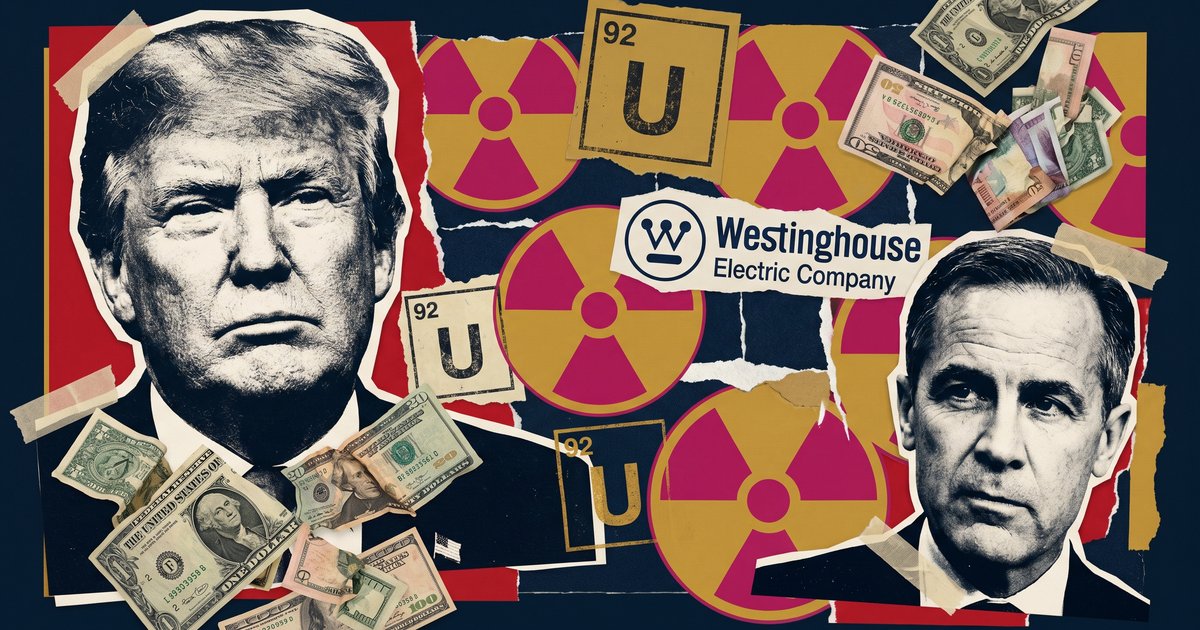
Trump Has Carney on a Leash
Mark Carney was elected to stand up to Donald Trump. But Trump controls the policy levers that determine the value of Carney's largest financial interest. The…
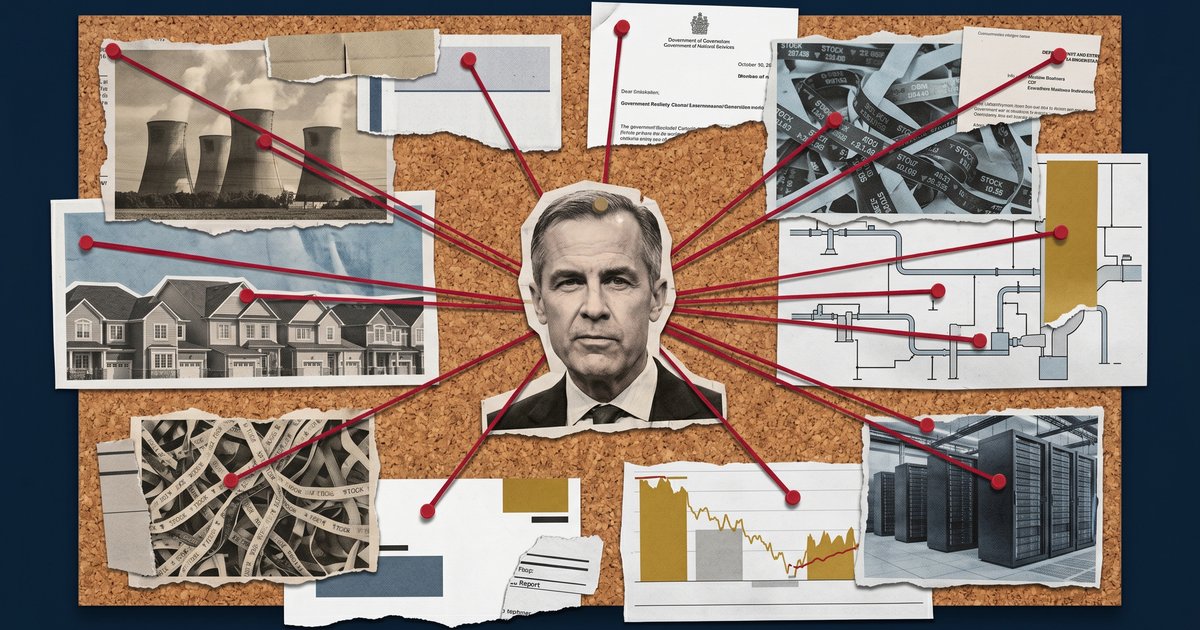
Where Brookfield sits in every room
Fourteen Carney-era policy decisions, mapped against Brookfield's portfolio. Some confirm the thesis. Some cut against it. Both matter.