Governor General Louise Arbour: the Laurentian default
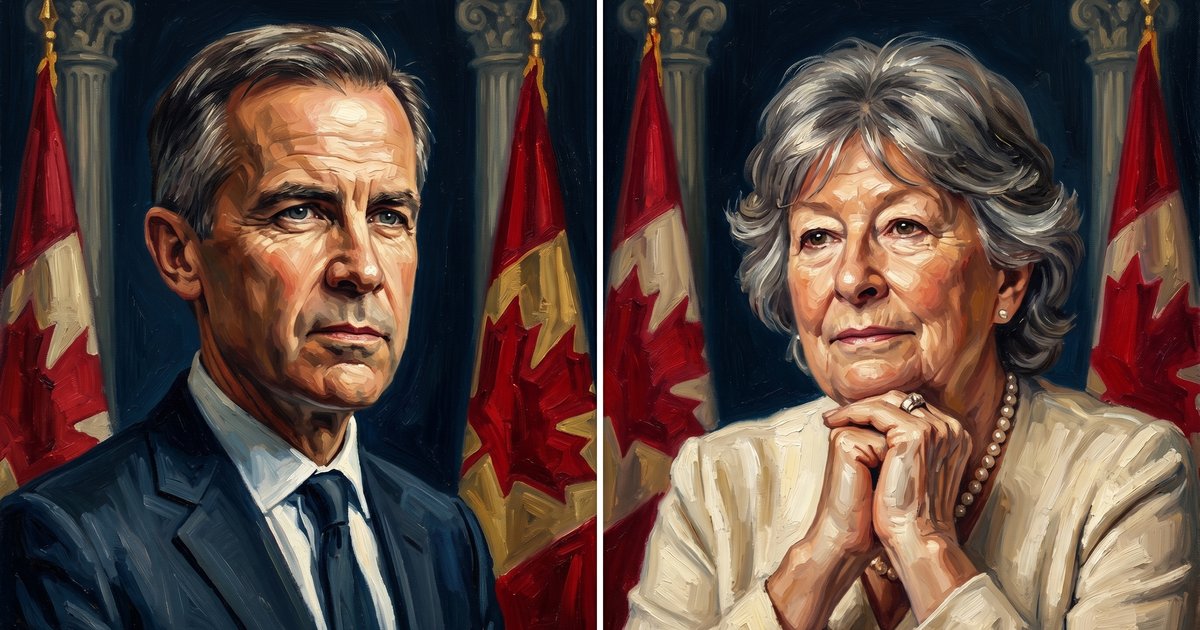
Mark Carney has named Louise Arbour as Canada's 31st Governor General. She is 79 years old, a former Supreme Court justice, a former UN High Commissioner for Human Rights, and a former chief prosecutor of international war crimes tribunals. She is bilingual, Montrealer, credentialed beyond argument, and the most ideologically loaded appointment to Rideau Hall in living memory.
The Prime Minister's Office has not confirmed whether any advisory committee was consulted. CBC asked. The PMO did not answer. This matters because Stephen Harper created a formal, non-partisan Advisory Committee on Vice-Regal Appointments in 2012 — the first institutional check on what had always been raw prime ministerial patronage. Justin Trudeau scrapped it, picked Julie Payette on vibes, and watched her resign in disgrace after a workplace abuse scandal. Trudeau then reconstituted an advisory panel for Mary Simon. Carney, apparently, has gone back to the Trudeau method: pick someone from the club and announce it.
Canada is a club, and you're not in it
Nine of Canada's fourteen Canadian-born Governors General have come from Quebec or Ontario. The last Western Canadian to hold the role was Ray Hnatyshyn, who left office in 1995. The last Albertan was Roland Michener, who left in 1974 — more than half a century ago. British Columbia has never produced a Governor General. Neither has Nova Scotia, Prince Edward Island, Newfoundland, or any of the three territories.
For deeper analysis and exclusive posts, subscribe to my Substack.
The acceptable GG candidate is bilingual (which narrows the pool to central Canada), credentialed in law or diplomacy or the CBC, holds a Companion of the Order of Canada, and subscribes to the set of assumptions John Ibbitson identified as the Laurentian consensus: that Canada is fragile, that the federal government's job is to bind it together, that Quebec must be placated, that poorer regions must be subsidized, and that Canada is a helpful fixer on the world stage.
Arbour checks every box. Chretien appointed her to the Supreme Court. Kofi Annan appointed her UN High Commissioner. The Trudeau government commissioned her to review sexual misconduct in the Canadian Armed Forces. She has been on the GG shortlist for years because she is exactly the kind of person who ends up on GG shortlists — a permanent member of the Canadian establishment's rotating cast of appointable notables. Ibbitson wrote in The Hub just last week that Carney's election represented the Laurentian elite being "determined in this time of crisis to put one of their own into the prime minister's office." Now Carney is putting another one into Rideau Hall.
Conservatives are not in this club and never will be. That is the arrangement.
The migration compact
From 2017 to 2018, Arbour served as the UN Secretary-General's Special Representative for International Migration and led the development of the Global Compact for Safe, Orderly and Regular Migration. The compact was adopted in December 2018 and immediately became one of the most divisive documents in international politics.
The United States, Hungary, Poland, the Czech Republic, and Israel voted against it. Austria, Australia, and several other countries abstained. Their objections centred on sovereignty: the compact, though formally non-binding, established normative frameworks that critics argued would inevitably harden into soft law constraining national immigration policy.
Objective 17 was the flashpoint. It called on states to "sensitize and educate media professionals on migration-related issues and terminology" and to stop funding media outlets that "systematically promote intolerance, xenophobia, racism and other forms of discrimination towards migrants." Read plainly, this is a framework for governments to discipline media coverage of immigration. Conservative leader Andrew Scheer said the compact "gives influence over Canada's immigration system to foreign entities" and "could open the door to foreign bureaucrats telling Canada how to manage our borders."
Arbour's response to the countries that withdrew was contempt. She called their reasons "bizarre" and "puzzling," said she was "very disappointed" in them, and characterized the opposition as driven by misinformation. She told a press conference that critics suffered from a "deficit of a reality check."
This is the person Mark Carney has chosen to represent the Canadian state. A woman who spent two years building an international framework to normalize mass migration, told democratic nations that their sovereignty concerns were misinformation, and advocated for government oversight of how journalists cover the subject. In a country where immigration is now the top domestic policy concern and where the previous government's immigration policy is widely regarded as a catastrophe, the symbolism is remarkable.
Israel, Zionism, and the double standard
Arbour's tenure as UN High Commissioner for Human Rights (2004-2008) produced a series of confrontations with Israel, Jewish organizations, and Canadian conservatives.
During the 2006 Israel-Hezbollah war in Lebanon, Arbour publicly warned that Israeli commanders could face personal criminal responsibility for war crimes. She stated that the scale of civilian killings and "their predictability" could engage the criminal liability of "those in a position of command and control." Two years later, Treasury Board President Vic Toews called her "a disgrace" in the House of Commons. B'nai Brith Canada called Toews' remarks justified. UN Watch accused her of applying a double standard — using quiet diplomacy with Russia and China while publicly threatening Israeli leaders with prosecution.
The double standard criticism was not trivial. Edward Greenspan, one of Canada's most prominent criminal lawyers, wrote a Globe and Mail op-ed titled "Louise Arbour's Unjust Verdict," noting that no previous High Commissioner had threatened prosecution of Russian leaders for Chechnya or Chinese rulers for their crackdowns. Israel was singled out for the megaphone treatment while actual totalitarian states got polite letters.
Then came the Arab Charter. In January 2008, Arbour issued an official statement welcoming the ratification of the Arab Charter on Human Rights, calling it "an important step forward." I wrote about it at the time. The Charter's preamble rejected "all forms of racism and Zionism" as violations of human rights and threats to international peace. Article 2 called for the elimination of Zionism. The Charter also sanctioned the death penalty for children.
Arbour endorsed it without, apparently, reading it carefully. UN Watch exposed the provisions. The World Jewish Congress demanded a retraction. Arbour's office issued an unprecedented reversal, conceding the Charter was "incompatible" with international norms. The damage was done. The Jerusalem Post ran the headline: "UNHRC Endorsed Anti-Semitic Charter."
There is a pattern here. Arbour inhabits an institutional world — the UN human rights apparatus — where Israel is the permanent defendant and where the reflex to single out the Jewish state is so deeply embedded that a former Supreme Court justice can endorse a document calling for the elimination of Zionism without noticing. The institutional bias is the water she swims in.
The Danish cartoons and the instinct to censor
In 2006, the Organization of Islamic Cooperation condemned Denmark over the Jyllands-Posten Muhammad cartoons. Arbour, as High Commissioner, wrote to the OIC expressing her concern about "behaviours that disregard the beliefs of others" and launched UN investigations into "racism" connected to the cartoons, asking the Danish government for an "official explanation."
She did not express corresponding alarm about the OIC's disregard for press freedom. She did not note that the cartoonists were living under death threats. The Heritage Foundation cited this as evidence that Arbour demonstrated "an alarming willingness to cater to the world's more repressive regimes." The instinct — protect the sensitivities of illiberal states, discipline the democracies — is the same instinct that produced the migration compact's media provisions.
The judicial record
The Governor General is supposed to be a figure above politics. Arbour's record on the bench suggests otherwise.
As a Supreme Court justice, she dissented in Gosselin v. Quebec to argue that Section 7 of the Charter creates positive obligations on government to provide a minimum level of social assistance — essentially constitutionalizing welfare spending. The majority rejected this reading. Legal scholars called it one of the most progressive dissents in Canadian constitutional history.
She sits on the Global Commission on Drug Policy, which advocates full decriminalization of all drugs. She dissented in R v. Malmo-Levine to argue that imprisonment for marijuana possession was unconstitutional. She has said the war on drugs has "nothing in it that works."
None of this is fringe in the world Arbour inhabits. It is standard-issue progressive jurisprudence. That is the point. Arbour has spent forty years articulating a specific political vision — one in which constitutional rights include entitlements to government spending, criminal law should retreat from drug enforcement, and media coverage of sensitive subjects should be supervised. So much for a figure above politics.
The age question
Arbour is 79. The conventional Governor General term is five years. She would be 84 at the end of it. Mary Simon is 78 and leaving office this summer. Adrienne Clarkson was 60 when appointed. David Johnston was 69. Julie Payette was 53. Michaelle Jean was 47.
Carney has appointed the oldest incoming Governor General in Canadian history. It is a legitimate question whether a five-year ceremonial commitment, with extensive travel, public appearances, and representational duties, is well-suited to someone approaching her mid-eighties. No one asks this question publicly because the etiquette of the Laurentian class forbids it. But Canadians who spend their RRSP years watching their own physical capacities diminish are entitled to wonder.
What this appointment tells you
The Governor General is a ceremonial role. The holder reads the Speech from the Throne, signs bills into law, and represents Canada at state functions. The position has no policy power in normal times. Its only constitutional significance arises in moments of crisis — prorogation, dissolution, coalition formation — where the GG exercises the Crown's reserve powers.
The appointment tells you something about the Prime Minister who makes it. Harper used a transparent advisory committee and picked David Johnston — an establishment figure, but one vetted through a process designed to insulate the choice from partisanship. Trudeau scrapped the process and picked Julie Payette, who resigned in disgrace. Carney has apparently scrapped the process again and picked Louise Arbour, a woman whose public career is a catalogue of positions that roughly half the country finds objectionable.
This is what the Laurentian default looks like. A prime minister from Goldman Sachs and Brookfield, educated at Harvard and Oxford, who spent his career at the Bank of England and the World Economic Forum, selects a Governor General from the UN human rights bureaucracy who thinks sovereignty concerns are misinformation and endorsed a charter calling for the end of Zionism. Both are bilingual. Both operate in the same international circuit. Both would be at home at Davos. Neither has ever had to answer to a constituency that disagreed with them about anything fundamental.
The rest of the country — the parts west of the Ottawa River, the parts that think immigration policy should be set by elected parliaments rather than UN compacts, the parts that think Israel has a right to defend itself without being threatened with prosecution by a Canadian jurist — gets to watch from the outside. As usual.
Related Posts
Louise Arbour commits to eradicating “Zionism”?
Jason Kenney responds, see update Louise Arbour responds, see update Louise Arbour, the UN High Commissioner for Human Rights, has voiced her support of the…
Awkward tweet from the UN
A one state solution tweet that could have come from Hamas. Amazingly, it came from the United Nations. The @UN later corrected their tweet: On Day of…

Syria now on UN human rights committee
Maariv via The Weekly Standard, A short time after UNESCO, the UN’s organization for education and science, accepted the Palestinian Authority as a full member…