The watchdog that cannot bite
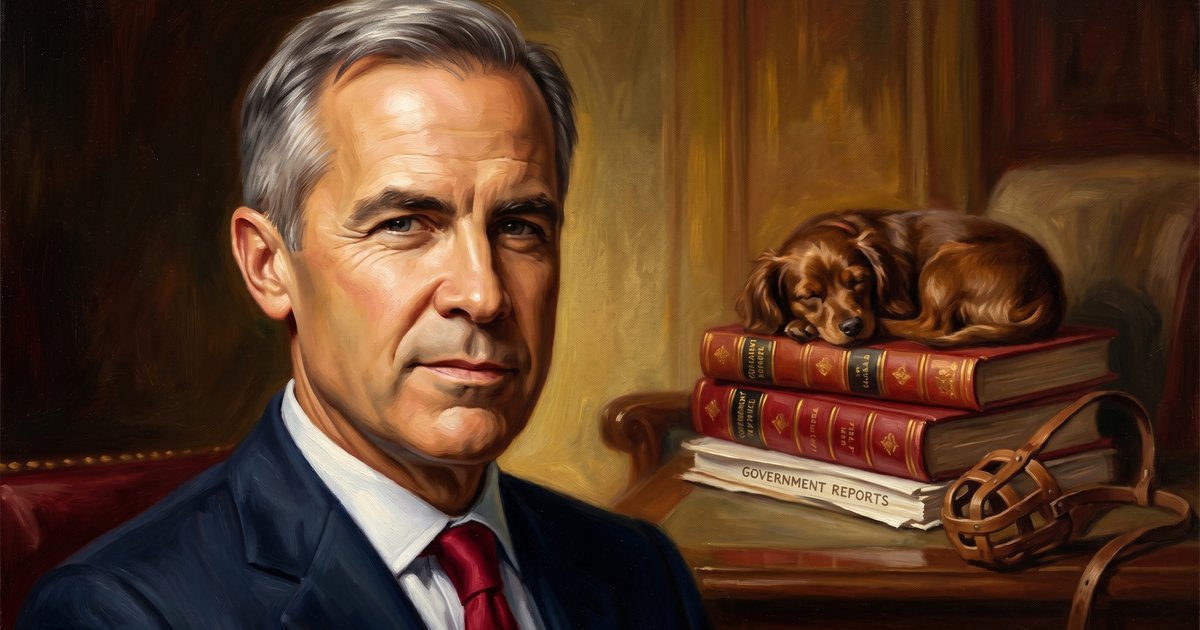
This is Part 5 — the final installment — of a five-part series on Prime Minister Mark Carney's conflict-of-interest arrangements. Part 1 examined the screen. Part 2 examined the lobbying data. Part 3 examined the policy matrix. Part 4 examined the international precedents.
The Office of the Conflict of Interest and Ethics Commissioner has 53 employees and a $7.7 million annual budget. It oversees roughly 3,000 senior public office holders plus all 343 Members of Parliament. It is the smallest federal integrity office after the Commissioner of Lobbying — 40% of the Information Commissioner's staff and 25% of the Privacy Commissioner's.
In its most recent reported year (2023-2024), the office:
For deeper analysis and exclusive posts, subscribe to my Substack.
- Received 6 examination requests from Members of Parliament
- Received 11 examination requests from members of the public
- Opened 19 case files
- Closed 16 of those files without examination — dismissed at intake
- Issued zero examination reports
- Issued 4 administrative monetary penalties totalling $900, all for paperwork lapses
The maximum statutory penalty for a substantive ethics violation under the Conflict of Interest Act — preferential treatment, furthering private interests, influence-trading — is not $500. It is nothing. There is no fine. The Act does not provide for monetary penalties on substantive violations. The $500 cap applies only to procedural failures: filing a report late, omitting a material change, forgetting to disclose a gift within 30 days. The biggest ethical violations in the Act are not penalizable at all.
The only enforcement tool for substantive violations is a published examination report naming the offender. The report goes to the Prime Minister and becomes part of the public record. Parliament can debate it. It cannot vote to sanction an individual on the basis of an Act examination. The Prime Minister can dismiss a minister. The only mechanism for removing a Prime Minister is the loss of confidence of the House — a political event entirely disconnected from the Commissioner's finding.
Ethics Commissioner findings against prime ministers: three strikes, no consequences
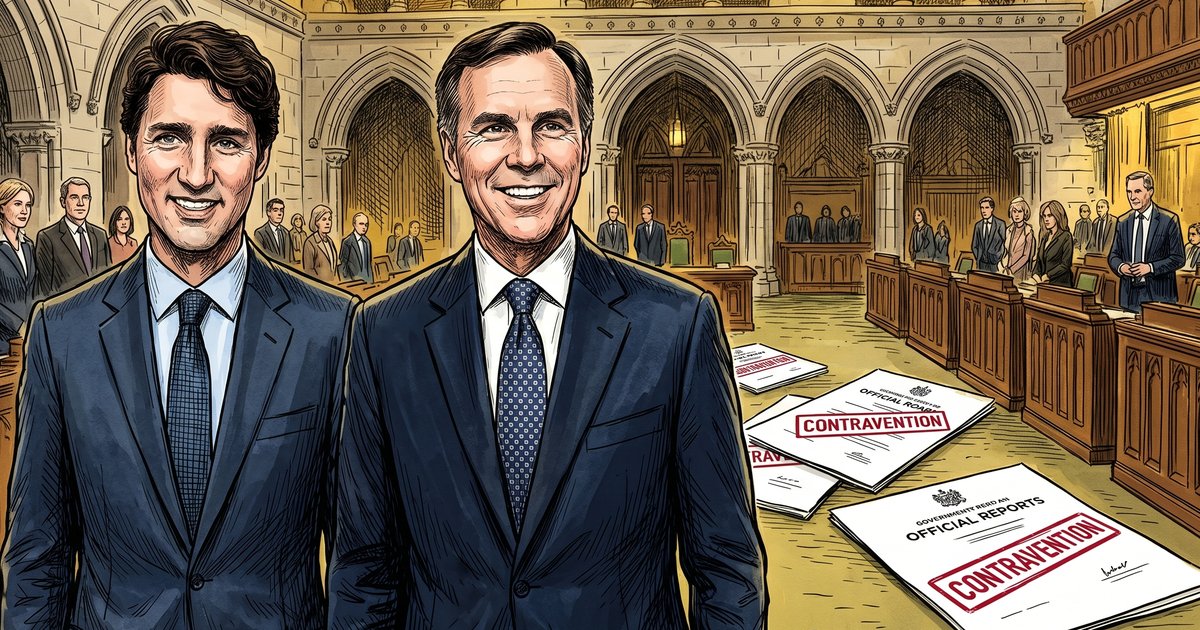 Justin Trudeau and Bill Morneau
Since the Conflict of Interest Act came into force in 2007, two Prime Minister-level examination reports have been issued. Both involved Justin Trudeau. Both produced findings of contravention. Both produced nothing.
December 2017: the Aga Khan trip. Commissioner Mary Dawson found that Trudeau contravened sections 5, 11, 12, and 21 of the Act by accepting a vacation on the Aga Khan's private island. Four sections violated simultaneously. Penalty: none. Trudeau apologized, called it a learning experience, and remained Prime Minister.
August 2019: SNC-Lavalin. Commissioner Mario Dion found that Trudeau contravened section 9 of the Act — the prohibition on using one's office to seek to influence a decision to further another person's private interests — by pressuring Attorney General Jody Wilson-Raybould to intervene in the prosecution of SNC-Lavalin. Penalty: none. Trudeau won a minority government three months later.
May 2021: Bill Morneau and WE Charity. Commissioner Dion found that Finance Minister Morneau contravened subsection 6(1), section 7, and section 21 of the Act over his family's financial relationship with WE Charity. Penalty: none. Morneau had already resigned — for political reasons, months earlier — before the report was published. The Commissioner did not order the resignation. He could not. He has no such power.
Three findings of contravention against a sitting Prime Minister and his Finance Minister. Combined institutional consequence: zero.
Can the Ethics Commissioner still investigate Carney
On April 8, 2026, Commissioner Konrad von Finckenstein issued a finding that Christiane Fox, then-Deputy Minister of Immigration, Refugees and Citizenship Canada, contravened section 9 of the Act. Fox used her position to give preferential treatment to Bjorn Charles, a university acquaintance from Carleton. The Commissioner found that Fox ensured Charles met departmental officials quickly, sought updates on his hiring, gave him an internal briefing document prepared for the minister's acting chief of staff, and pushed for a higher classification for which he was not qualified. IRCC staff reported feeling pressured to accommodate the hire.
Fox acknowledged the findings and said she "takes the matter seriously." She was not removed from federal service. She now serves as Deputy Minister of National Defence.
The Fox finding demonstrates that the office is not dormant. It can investigate. It can produce findings. It can name names. The section 9 violation Fox was found to have committed is the same section Trudeau was found to have violated in SNC-Lavalin.
But notice the scale. The office acted on a deputy minister's hiring favour for a university friend. The question this series has been building toward is whether the same office can do anything comparable about a Prime Minister whose former employer manages US$900 billion in assets and whose personal carry vests through 2034. The Fox finding is useful precisely because of the contrast: the office functions on cases within its institutional capacity. PM-level structural conflicts are not within that capacity.
Carney's ethics screen is run by his own staff
Carney's ethics screen, as described in Part 1, is administered by two people: Marc-André Blanchard, his Chief of Staff, and Michael Sabia, the Clerk of the Privy Council.
Both are political appointees. Both serve at the pleasure of the Prime Minister. The Ethics Commissioner is not in the room. He receives notifications after the fact. He does not gate decisions or run the screen in real time.
Sabia told the House of Commons ethics committee that the screen has been implemented six times in approximately one year. Six times, in a government that announced a nuclear acceleration strategy, a housing program, a carbon-tax redesign, a capital-gains reversal, a major projects office, an AI infrastructure strategy, a transition-finance taxonomy, and a defence procurement overhaul — all of which touch Brookfield's portfolio to varying degrees, as documented in Part 3.
Six implementations in a year. Fourteen major policy decisions with identifiable Brookfield exposure. Either the screen administrators are applying the general-application carveout aggressively — classifying most government business as "general" and therefore exempt — or the screen is being triggered selectively for narrow, entity-specific matters while systemic exposure passes through unchecked. The data does not tell us which. The Commissioner has not told us either.
The spouse gap in Canada's conflict of interest rules
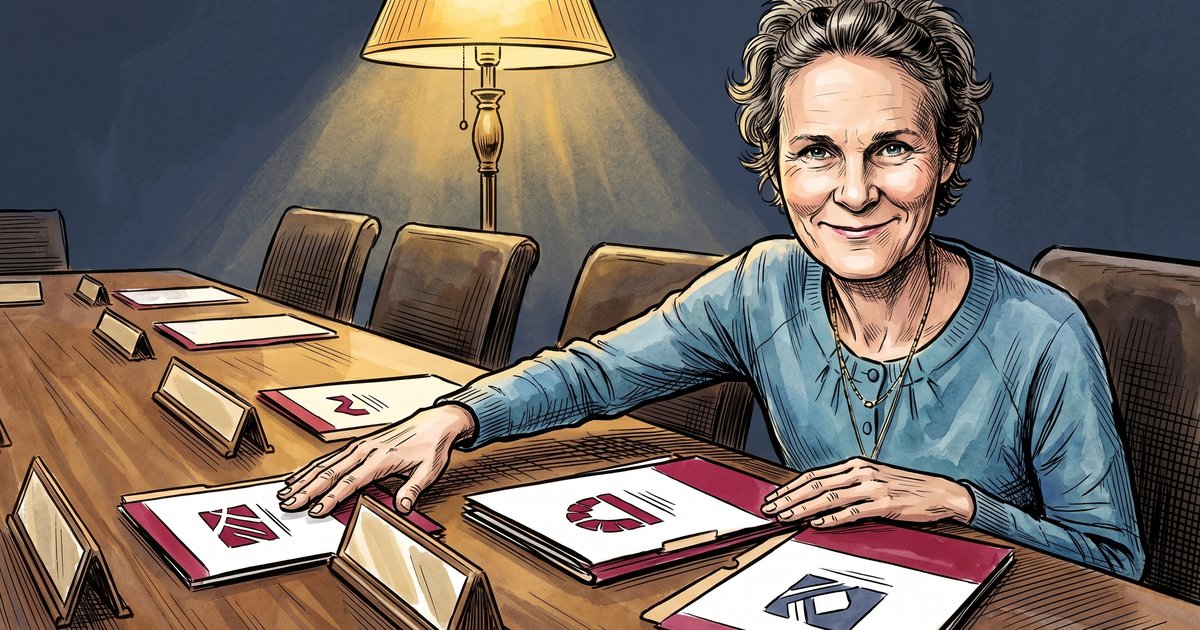 Diana Fox Carney, the Prime Minister's spouse
The ethics screen names three parent entities: Brookfield Asset Management, Brookfield Corporation, and Stripe. It covers 103 corporate entities in Annex A. It does not cover General Atlantic, BeyondNetZero, Helios CLEAR, TechMet, Willis Towers Watson, Terramera, or Eurasia Group.
Diana Fox Carney, the Prime Minister's spouse, holds paid positions at all of them.
She is an adviser to BeyondNetZero, General Atlantic's climate growth-equity fund. Carney's own public ethics filing reports "contract income from General Atlantic" — an acknowledgment that she earns money from this relationship.
She chairs Helios CLEAR, a $400 million climate-focused Africa infrastructure fund backed by the European Investment Bank.
She holds shares and share options in TechMet Ltd, a critical-minerals investment company. The Prime Minister's ethics filing discloses TechMet as a spousal holding.
She advises Willis Towers Watson's Climate and Resilience Hub. She sits on the Strategic Advisory Board of Terramera, a Vancouver ag-tech company. She serves as a Senior Adviser at Eurasia Group, the political-risk consultancy, alongside Chairman Gerald Butts — Trudeau's former principal secretary.
Eurasia Group has received approximately $1.53 million in sole-source contracts from Natural Resources Canada between 2017 and 2024. The largest — $446,000 — was awarded in February 2024, during Diana Fox Carney's tenure as Senior Adviser. NRCan is a core department for the energy, critical-minerals, and climate-policy files the Prime Minister directly oversees.
The ethics screen covers Brookfield. It does not cover the firms that pay the Prime Minister's spouse. The Commissioner's public summary statement discloses some spousal holdings — the TechMet shares, the General Atlantic contract income, an iShares Core S&P 500 ETF. The screen is doing the work the disclosure already made unnecessary. It is not doing the work the disclosure left undone.
Diana Fox Carney's portfolio touches nearly every federal-policy domain her husband now chairs: private climate capital, Africa infrastructure finance, critical minerals, insurance and ESG advisory, political-risk consulting, and Canadian ag-tech. Each of her roles intersects with federal spending, federal regulation, or federal trade policy. None of them is screened.
This is not an allegation of concealment. The spousal disclosure was filed. The information is on the public registry. But the screen's architecture covers the Prime Minister's former employer and not his spouse's current employers. The gap is structural.
The Ethics Commissioner's approach to enforcement
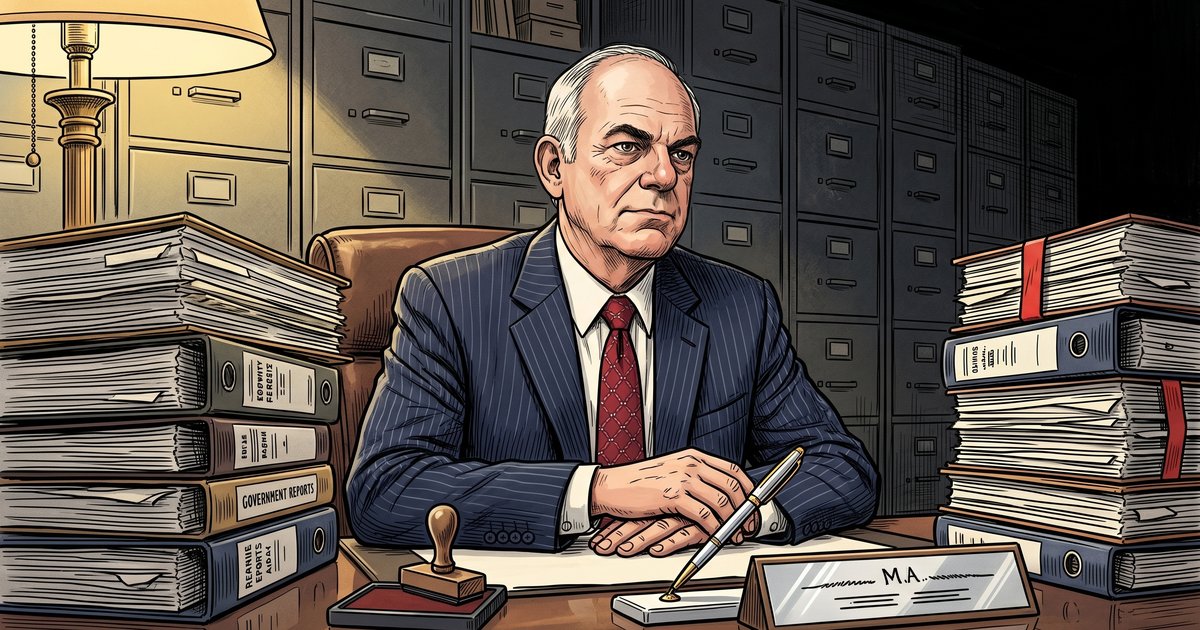 Konrad von Finckenstein, Conflict of Interest and Ethics Commissioner
Commissioner von Finckenstein's public statements to the ethics committee are worth reading carefully.
He confirmed that Carney's "financial fate is directly tied to Brookfield's success." He confirmed the screen covers more than 100 entities. He defended the current legislative framework by framing his job in a particular way:
"It's specifically set out in the law, which means to make sure that the most talented and able people can come into the public service, in and out, without conflict of interest, or if there is a conflict, we'll manage it."
This is a Commissioner who defines his role as facilitating the entry of wealthy, well-connected people into government — while managing their conflicts as a secondary concern. It is a defensible policy position. Many serious people believe that excluding business leaders from government is worse than managing their conflicts. Von Finckenstein is not wrong that overly restrictive rules could discourage capable people from serving.
But a Commissioner whose instinct is to facilitate rather than to constrain is unlikely to be the one who draws a harder line than any of his predecessors. The three commissioners who preceded him — Mary Dawson, Mario Dion, and Martine Richard (briefly, as interim) — all operated within the same general-application framework. Two produced findings against Trudeau. Neither attempted to narrow the carveout itself.
Von Finckenstein was appointed by the Trudeau government in February 2024 and confirmed by unanimous consent of the House. His seven-year term runs until 2031. He will oversee Carney's entire prime ministership under an appointment made by the previous Liberal Prime Minister. The Act he enforces was written — in its structural features — by the Conservative government in 2006. The doctrine inside it was written by a Liberal Ethics Counsellor in 1995. Nobody who wrote, reformed, or currently administers the Act has ever challenged the general-application carveout that makes PM-level enforcement functionally impossible.
Italy's parallel: ethics oversight that cannot function
Italy's antitrust authority, the AGCM, has enforced the Frattini Law — Italy's conflict-of-interest statute — since 2004. The AGCM has a broader mandate than Canada's Ethics Commissioner: it also regulates competition and consumer protection. It publishes semi-annual reports to Parliament on conflict-of-interest enforcement.
The result, across eight Italian governments and roughly 38 reports, mirrors Canada's record:
- Zero Article 3 findings of conflict against a sitting officeholder
- Zero desistance orders against benefiting companies
- Zero pecuniary sanctions
The AGCM itself, in its December 2012 report to Parliament, conceded that the Article 3 mechanism is "del tutto inefficace" — entirely ineffective — on the enforcement side. The authority has repeatedly asked Parliament to strengthen the law. No government has acted on those requests.
Italy has two such offices — the AGCM for general conflicts and AGCOM for broadcasting conflicts — and both have the same null record. The structural defect is the same one that runs through Canada's section 2(1): ownership without an operational role is permitted, and acts of "general application" are exempt from scrutiny. When almost every government decision qualifies as general application, the exemption swallows the rule.
The Canadian and Italian offices issue reports, publish registries, maintain websites, and testify before parliamentary committees. They do everything an accountability institution is supposed to do, except hold a head of government accountable.
The House ethics committee study on Carney's conflict of interest
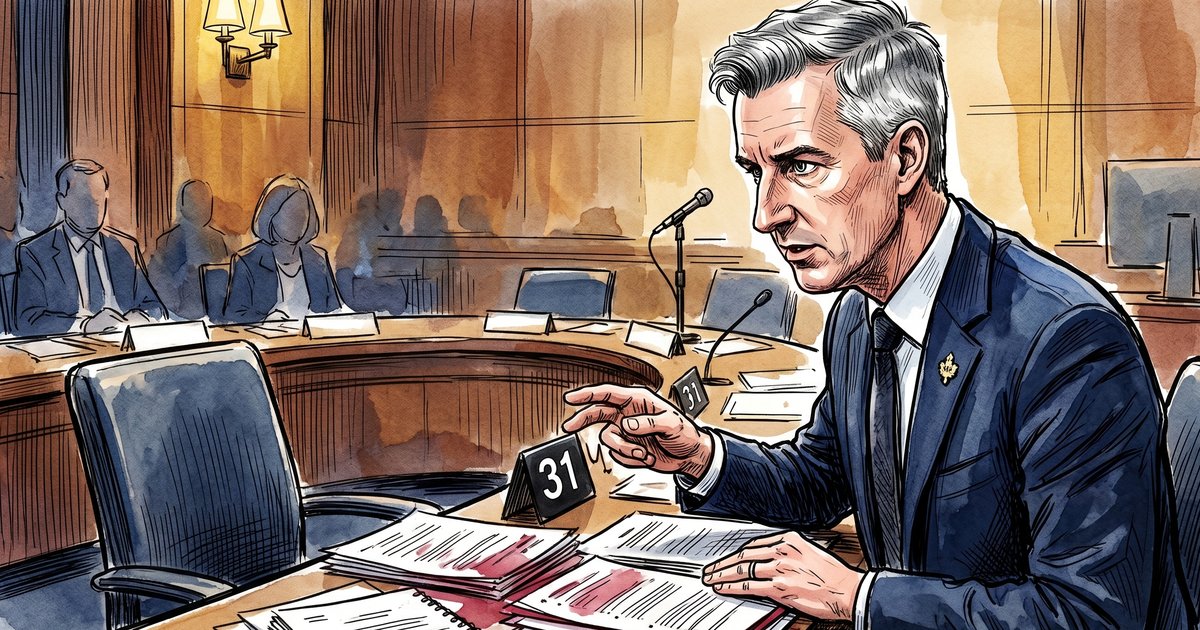 Michael Barrett, Conservative MP and ETHI committee member
The House of Commons Standing Committee on Access to Information, Privacy and Ethics (ETHI) voted in 2025 to study the Conflict of Interest Act. Conservative MP Michael Barrett moved the motion after Commissioner von Finckenstein briefed the committee on Carney's blind trust and screen.
The study's focus areas:
- Limiting the use of blind trusts and tax havens
- Extending the Act's standards to party leadership candidates — a provision designed to capture situations like Carney's, where the conflicts were acquired during a leadership race, not while in office
The ETHI committee has produced two reports in the 45th Parliament related to the Act's review. The study is ongoing as of April 2026. No bill amending the Act has been tabled.
The study is the right response. The Act's general-application carveout was written in an era when the typical conflict involved a minister who owned shares in a bank or a resource company. It was not designed for a Prime Minister who retains carried interest in US$35 billion in transition funds, stock options in a company that manages US$900 billion in assets, and an ethics screen administered by political appointees who owe their positions to him.
If Parliament concludes that the current framework is adequate, that is Parliament's prerogative. But the conclusion should be deliberate, not the result of a framework that has never been seriously tested against the situation it now faces.
The structural failure in Canada's conflict of interest oversight
The screen is supposed to keep Carney out of decisions that benefit Brookfield. But it contains a loophole — inherited from a 1995 ruling that was never challenged — that exempts any decision broad enough to affect more than one company. It is run by two of Carney's own appointees. It has been triggered six times in a year when the government made at least fourteen major decisions that touch Brookfield's portfolio.
The subsidiaries are lobbying Ottawa aggressively while the parent companies remain silent. Westinghouse's lobbying surged five-fold after Carney took office, with two contacts reaching the PMO. Evolugen met eight deputy ministers in a single meeting. The lobbying registry does not connect subsidiary activity to the Brookfield parent.
The policy matrix mapped fourteen major Carney-era decisions against Brookfield's holdings. Four showed strong connections. Six showed moderate ones. Two cut the other way. No single decision is a smoking gun. But taken together, the pattern is clear — and every individual decision slips through the loophole because each one, on its own, can be called "general policy."
The precedents show that every democracy facing this problem has struggled with it. The closest rulings — the European Commission on Babiš, the Italian AGCM on Berlusconi — either required supranational enforcement or produced nothing. Canada's framework is stronger than most, but the general-application carveout functions the same way Italy's "specific and preferential impact" test does: it exempts everything that looks like general policy.
The office tasked with enforcing all of this has 53 employees, a $7.7 million budget, no statutory penalty for substantive violations, and a record of three findings against Trudeau and Morneau that produced no institutional consequences. Its current Commissioner has publicly framed his job as helping wealthy entrants into government.
None of this means Carney is corrupt. The BAM event study from Part 3 shows that the stock market does not price his decisions as systematically beneficial to Brookfield. Several policy decisions — the EV mandate scrap, defence procurement — have no Brookfield connection. The concern documented here is structural, not criminal. It is about whether the institutional framework designed to manage conflicts at the highest level of government is adequate for someone whose financial entitlements span an asset manager with exposure to virtually every sector of the economy.
The honest question, after all of this, is not whether the Ethics Commissioner will act on Carney. After two findings against Trudeau and one against Morneau produced nothing, and after twenty years of Italian non-enforcement of a similarly designed regime, the honest question is what this office is actually for.
Parliament is studying the Act. The answer should come from there.
This is the final post in the series. The full series: Part 1 — Mark Carney's Ethics Screen Has a Huge Hole · Part 2 — How Brookfield Lobbies Ottawa Without Brookfield · Part 3 — Where Brookfield Sits in Every Room · Part 4 — The Loophole That No Democracy Has Closed · Part 5 — The Watchdog That Cannot Bite
For extra details, subscribe to the Substack.
Related Posts
The loophole that no democracy has closed
Carney's situation is not unprecedented. Every democracy that has faced it — Canada, the EU, Italy, the United States — has struggled with the same structural…
Mark Carney's ethics screen has a huge hole
Most coverage of Mark Carney's conflict-of-interest arrangements is secondhand. This is what the actual document says — line by line — and what the law…
Airlines owe Brookfield's partners rent. The government just sent $150 million to keep them paying.
The fuel crisis has doubled jet fuel prices. Airlines are cutting routes and requesting lease deferrals from their lessors. Today the government announced $150…