Mark Carney's ethics screen has a huge hole
This is Part 1 of a five-part series on Prime Minister Mark Carney's conflict-of-interest arrangements, the law that governs them, and the institutions that are supposed to enforce them. For extra details, subscribe to the Substack.
On July 11, 2025, the Office of the Conflict of Interest and Ethics Commissioner published Prime Minister Mark Carney's ethics screen on its public registry. The document is short — about 350 words plus a list of 103 corporate entities. Most Canadians have never read it. Most of the coverage of Carney's Brookfield ties cites the screen secondhand, filtered through press conferences, committee testimony, and opposition talking points.
The document is worth reading directly, because what it says and what it does not say are two different things.
For deeper analysis and exclusive posts, subscribe to my Substack.
Full text of Carney's ethics screen
Here is the operative text of the screen, published under Carney's name on the Commissioner's registry:
Conflict of interest screens are preventive compliance measures, agreed upon pursuant to section 29 of the Conflict of Interest Act (Act) by a public office holder and the Conflict of Interest and Ethics Commissioner, to assist public office holders in avoiding conflicts of interest. Screens also seek to minimize the possibility of conflicts arising between the public duties of the public office holder and their private interests or those of their relatives and friends.
The Conflict of Interest and Ethics Commissioner and I have agreed that a conflict of interest screen is an appropriate compliance measure, aimed at preventing any opportunity to further my interests or to improperly further those of Brookfield Asset Management, Brookfield Corporation, and Stripe Inc., and any company owned or controlled by them ("the Companies") of which I am aware on the date that my blind trust was established. Attached hereto as Annex A is a list of all of the Companies of which I am aware.
This screen will prevent me from giving preferential treatment to any of the Companies while I exercise my official powers, duties, and functions as a reporting public office holder.
This screen is administered by my Chief of Staff and by the Clerk of the Privy Council to ensure that I am neither made aware of nor participate in any official matters or decision-making processes involving the Companies' interests. I may, however, participate in a discussion or decision on a matter that is of general application or that affects the Companies' interests as a member of a broad class of persons unless those interests are disproportionate to the other members of the class.
All powers, duties and functions on matters that form part of this screen will be exercised by the appropriate minister, as selected by the screen administrators.
All ministers, members of my ministerial staff and other necessary ministerial staff and public servants have been informed in writing about this conflict of interest screen.
I have undertaken to inform the Conflict of Interest and Ethics Commissioner at the earliest opportunity of all changes of which I become aware that relate to or should form part of the matters caught by this screen.
In the event that I am made aware of a matter forming part of this screen or any such matter comes before me, I am required under section 21 of the Act to recuse myself from that matter by removing myself from the room where the discussion or decision is taking place. I must so inform the Conflict of Interest and Ethics Commissioner and, where appropriate, make a public declaration of recusal pursuant to subsection 25(1) of the Act.
Source: Office of the Conflict of Interest and Ethics Commissioner — Carney declaration
What Carney's ethics screen does and does not do
The screen is a compliance measure under section 29 of the Conflict of Interest Act. It was agreed between Carney and Commissioner Konrad von Finckenstein. It covers three parent entities — Brookfield Asset Management, Brookfield Corporation, and Stripe — plus any company "owned or controlled by them" that Carney was aware of when his blind trust was established.
A few things to note about what this document is not:
It is not a blind trust. Carney does have a separate blind trust, established before he was sworn in, where the trustee manages his financial assets. The screen is a separate mechanism. The blind trust handles the assets. The screen handles decisions — it is supposed to keep Carney out of the room when Brookfield's interests come up.
It is not a divestment. Carney has not sold his Brookfield holdings. He retains deferred share units in Brookfield Asset Management and Brookfield Corporation, stock options, and carried-interest eligibility in Brookfield Global Transition Fund I and II. The carried interest vests in 2032 and 2034. The assets sit in the blind trust, but he remains the beneficial owner. When those instruments mature, he collects the proceeds.
It is not administered by the Ethics Commissioner. The screen is run day-to-day by two people: Marc-André Blanchard, Carney's Chief of Staff, and Michael Sabia, the Clerk of the Privy Council. Both are political appointees. Both serve at the pleasure of the Prime Minister. The Ethics Commissioner receives notifications after the fact — he does not sit in the room, gate the decisions, or run the screen in real time.
Who administers Carney's conflict of interest screen
The two screen administrators deserve attention.
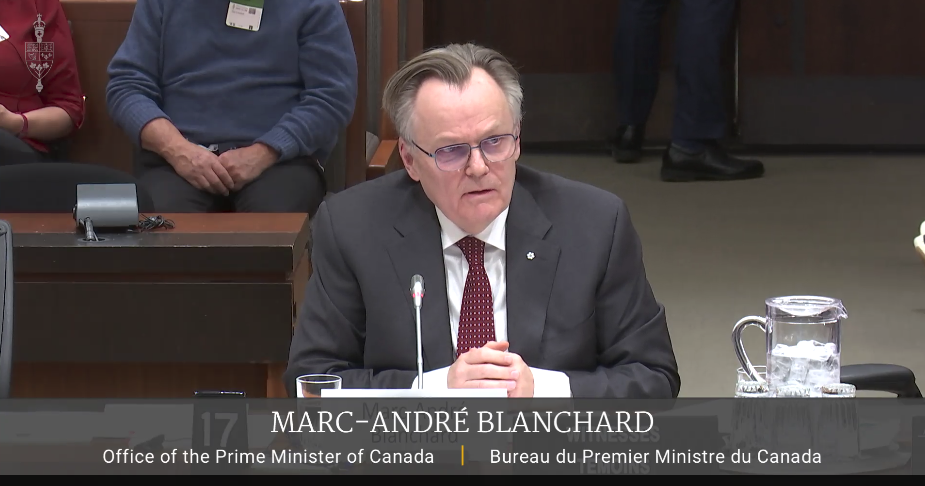
Marc-André Blanchard was CEO of McCarthy Tétrault, one of Canada's largest law firms, before serving as Canada's Ambassador and Permanent Representative to the United Nations from 2016 to 2020 — an appointment by the Trudeau government. He then became Executive Vice-President and Head of CDPQ Global at the Caisse de dépôt et placement du Québec. Carney made him Chief of Staff when he became Prime Minister.
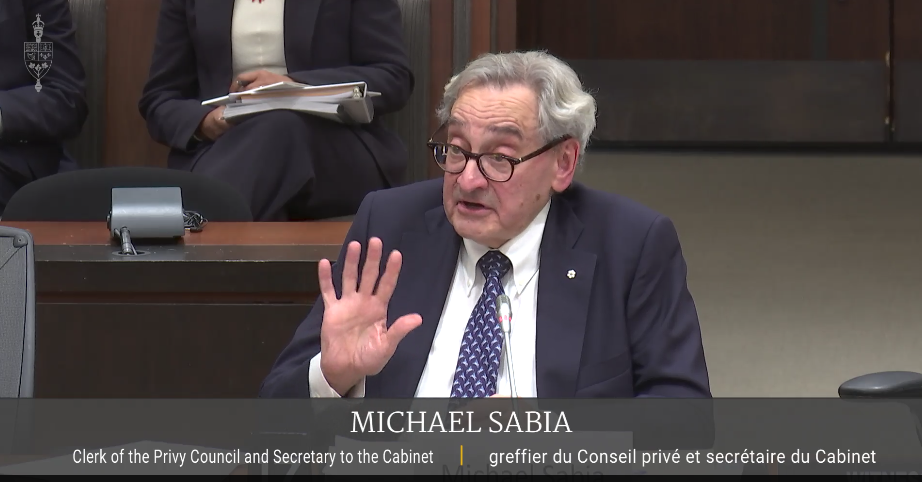
Michael Sabia was appointed Clerk of the Privy Council by Justin Trudeau in 2023. Before that, he was CEO of the Caisse de dépôt et placement du Québec — the same institution Blanchard later joined — and before that, he served as Deputy Minister of Finance under Paul Martin and Jean Chrétien. Earlier in his career, Sabia was a senior executive at Bell Canada Enterprises and, notably, at Brookfield. He has publicly stated that he disposed of his personal Brookfield shares in order to administer Carney's screen.
The screen asks Canadians to trust that the Prime Minister's Chief of Staff and the Clerk of the Privy Council — both of whom owe their positions to Carney, both of whom come from the same Bay Street and institutional investor ecosystem as Carney — will reliably prevent him from participating in decisions that benefit the companies where he spent his private-sector career and where he retains financial interests worth millions of dollars.
The general-application carveout that weakens the screen
The most important sentence in the screen is this one:
I may, however, participate in a discussion or decision on a matter that is of general application or that affects the Companies' interests as a member of a broad class of persons unless those interests are disproportionate to the other members of the class.
This is the general-application carveout. It is drawn from the definition of "private interest" in section 2(1) of the Conflict of Interest Act, which excludes from the definition of a conflict any decision that is "of general application" or that "affects a public office holder as one of a broad class of persons."
In plain language: if a policy decision applies broadly — to many companies, to a whole sector, to the economy at large — then Carney can participate in it, even if it benefits Brookfield. The screen only blocks him from decisions that specifically and disproportionately target one of the 103 listed entities.
Think about what that means for a Prime Minister whose former employer manages more than US$900 billion in assets across renewables, infrastructure, real estate, private credit, nuclear energy, insurance, and transition finance. Brookfield has portfolio companies and fund strategies in virtually every sector the federal government touches. A housing policy benefits Brookfield's real estate arm. An energy policy benefits Brookfield's renewables and nuclear holdings. A trade policy benefits Brookfield's infrastructure portfolio. A carbon pricing decision benefits Brookfield's transition fund thesis.
Each of those decisions is "of general application." Each affects Brookfield "as a member of a broad class." Under the Act's definition, none of them creates a "private interest," and therefore none triggers Carney's recusal obligation.
The carveout was not invented for Carney. It has been in the law since the Conflict of Interest Act came into force in 2007. But the Act was written for ministers who might own shares in a bank or a pipeline company — discrete holdings in discrete sectors where the line between "general" and "specific" could be drawn. It was not designed for someone whose financial entitlements span an asset manager with exposure to every major sector of the Canadian and global economy.
How the Conflict of Interest Act created this loophole
The Conflict of Interest Act was enacted as part of the Federal Accountability Act — the first major bill Stephen Harper's government introduced after winning the 2006 election. It replaced a non-statutory code that had been in place, in various forms, since 1973. The code had been administered by the Ethics Counsellor, an official who reported directly to the Prime Minister.
Harper's legislation made several important changes. It created an independent Commissioner appointed by Parliament. It required public declarations of recusal under section 25(1). And it abolished the "blind management agreement" — the compliance vehicle that Paul Martin had used to manage his ownership of Canada Steamship Lines while serving as Finance Minister.
Martin's arrangement had allowed him to retain ownership of CSL while a manager ran the company. The manager could brief Martin on "extraordinary corporate events." Over nine years as Finance Minister, Martin received roughly a dozen briefings from his manager and CSL's president, including one on an Indonesia-linked contract worth over C$140 million that involved the Suharto family. In January 2004, Public Works disclosed that CSL-related companies had received approximately C$161 million in federal contracts, grants, and loans since 1993. Ethics Counsellor Howard Wilson cleared all of it under the same "general application" reasoning that now appears in Carney's screen.
The Harper government abolished the blind management agreement in section 27(3) of the new Act. The vehicle was gone. But the definition of "private interest" in section 2(1) — with its general-application exclusion — survived intact. The architecture of the Act is Conservative. The doctrine inside it is older, and it was written in 1995 by Howard Wilson to protect a different finance minister with a different set of corporate interests.
Wilson's ruling on Martin was never tested in court. It was never reviewed by Parliament. It became the working assumption of every Ethics Commissioner who followed. When Commissioner von Finckenstein approved Carney's screen in 2025, he was applying a definition of "private interest" that a non-statutory Ethics Counsellor wrote three decades earlier to protect a Prime Minister from scrutiny over a shipping company.
The 103 Brookfield entities on Carney's disclosure list

Annex A of the screen lists 103 corporate entities organized into three categories.
Section A (entities 1–25) covers entities where Carney personally had "a management position or an oversight role." These include Brookfield Asset Management, Brookfield Renewable Partners, Brookfield Infrastructure Partners, Brookfield Business Partners, and Brookfield Global Transition Fund I — the fund Carney chaired and whose carried interest he retains. Also listed: Westinghouse (entity 23), the nuclear technology company 51% owned by Brookfield that is the anchor asset of BGTF I.
Section B (entities 26–29) covers Brookfield portfolio companies that appear on the federal Lobbying Registry. These four entities — NorthRiver Midstream, Evolugen (Brookfield's Canadian hydro and renewables subsidiary), Brookfield LePage Johnson Controls, and Inter Pipeline — are the ones with active lobbying registrations in Ottawa.
Section C (entities 30–103) covers 74 additional entities screened "out of an abundance of caution" because the Commissioner identified them as Brookfield-related, "even though I had no role in managing them, and no direct financial interest in them." These range from Sagen Mortgage Insurance Company Canada (entity 46) — one of only three private mortgage default insurers in the country — to a series of UK wind farms, French real estate vehicles, and American solar companies.
The list is specific. It is also, by any honest measure, incomplete. Brookfield's own investor presentations describe more than 300 operating companies across its strategies. Conservative critics count downstream subsidiaries and project vehicles in the thousands. The screen covers what Carney was "aware of" when his blind trust was established — a self-reported knowledge cutoff that cannot be independently verified.
Absent from the screen entirely: Bloomberg L.P., PIMCO, Macro Advisory Partners, Chatham House, the Group of Thirty, the World Economic Forum, GFANZ (the Glasgow Financial Alliance for Net Zero that Carney co-founded), Watershed, and the Harvard Board of Overseers. Carney held roles at all of these organizations. None are screened.
How often Carney's ethics screen has been triggered
Privy Council Clerk Michael Sabia told the House of Commons ethics committee (ETHI) that Carney's screen had been implemented six times in approximately one year of service as Prime Minister.
Six times. In a government that has announced a Build Canada Homes program, a Major Projects Office, a carbon-tax redesign, a capital-gains inclusion-rate reversal, an EV mandate replacement, a nuclear acceleration strategy, and a defence procurement overhaul — all of which touch Brookfield's portfolio in some form — the screen was triggered six times.
The low number has two possible explanations. Either the screen administrators are applying it narrowly, flagging only those rare cases where a specific Annex A entity is directly and uniquely affected. Or the general-application carveout is doing the work it was designed to do: classifying virtually every macroeconomic and sectoral decision as "general" and exempting it from the screen before the question is ever asked.
Both explanations lead to the same place. The screen is porous by design. The law makes it porous. The people administering it work for the person it is supposed to constrain.
The structural problem with Carney's ethics screen

The Conflict of Interest Act gives Canadians a framework that sounds rigorous: an independent Commissioner, a public registry, a recusal obligation, and a screen administered by senior officials. The framework is real. The screen exists. The registry is public. The Commissioner is appointed by Parliament.
But the general-application carveout hollows it out from the inside. For a Prime Minister whose former employer operates across virtually every sector of the economy, "general application" covers nearly everything. The screen catches the specific — a procurement contract awarded to Westinghouse by name, a regulatory decision targeting Sagen by name. It does not catch the systemic — a housing strategy that benefits Brookfield's modular and real estate holdings, a carbon pricing regime that underwrites Brookfield's transition fund thesis, a capital-gains tax structure that preserves the after-tax value of Carney's carried interest.
The specific is rare. The systemic is constant. The screen was built for the specific.
Next: Part 2 — How Brookfield Lobbies Ottawa Without Brookfield
For extra details, subscribe to the Substack.
Related Posts
Brookfield bought a fleet of Canadian-made jets. Then Carney sold 150 more.
On April 8, Brookfield completed its acquisition of one of the world's largest A220 customers. Four weeks later, Carney personally attended the announcement of…
The watchdog that cannot bite
Fifty-three employees. A $7.7 million budget. Zero examination reports in its most recent year. Three findings against a sitting Prime Minister and his Finance…
Airlines owe Brookfield's partners rent. The government just sent $150 million to keep them paying.
The fuel crisis has doubled jet fuel prices. Airlines are cutting routes and requesting lease deferrals from their lessors. Today the government announced $150…