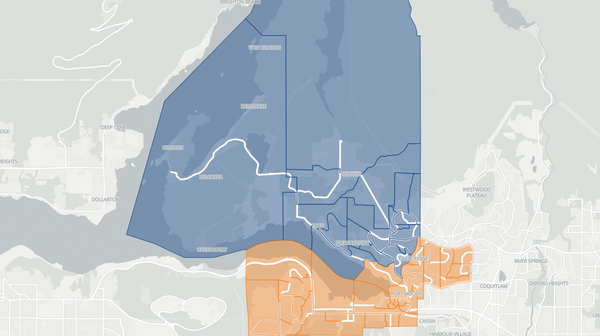
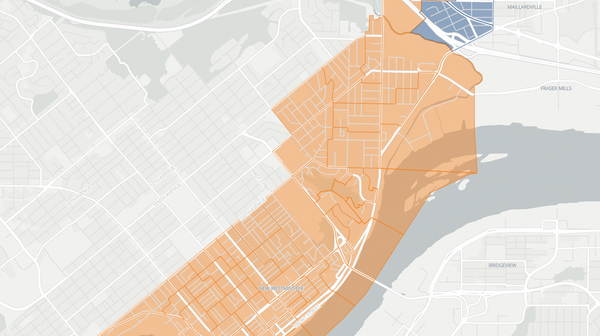
Port Coquitlam — 2024 British Columbia Provincial Election Results Map
Port Coquitlam — 2024 Election Results
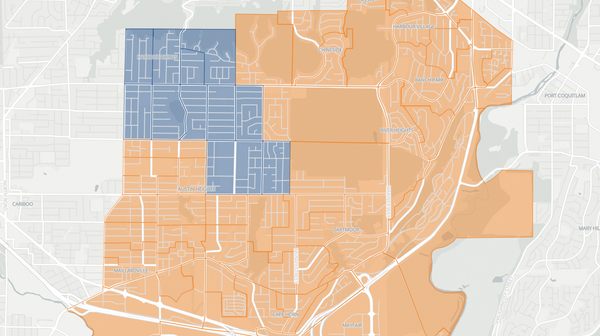
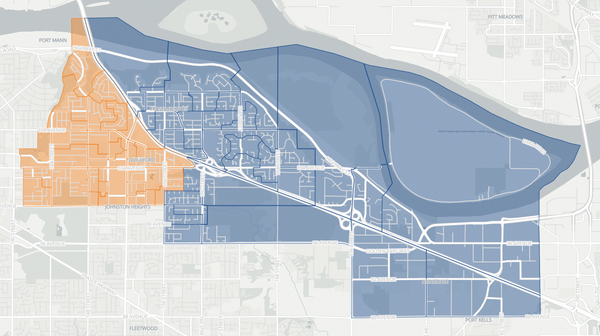
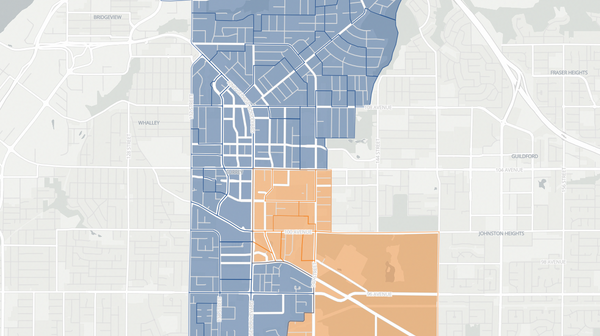
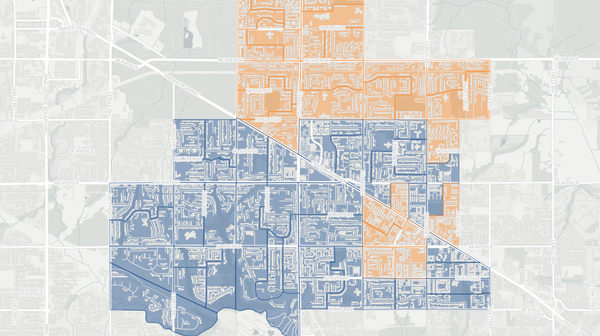
Poll-by-poll results for Port Coquitlam in the 2024 British Columbia election. The BC NDP candidate won this riding. Explore detailed voting data, candidate results, and turnout statistics at the poll level.
Riding information
Auto generated. Flag an issue.Port Coquitlam
Port Coquitlam occupies a wedge of suburban land in the northeast corner of Metro Vancouver, bounded by the Pitt River to the east and the communities of Coquitlam and Port Moody to the west and north. The city grew from sawmill and railway roots into a predominantly residential community that retained a middle-class, family-oriented character even as housing costs climbed sharply across the region. The Dominion Triangle neighbourhood — once an industrial zone along Lougheed Highway — was in the midst of a transformation into mixed-use residential development, with townhouse and apartment projects reshaping the area. Despite sitting at the eastern edge of the Millennium Line SkyTrain corridor, Port Coquitlam remained the only Tri-Cities municipality without its own rapid transit station.
Mike Farnworth had held the seat since 1991 — with one interruption during the BC Liberal sweep of 2001 — making it one of the longest continuous incumbencies in the province. As Minister of Public Safety and Solicitor General, he had been one of the most senior figures in the NDP government, and his name recognition and deep community roots made Port Coquitlam among the safest NDP seats in British Columbia.
Candidates
Mike Farnworth (BC NDP) — Farnworth was the longest-serving MLA in the legislature, first elected in 1991 after three terms on Port Coquitlam city council starting in 1983. Born in Bebington, England, he held a bachelor's degree in geography from Simon Fraser University. He had held senior cabinet portfolios including Municipal Affairs and Housing, Health, and — since 2017 — Public Safety and Solicitor General, overseeing policing, emergency management, and the province's response to the opioid crisis.
Keenan Adams (Conservative Party) — Adams was a locomotive engineer who graduated from BCIT's Railway Conductor program in 2010 and had lived in Port Coquitlam since that year. He initially ran as a BC United candidate before switching to the Conservatives when BC United suspended its campaign. He had volunteered with the Elk Valley Socio-Community and Economic Effects Advisory Committee and participated in Port Coquitlam's Adopt-A-Spot program.
Adam Bremner-Akins (BC Green Party) — Bremner-Akins grew up in Port Coquitlam and was a political science student at Simon Fraser University. He had previously run for the Greens in Coquitlam-Burke Mountain in 2020 and served as secretary of the BC Green Party's provincial council.
Lewis Dahlby ran for the Libertarian Party with negligible support.
Local Issues
The campaign for a SkyTrain extension into Port Coquitlam had advanced but remained unfulfilled. The infrastructure for a future eastward extension of the Millennium Line had been built into the Evergreen Extension when it opened in 2016 — including the first metres of track and the necessary switches at Coquitlam Central Station — and the city had completed a feasibility study examining a roughly two-kilometre extension along the Canadian Pacific Railway corridor. TransLink's Transport 2050 strategy identified the extension as a priority, and Port Coquitlam's mayor continued to press the case at the Metro Vancouver Mayors' Council. But no firm funding commitment or construction timeline had been announced, leaving Port Coquitlam's commuters reliant on bus connections to reach the nearest SkyTrain station in Coquitlam. For a riding whose residents depended heavily on the commute to employment centres in Vancouver and Burnaby, the transit gap remained a persistent frustration.
Housing affordability had eroded one of Port Coquitlam's traditional advantages in the Metro Vancouver market. What had once been a more accessible community for middle-class homeownership saw benchmark prices climb steadily between 2020 and 2024, driven by the same regional dynamics that pushed buyers eastward from Vancouver and Burnaby. The provincial government's legislation mandating transit-oriented development within 800 metres of SkyTrain stations was primarily affecting neighbouring Coquitlam, but the ripple effects — including increased speculation on properties along the anticipated extension route — were felt across Port Coquitlam. The Dominion Triangle development, with proposals for hundreds of new housing units, crystallized the tension between accommodating growth and preserving the city's character.
Public safety and the opioid crisis were issues that connected directly to Farnworth's ministerial portfolio. The Tri-Cities experienced rising overdose numbers throughout the 2020-2024 term, consistent with the broader provincial crisis that was killing roughly six British Columbians per day by 2024. The NDP government's decriminalization pilot, which began in January 2023, and its subsequent partial reversal proved politically contentious. Cost of living — encompassing grocery prices, auto insurance, and childcare — was the overarching economic concern for the riding's commuter households, and the NDP's suite of affordability measures, including the BC Family Benefit expansion and the elimination of ICBC's basic insurance model in favour of Enhanced Care, were debated at the doorstep.