Cowichan—Malahat—Langford, BC — 2025 Federal Election Results Map
Cowichan—Malahat—Langford — 2025 Election Results
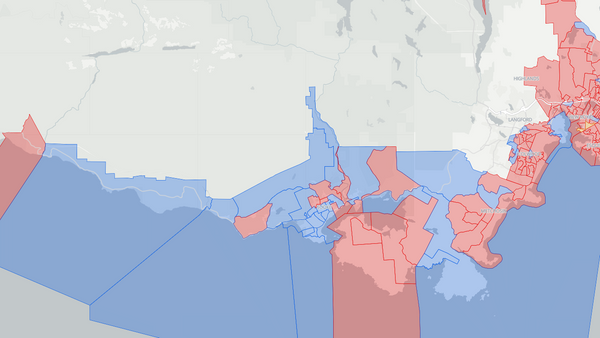
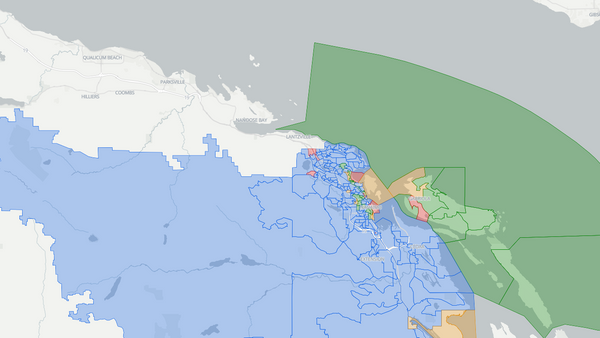
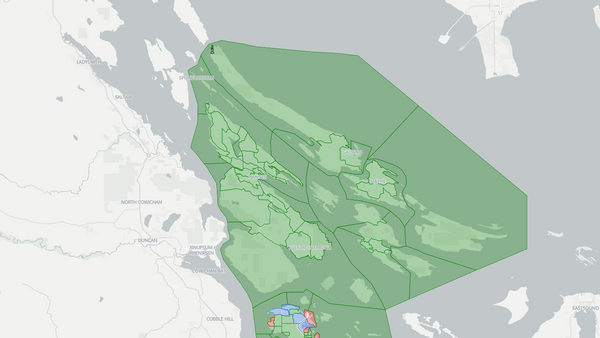
Poll-by-poll results for Cowichan—Malahat—Langford in the 2025 Canadian federal election. The Conservative candidate won this riding. Explore detailed voting data, candidate results, and turnout statistics at the poll level.
Riding information
Auto generated. Flag an issue.Cowichan—Malahat—Langford
Cowichan—Malahat—Langford stretches across south-central Vancouver Island, running from the fast-growing City of Langford and the municipality of Highlands northwest along the Malahat corridor, through Shawnigan Lake, Cobble Hill, and Mill Bay, then up through the Cowichan Valley to Duncan, North Cowichan, Lake Cowichan, and Chemainus. The riding also extends west along the Strait of Juan de Fuca past Sooke to Port Renfrew. Several Cowichan Tribes reserves and other First Nations communities are located within the riding. The population is split roughly evenly between the suburban residents of Langford, one of the fastest-growing municipalities in British Columbia, and the more rural communities of the Cowichan Valley.
Candidates
Jeff Kibble (Conservative) is a retired Royal Canadian Navy veteran who spent 28 years in the military, including commanding a warship. He has lived in the riding for 14 years. A first-time federal candidate, Kibble ran on a platform focused on defence, affordability, and local economic concerns.
Alistair MacGregor (NDP) is the incumbent, first elected in 2015 when the riding was newly created. Born in Victoria and raised in Duncan, MacGregor holds a Bachelor of Arts from the University of Victoria and a Master of Arts in professional communication from Royal Roads University. Before entering politics, he worked as a tree-planting supervisor, a millworker, and a constituency assistant to former NDP MP Jean Crowder.
Blair Herbert (Liberal) is a small businessperson with 35 years of experience in home building and real estate brokerage. Born in Ottawa as part of a military family, Herbert is a former RCMP officer who served in northern Saskatchewan and previously worked as an investigator for the provincial Ombudsman in Saskatchewan. He has run for the Liberals in the riding in three consecutive elections.
Kathleen Code (Green Party) is a retired provincial government economic development policy analyst who worked in the role for 21 years. A resident of the riding since 2012, she joined the Ecoforestry Institute Society as a trustee and was part of the legal team that fought to keep the publicly donated Wildwood Ecoforest in the public domain.
About the Riding
The riding’s dual character—suburban Langford and rural Cowichan—gives it a distinctive political dynamic. Langford has experienced explosive population growth, transforming from a small community into a city of more than 46,000 in roughly two decades. New housing developments, commercial centres, and transportation infrastructure have reshaped the landscape, but growth has also strained roads and services, particularly along the Trans-Canada Highway corridor through the Malahat.
The Cowichan Valley, by contrast, has a more established rural and small-town character. Duncan and North Cowichan serve as the valley’s commercial centres, while agriculture—including vineyards that have made the valley a wine-producing region—forestry, and tourism form the economic base. The Cowichan River is one of British Columbia’s most important salmon and steelhead waterways, and fisheries management is a perennial concern. The Cowichan Tribes, one of the largest First Nations in British Columbia, play a central role in the valley’s cultural and economic life.
In 2025, housing affordability was the dominant issue across the riding. Langford’s rapid growth had not kept pace with demand, and prices throughout the Cowichan Valley had risen sharply. Health-care access—particularly physician shortages in Duncan and surrounding communities—remained a serious concern. The riding’s extensive coastline and forested interior also kept environmental issues, including old-growth logging and marine conservation, at the forefront of the campaign.