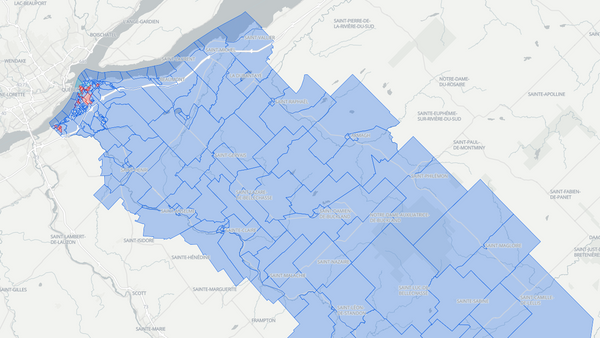
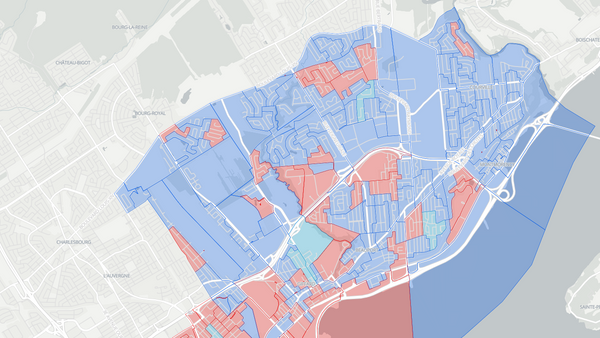
Rimouski—La Matapédia, QC — 2025 Federal Election Results Map
Rimouski—La Matapédia — 2025 Election Results
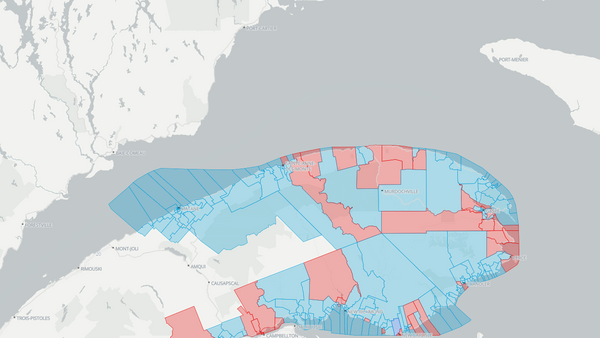
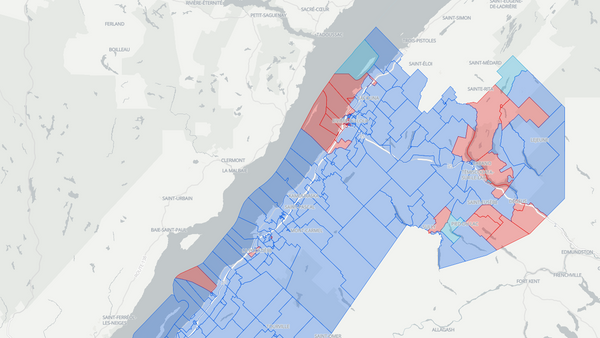
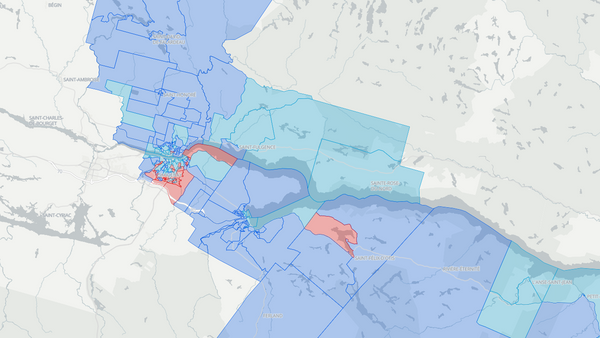
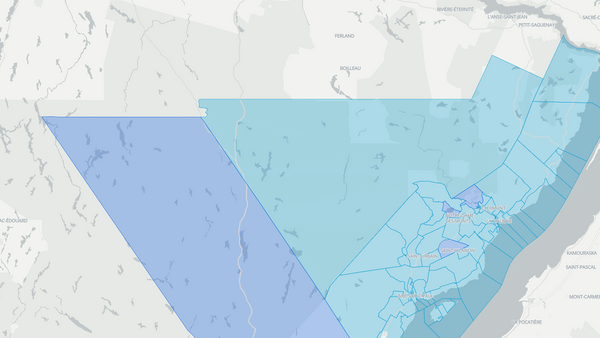
Poll-by-poll results for Rimouski—La Matapédia in the 2025 Canadian federal election. The Bloc Québécois candidate won this riding. Explore detailed voting data, candidate results, and turnout statistics at the poll level.
Riding information
Auto generated. Flag an issue.Rimouski—La Matapédia
Rimouski—La Matapédia is a new riding created through the 2022 redistribution, combining most of the former Rimouski—Neigette—Témiscouata—Les Basques with the regional county municipalities of La Mitis and La Matapédia, previously part of Avignon—La Mitis—Matane—Matapédia. Located in the Bas-Saint-Laurent region of eastern Quebec, the riding stretches from the St. Lawrence shoreline at Rimouski inland through the forested Appalachian foothills to the Matapédia Valley along the New Brunswick border. Rimouski, with a population of roughly 50,000, is the largest city and the administrative and educational hub of the region. The riding covers approximately 11,000 square kilometres.
Candidates
Maxime Blanchette-Joncas (Bloc Québécois) — Born in Rimouski in 1989, Blanchette-Joncas was first elected in 2019 in the predecessor riding and re-elected in 2021. He obtained a bachelor’s degree in business administration from the Université du Québec à Rimouski and worked at the Business Development Bank of Canada and as deputy general manager of the municipality of L’Isle-Verte before entering politics. He has served as the Bloc’s critic for science, innovation, and the St. Lawrence Seaway.
Alexander Reford (Liberal) — Director general of the Jardins de Métis (Reford Gardens) for more than 30 years, Reford is the great-grandson of Elsie Reford, who created the celebrated gardens in Grand-Métis. Under his stewardship, the site has become a major cultural and horticultural destination in eastern Quebec, hosting the International Garden Festival. He was recruited by Mark Carney’s team and was acclaimed as the Liberal candidate in his first foray into electoral politics.
Nancy Joannette (Conservative) — Joannette is a hair salon owner who also works as an assistant director at the Commission des normes, de l’équité, de la santé et de la sécurité du travail. She was designated as the Conservative candidate for the riding, running on the party’s national priorities of affordability and economic growth.
Salomé Salvain (NDP) — Salvain carried the NDP banner in the riding, campaigning on workers’ rights, pharmacare, and environmental protection.
Noémi Bureau-Civil (Independent) — Bureau-Civil ran as an independent candidate, seeking to represent the riding outside of party structures and focusing on local community concerns.
Taraneh Javanbakht (People’s Party) — Javanbakht represented the People’s Party of Canada, running on the party’s platform of reduced government spending and lower immigration.
About the Riding
Rimouski is the institutional anchor of the Bas-Saint-Laurent, home to the Université du Québec à Rimouski (UQAR), the Cégep de Rimouski—which houses the Institut maritime du Québec—and several federal research institutions focused on oceanography and marine sciences. The city’s economy blends education, healthcare, public administration, and a growing technology sector.
Beyond Rimouski, the riding is predominantly rural. The Matapédia Valley is renowned for Atlantic salmon fishing on the Matapédia and Restigouche Rivers, while forestry, agriculture, and small-scale tourism sustain communities in the interior. The region faces chronic demographic challenges as young people migrate to larger centres, leaving aging populations and labour shortages.
In 2025, the campaign centred on economic development in a region vulnerable to rural depopulation, the protection of seasonal industries—particularly forestry and fishing—from US trade disruptions, healthcare access in communities that struggle to recruit physicians, and federal investment in transportation infrastructure linking the dispersed population centres of the Bas-Saint-Laurent. The redrawn riding boundaries brought together communities that share economic and geographic ties but had been split across two federal districts for decades.