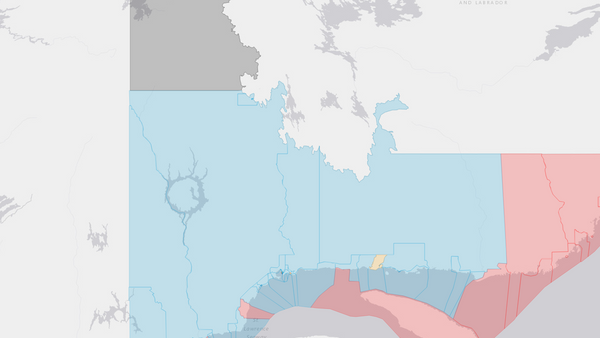
Abitibi—Baie-James—Nunavik—Eeyou, QC — 2015 Federal Election Results Map
Abitibi—Baie-James—Nunavik—Eeyou — 2015 Election Results
📌 The Canadian federal electoral district of Abitibi—Baie-James—Nunavik—Eeyou was contested in the 2015 election.
🏆 Romeo Saganash, the NDP-New Democratic Party candidate, won the riding with 12,778 votes (37.0% of the vote).
🥈 The runner-up was Pierre Dufour (Liberal) with 11,094 votes (32.1%), defeated by a margin of 1,684 votes.
📊 Other notable candidates: Luc Ferland (Bloc Québécois, 19%) and Steven Hébert (Conservative, 9%).
Riding information
Auto generated. Flag an issue.Abitibi—Baie-James—Nunavik—Eeyou
Stretching from Val-d'Or northward to the Hudson Strait, Abitibi—Baie-James—Nunavik—Eeyou encompasses more than half of Quebec's total landmass, making it one of the largest federal ridings in Canada. The district spans the ancestral territories of the Cree, Inuit, Naskapi, and Anishinaabe peoples, and includes communities ranging from the mining hub of Val-d'Or to the Cree villages of Eeyou Istchee and the Inuit settlements of Nunavik along the Ungava coast. With a population of roughly 44,000 spread across this vast territory, the riding's economy depends on mining, hydroelectric development, and the traditional activities of its Indigenous communities.
Candidates
Romeo Saganash (NDP) — A Cree lawyer from Waswanipi, Saganash studied law at the Université du Québec à Montréal. Before entering federal politics in 2011, he spent more than two decades representing the Cree at national and international forums, including negotiations that shaped the United Nations Declaration on the Rights of Indigenous Peoples. He also served as Deputy Grand Chief of the Grand Council of the Crees and entered the 2012 NDP leadership race to succeed Jack Layton, withdrawing before the final vote.
Pierre Dufour (Liberal) — Dufour worked as Director General of the Centre local de développement de la Vallée-de-l'Or for seven years before making his first entry into electoral politics in 2015. He campaigned on a platform of economic development and improved infrastructure for the region.
Luc Ferland (Bloc Québécois) — A veteran of public service in northern Quebec, Ferland had represented the Parti Québécois in Quebec's National Assembly as MNA for Ungava from 2007 to 2014. He faced a notable challenge in the riding's northern reaches, where many Inuit voters in Nunavik identify as federalist and where he did not speak Inuktitut or much English.
Steven Hébert (Conservative) — A 28-year-old from Val-d'Or who had been working in the Prime Minister's Office in Ottawa as a communications advisor, Hébert promoted his party's mining exploration tax credits and economic proposals tailored to resource-dependent regions.
About the Riding
The riding's vastness presents singular logistical challenges for candidates, who must campaign across time zones and in communities accessible only by air. Mining has long been the economic backbone of the southern portion, with the Abitibi gold belt sustaining operations around Val-d'Or and Malartic, where the Canadian Malartic open-pit gold mine began commercial production in 2011. Quebec's Plan Nord initiative, launched that same year, promised billions of dollars in investment for resource development across the north, making northern development policy a central issue. Hydroelectric infrastructure built by Hydro-Québec along the James Bay watershed provides power to much of southern Quebec. Housing shortages, access to health services, and the preservation of Indigenous languages remained persistent concerns in the riding's remote communities heading into the 2015 contest.