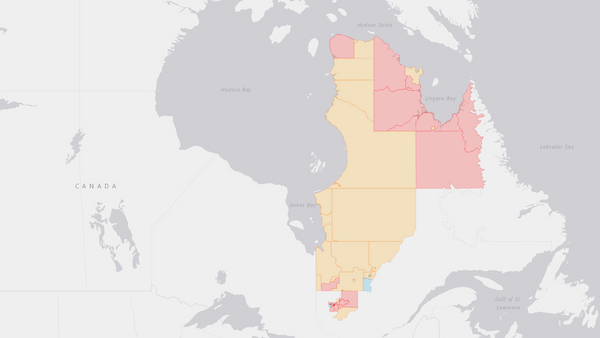
Manicouagan, QC — 2015 Federal Election Results Map
Manicouagan — 2015 Election Results
📌 The Canadian federal electoral district of Manicouagan was contested in the 2015 election.
🏆 Marilène Gill, the Bloc Québécois candidate, won the riding with 17,338 votes (41.3% of the vote).
🥈 The runner-up was Mario Tremblay (Liberal) with 12,343 votes (29.4%), defeated by a margin of 4,995 votes.
📊 Other notable candidates: Jonathan Genest-Jourdain (NDP-New Democratic Party, 18%) and Yvon Boudreau (Conservative, 10%).
Riding information
Auto generated. Flag an issue.Manicouagan
One of Canada's largest federal ridings by area, Manicouagan covers more than 264,000 square kilometres of Quebec's North Shore, running from the St. Lawrence coastline deep into the boreal interior. The riding's population is concentrated in the coastal towns of Baie-Comeau, Sept-Îles, Port-Cartier, and Hauterive, while vast stretches of forest, tundra, and hydroelectric infrastructure make up the hinterland.
Candidates
Marilène Gill (Bloc Québécois) — A literature teacher at Cégep de Baie-Comeau, Gill was born in 1977 and had lived on the North Shore for many years before seeking federal office. She campaigned on regional economic development and the defence of Quebec's interests in Ottawa.
Mario Tremblay (Liberal) — The former mayor of Longue-Rive, a small municipality on the North Shore, Tremblay won the Liberal nomination at an assembly in Baie-Comeau. He brought municipal government experience to a campaign focused on federal investment in the region's infrastructure.
Jonathan Genest-Jourdain (NDP) — A lawyer and member of the Innu Nation from Uashat-Maliotenam near Sept-Îles, Genest-Jourdain held a law degree from Université Laval. Elected in 2011 as the first NDP member to represent Manicouagan, he served in the Official Opposition shadow cabinet as deputy critic for Aboriginal affairs under Thomas Mulcair.
Yvon Boudreau (Conservative) — Boudreau represented the Conservative Party in a region where the party had limited historical support, though it drew votes from residents concerned with resource sector regulation.
Nathan Grills (Green Party) — Grills stood for the Green Party in a riding where environmental issues around hydroelectric development and mining operations were significant.
About the Riding
The North Shore economy runs on natural resources. Hydroelectric power generation anchors the region, with Hydro-Québec's massive Manic-Outardes complex—including the Daniel-Johnson Dam, one of the world's largest multiple-arch dams—providing employment and energy exports. Sept-Îles serves as a deep-water port for iron ore shipments from mines in the interior, while Baie-Comeau hosts an Alcoa aluminium smelter and forest products operations. The riding is also home to several Innu communities, including Uashat-Maliotenam, Pessamit, and Ekuanitshit, where issues of housing, education, and self-governance were persistent concerns. During the 2011–2015 period, debates over Plan Nord—Quebec's northern development strategy—and its implications for resource extraction, environmental protection, and consultation with Indigenous communities shaped much of the political conversation. Federal investment in coastal highway infrastructure along Route 138 and ferry services connecting isolated North Shore communities were also recurring issues.