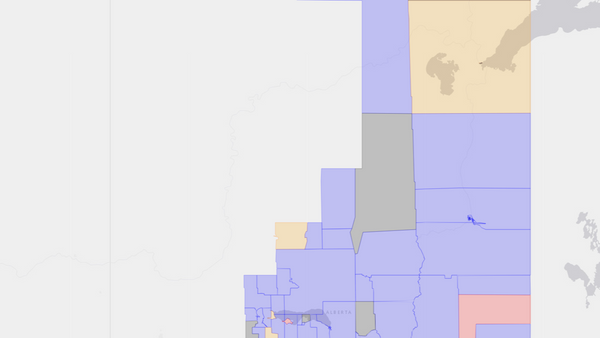
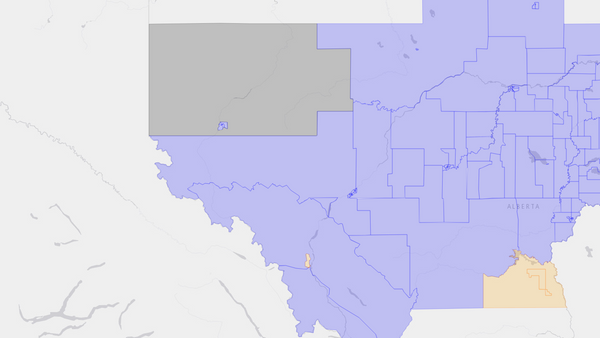
Peace River, AB — 2008 Federal Election Results Map
Peace River — 2008 Election Results
📌 The Canadian federal electoral district of Peace River was contested in the 2008 election.
🏆 Chris Warkentin, the Conservative candidate, won the riding with 29,550 votes (69.5% of the vote).
🥈 The runner-up was Adele Boucher Rymhs (NDP-New Democratic Party) with 6,124 votes (14.4%), defeated by a margin of 23,426 votes.
📊 Other notable candidates: Jennifer Villebrun (Green Party, 8%) and Liliane Maisonneuve (Liberal, 7%).
Riding information
Auto generated. Flag an issue.Peace River
Few Canadian constituencies covered more ground. Peace River spread across some 168,000 square kilometres of northwestern Alberta, from the grain and canola country around Grande Prairie and Beaverlodge north through the Peace River valley to Mackenzie County, High Level, Fort Vermilion and the Northwest Territories boundary. Within it lay Clear Hills, Saddle Hills, Birch Hills and Northern Lights counties, the County of Grande Prairie, the Municipal District of Greenview, most of Northern Sunrise County, and the municipal districts of Fairview, Peace, Spirit River and Smoky River.
Candidates
Chris Warkentin (Conservative) — Born at Grande Prairie in November 1978 and raised on his family's farm near the hamlet of DeBolt, Warkentin went to the Peace River Bible Institute, then studied business and marketing at Grande Prairie Regional College. He owned and ran a custom home building company before winning the seat in 2006 at the age of twenty-seven, and he sought a second term in 2008.
Adele Boucher Rymhs (NDP) — Boucher Rymhs was a retired resident of the town of Peace River, standing for the New Democrats across a riding whose size made canvassing a matter of highway hours rather than doorsteps.
Jennifer Villebrun (Green Party) — A lawyer practising in Grande Prairie, Villebrun ran for the Greens in a constituency where the resource industries the party criticized were also the source of most local paycheques.
Liliane Maisonneuve (Liberal) — Maisonneuve was a teacher from St. Isidore, the francophone settlement east of the town of Peace River, and carried the Liberal banner in a district that had not elected a Liberal in decades.
Edwin Siggelkow, a Grande Prairie businessman, ran for the Canadian Action Party, and Mélanie Simard, a teacher from Girouxville, ran for the Libertarian Party.
About the Riding
Distance defined the constituency. Grande Prairie, with 47,076 residents at the 2006 census, was the largest centre by a wide margin and served as the wholesale, retail and medical hub for the northwest; the town of Peace River, several hours north, was the administrative centre, home to more than a dozen provincial government offices. Communities strung along the Mackenzie Highway toward High Level and Rainbow Lake could be hundreds of kilometres apart, and getting federal services into places that far from the capital was a recurring constituency issue.
Three industries carried the economy. Oil and gas was the largest, with conventional drilling and gas processing throughout the region and in-situ bitumen operations in the Peace River oil sands, where Shell had been running steam projects since the early 1980s. Forestry was the second: pulp and lumber operations around Grande Prairie and the kraft pulp mill downstream from the town of Peace River anchored a sector that was already under strain from the collapse of the American housing market and the softwood lumber regime. The mountain pine beetle had spread east out of British Columbia into the Grande Prairie region, and control programs were stood up from 2007 to slow it.
Agriculture filled in the rest. The Peace Country grew wheat, barley, canola, forage seed and honey — Falher called itself Canada's honey capital — and arguments over the Canadian Wheat Board's barley monopoly were as live here as anywhere on the prairies. The Smoky River area around Falher, Donnelly, Girouxville, McLennan and St. Isidore held one of the largest francophone populations in Alberta, and Mackenzie County to the north included the Mennonite farming community at La Crête. First Nations and Métis communities were spread across the riding, and consultation over resource development on traditional territories, with housing and health services in northern settlements, was a steady part of the federal agenda.
By October 2008 the economic weather had turned. Natural gas prices had fallen sharply, forestry was cutting shifts, and the credit crisis threatened the flow of capital into northern projects — a combination that put employment, not environmental regulation, at the front of the local campaign.