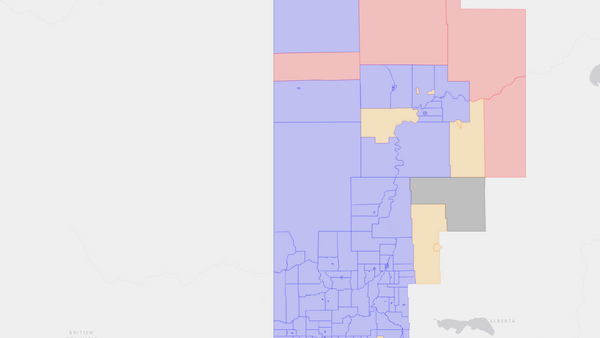
Fort McMurray—Athabasca, AB — 2008 Federal Election Results Map
Fort McMurray—Athabasca — 2008 Election Results
📌 The Canadian federal electoral district of Fort McMurray—Athabasca was contested in the 2008 election.
🏆 Brian Jean, the Conservative candidate, won the riding with 17,160 votes (67.1% of the vote).
🥈 The runner-up was Mark Voyageur (NDP-New Democratic Party) with 3,300 votes (12.9%), defeated by a margin of 13,860 votes.
📊 Other notable candidates: John Webb (Liberal, 11%) and Dylan Richards (Green Party, 6%).
Riding information
Auto generated. Flag an issue.Fort McMurray—Athabasca
At 180,320 square kilometres, Fort McMurray—Athabasca covered most of northeastern Alberta, running from farm country around the town of Athabasca and the Lac La Biche lakes north through Wabasca and the Regional Municipality of Wood Buffalo to the Northwest Territories boundary. Fort McMurray, Fort MacKay, Anzac, Conklin, Janvier and Fort Chipewyan lay inside it, along with the Alberta share of Wood Buffalo National Park. Boreal forest, muskeg and bitumen filled almost all of it.
Candidates
Brian Jean (Conservative) — Jean, born in 1963, practised law and ran businesses in Fort McMurray before entering federal politics. He won the old riding of Athabasca in 2004 and was returned in 2006 for the redrawn Fort McMurray—Athabasca. From February 2006 until dissolution he was parliamentary secretary to Lawrence Cannon at Transport, Infrastructure and Communities, which put him on the road and municipal funding files his constituents cared most about. He was the sitting member.
Mark Voyageur (NDP) — A heavy equipment operator living in Fort McMurray, Voyageur ran for the New Democrats from inside the industry that employed most of the riding's working population.
John Webb (Liberal) — A barrister who gave his residence as Calgary, Webb carried the Liberal banner in a riding where his party's environmental platform faced its hardest audience in Canada.
Dylan Richards (Green Party) — A pastor from the town of Athabasca, Richards represented the Greens across a district whose economy rested on the resource his party proposed to constrain.
Shawn Reimer, a Fort McMurray student, ran as an independent; John Malcolm of Anzac, a consultant on Aboriginal rights and environmental questions, stood for the First Peoples National Party; and Jacob Strydhorst, a farmer from Neerlandia, was the Christian Heritage Party candidate.
About the Riding
Wood Buffalo's 2008 municipal census counted 103,334 people, 41% more than in 2005, with work camps accounting for slightly more than half the increase over those three years. That figure explains most of the riding's politics. Syncrude and Suncor had been mining and upgrading bitumen for decades; Shell's Albian Sands operation north of the city was expanding, and Canadian Natural Resources was still building its Horizon project, which had not yet produced a barrel. Housing costs in Fort McMurray ranked with the most expensive in the country, and serviced land was scarce enough that the municipality spent much of the decade arguing with the province about releasing more of it.
Highway 63, the single road in and out, was one lane in each direction along long stretches and carried a fatality record residents raised at every level of government. Ottawa and Alberta had announced a $320-million twinning agreement in August 2006 for the section running north from Grassland, with the federal share up to $150 million, but little of that pavement had been laid. Labour was the other constant: the number of temporary foreign workers in Alberta rose from about 13,000 in 2004 to roughly 58,000 by 2008, and camps, flights and rotations shaped daily life more than any local institution.
The campaign arrived at an odd moment. Oil had peaked in July and was falling hard through September and October, taking some of the certainty out of a place built on expansion. The Liberal carbon tax proposal was the sharpest local issue, opposed as a direct levy on the region's product. Emissions rules for new projects, tailings management and water quality in the lower Athabasca all sat in federal jurisdiction, and health concerns raised downstream at Fort Chipewyan in the preceding two years remained unresolved. Under all of it ran a grievance that crossed party lines: a region generating enormous public revenue could not get roads, schools and hospitals built fast enough to keep up with the people arriving to work in it.