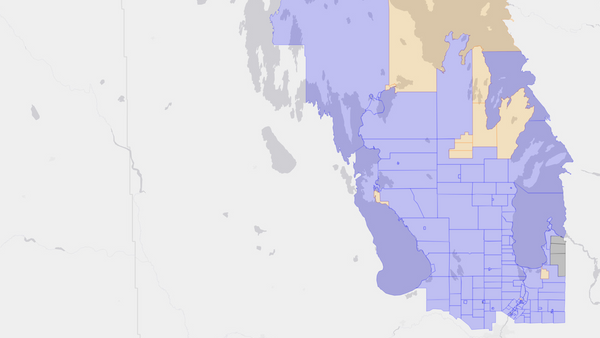
Churchill, MB — 2008 Federal Election Results Map
Churchill — 2008 Election Results
📌 The Canadian federal electoral district of Churchill was contested in the 2008 election.
🏆 Niki Ashton, the NDP-New Democratic Party candidate, won the riding with 8,734 votes (47.5% of the vote).
🥈 The runner-up was Tina Keeper (Liberal) with 5,289 votes (28.7%), defeated by a margin of 3,445 votes.
📊 Other notable candidates: Wally Daudrich (Conservative, 21%).
Riding information
Auto generated. Flag an issue.Churchill
Churchill covered close to three-quarters of Manitoba's land area — some 490,000 square kilometres of Canadian Shield, boreal forest and, at its northern edge, tundra meeting Hudson Bay. Thompson was the largest community, then The Pas and Flin Flon, with the town of Churchill at the end of the rail line and dozens of First Nations and settlements between them, many reachable only by air or winter road.
Candidates
Niki Ashton (NDP) — Born in Thompson and teaching there at University College of the North, Ashton was making her second run at the seat. She had taken the New Democratic nomination in 2005 from the sitting member, Bev Desjarlais, who left the party and ran against her as an independent in 2006, and she studied global political economy at the University of Manitoba. Her father, Steve Ashton, had sat for Thompson in the Manitoba legislature since 1981 and was the province's minister of intergovernmental affairs.
Tina Keeper (Liberal) — Keeper was the sitting member, elected in 2006. She came from Norway House Cree Nation and was known nationally as an actor, having played the RCMP officer Michelle Kenidi through six seasons of the CBC series North of 60. In Parliament she was the Liberal critic for public health and later for Canadian heritage, pressing the government on health services in First Nations communities and on the Kelowna Accord the Conservatives had set aside. The case of Jordan River Anderson, a child from her own community whose care was delayed by a jurisdictional dispute between Ottawa and Manitoba, was central to that work.
Wally Daudrich (Conservative) — Daudrich lived in Churchill and ran an ecotourism business there. From 1999 he and his wife Dawn hauled more than a thousand logs of fire-killed timber out of the bush to build the Lazy Bear Lodge by hand, and they ran Lazy Bear Expeditions taking visitors out to see polar bears and beluga whales.
Saara Harvie (Green) — Harvie, a health care aide from Flin Flon, stood for the Green Party.
About the Riding
Three resource towns carried the northern economy. Thompson existed because of nickel: the mine, mill, smelter and refinery complex begun by Inco in the 1950s and owned since 2006 by the Brazilian company Vale was by far the largest employer, and about 1,300 members of United Steelworkers Local 6166 ratified a three-year contract there in mid-September, with the campaign already under way — their first with the new owner. Flin Flon, on the Saskatchewan boundary, was a copper and zinc town, and The Pas a regional centre with a forest products mill and the farmland of the Carrot River valley beyond.
Churchill itself, a town of about a thousand with no road to the rest of Canada, depended entirely on the Hudson Bay Railway and the port at the end of it. Wheat moved by the Canadian Wheat Board made up the overwhelming bulk of what crossed the docks and most of what kept the line running. The Conservative campaign to end the board's single desk therefore read very differently here than on the southern prairies: the port's jobs and the viability of a railway that also carried groceries, fuel and medical travel were understood locally to be at stake.
Most of the riding's people were Indigenous, with Dene, Cree, Oji-Cree and Metis communities across the north and east. Norway House, Cross Lake, the Island Lake settlements, Shamattawa, Pukatawagan and dozens more faced overcrowded housing, boil-water advisories, schools in poor repair and health care that required patients to fly hundreds of kilometres to Winnipeg. The Kelowna Accord, the funding formula for on-reserve education, and the mechanics of getting a child's care paid for when Ottawa and the province each said the other was responsible were the arguments that mattered here. Distance governed the rest: winter roads were shortening, air freight set the price of food, and diesel generators powered places the grid never reached.