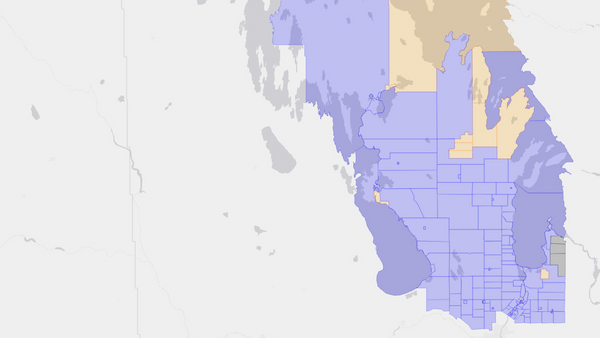
Dauphin—Swan River—Marquette, MB — 2008 Federal Election Results Map
Dauphin—Swan River—Marquette — 2008 Election Results
📌 The Canadian federal electoral district of Dauphin—Swan River—Marquette was contested in the 2008 election.
🏆 Inky Mark, the Conservative candidate, won the riding with 18,132 votes (61.4% of the vote).
🥈 The runner-up was Ron Strynadka (NDP-New Democratic Party) with 4,914 votes (16.6%), defeated by a margin of 13,218 votes.
📊 Other notable candidates: Wendy Menzies (Liberal, 14%) and Kate Storey (Green Party, 7%).
Riding information
Auto generated. Flag an issue.Dauphin—Swan River—Marquette
Western Manitoba's Parkland region supplied the shape of this constituency, which ran from the grain districts around Neepawa and Minnedosa north through Dauphin to the Swan Valley on the Saskatchewan boundary. Riding Mountain National Park and the Duck Mountains broke the farmland with escarpment forest, while Lake Manitoba and Lake Winnipegosis closed off much of the eastern side. Dauphin, a city of 7,906 at the 2006 census, was the largest centre, with Swan River, Minnedosa, Birtle, Grandview, Gilbert Plains and Ethelbert serving the districts around them, alongside First Nations including Waywayseecappo, Keeseekoowenin, Ebb and Flow, Pine Creek and Tootinaowaziibeeng.
Candidates
Inky Mark (Conservative) — Mark was born at Taishan, China, in November 1947. His father and grandfather had come to Canada years earlier but could not bring their families under the immigration law of the day; Mark and his mother left China in 1953 and the family settled at Gilbert Plains. He took a Bachelor of Arts at Brandon University and a Bachelor of Education at the University of Manitoba, then taught high school and ran a small business. He was elected to Dauphin's town council in 1991 and served as mayor from 1994 to 1997. Elected federally in 1997 as a Reform candidate, he had since sat as a Canadian Alliance member, in the Democratic Representative Caucus, with the Progressive Conservatives, and from 2004 with the Conservative Party. Campaigning for a fifth term, he argued that fuel prices fell hardest on rural drivers with no transit to fall back on, and that the Competition Bureau had no teeth.
Ron Strynadka (NDP) — Strynadka was retired and lived at Birtle. His campaign centred on the Canadian Wheat Board, which he said farmers wanted kept intact and expanded rather than dismantled.
Wendy Menzies (Liberal) — A teacher and musician from Neepawa, Menzies made bovine tuberculosis her signature file. She had written to Ottawa and met MPs on behalf of cattle producers around Riding Mountain National Park who had to test their herds because of infection in the park's elk, and said Ottawa had the means to help them.
Kate Storey (Green Party) — Storey farmed near Grandview. She campaigned on the squeeze between commodity prices and farm input costs, and argued for directing federal support into small business.
David Andres, an insurance broker from Ethelbert, ran for the Christian Heritage Party on rural road renewal, and Charles Prefontaine, a Winnipeg courier, stood for the People's Political Power Party of Canada on the Wheat Board question.
About the Riding
Bovine tuberculosis gave the riding a federal file of its own. Infection persisted in elk and deer around Riding Mountain National Park, and on 8 May 2008 the disease was confirmed in a five-year-old beef cow from a herd within ten kilometres of the park, inside the highest-risk portion of the Riding Mountain Eradication Area. Roughly 200 herds were scheduled for testing that winter and spring, and producers inside the zone faced repeated testing and movement restrictions after years of pressing Ottawa for compensation and an eradication plan.
Grain, oilseeds and cattle underpinned the economy, and 2008 was an anxious year for all three. Input costs had risen alongside fuel and fertiliser prices, and the future of the Canadian Wheat Board's single desk — contested in the courts and in Parliament since the government's 2007 attempt to remove barley from the board's authority — was argued over at coffee rows across the riding. Forestry mattered in the north, where the oriented strand board mill in the Rural Municipality of Minitonas, running since January 1996, was one of the Parkland's largest industrial employers; the collapse of American housing starts had the whole North American OSB sector cutting output through 2008.
Ukrainian settlers founded one of their earliest prairie colonies here in 1896, at Trembowla near the Drifting River, and the heritage stayed visible in church architecture and at Selo Ukraina, twelve kilometres south of Dauphin, home of Canada's National Ukrainian Festival each August long weekend. A substantial share of residents were Indigenous, and services and schooling on reserve were recurring concerns. Mark had held the seat since 1997, under a succession of party labels.