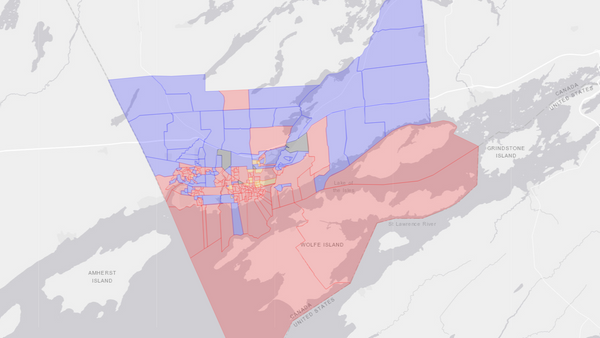
Leeds—Grenville, ON — 2008 Federal Election Results Map
Leeds—Grenville — 2008 Election Results
📌 The Canadian federal electoral district of Leeds—Grenville was contested in the 2008 election.
🏆 Gord Brown, the Conservative candidate, won the riding with 27,473 votes (58.4% of the vote).
🥈 The runner-up was Marjory Loveys (Liberal) with 8,075 votes (17.2%), defeated by a margin of 19,398 votes.
📊 Other notable candidates: Steve Armstrong (NDP-New Democratic Party, 14%) and Jeanie Warnock (Green Party, 10%).
Riding information
Auto generated. Flag an issue.Leeds—Grenville
This riding matched the United Counties of Leeds and Grenville together with the three separated municipalities inside them — Brockville, Gananoque and Prescott. It fronted the St. Lawrence River from Cardinal in the east to the Thousand Islands at Gananoque in the west, and reached inland through Augusta, Elizabethtown-Kitley and Rideau Lakes to Merrickville-Wolford and North Grenville.
Candidates
Gord Brown (Conservative) — Brown had held the seat since 2004, having first contested it in 2000 for the Canadian Alliance against Liberal Joe Jordan. Born in Toronto in 1960 and raised in Gananoque, he graduated from Gananoque Secondary School and took a political science degree at Carleton University in 1983. He raced kayaks out of the Gananoque Canoe Club, taking a national title and competing at the 1988 world championships. His public life before Ottawa ran through the 1000 Islands–Gananoque Chamber of Commerce, which he headed, a term on Gananoque town council, and the chair of the St. Lawrence Parks Commission, the provincial agency that runs Fort Henry and Upper Canada Village. He held an interest in a family business in the town.
Marjory Loveys (Liberal) — Loveys worked as a consultant.
Steve Armstrong (NDP) — Armstrong was a service controller in manufacturing and lived in Brockville.
Jeanie Warnock (Green Party) — Warnock grew up on her family's farm in Quebec and had worked as a horse-riding instructor and taught at the post-secondary level. She had carried the Green banner in the corresponding provincial riding at the 2007 Ontario election.
John McCrea, an arborist from Spencerville, also stood for the Progressive Canadian Party.
About the Riding
Brockville was the riding's largest community and its industrial anchor, a river city built on manufacturing and on its position on Highway 401. 3M ran plants there making pressure-sensitive tapes and occupational health and safety products, and Procter & Gamble made household cleaning and fabric-care goods at a second facility. Black & Decker's Canadian head office had long been based in the city, though the Brockville plant had lost its manufacturing work and roughly 300 jobs a decade earlier. A high dollar and a weakening American economy squeezed exporters through 2008, and manufacturing employment ran under every other local issue.
Gananoque, at the western end, marketed itself as the entrance to the Thousand Islands, living on cruise boats, marinas and seasonal accommodation. Prescott, downriver, kept a working harbour, the Fort Wellington national historic site and the Canadian end of the Ogdensburg–Prescott International Bridge, opened in 1960. Both towns were watching Washington. The air phase of the United States Western Hemisphere Travel Initiative had required passports for flights since January 2007, and the land and sea phase — covering every car, bus and boat crossing — was scheduled to take effect in June 2009. Tourism operators and border businesses along the river expected casual American day-trip traffic to fall away.
Inland the riding was farm country and lake country. Rideau Lakes and Merrickville-Wolford sit on the Rideau Canal, added to the UNESCO World Heritage list in 2007, which brought boaters through the summer. North Grenville, centred on Kemptville, was among the fastest-growing municipalities in eastern Ontario, roughly half an hour from downtown Ottawa on Highway 416; it also hosted the University of Guelph's Kemptville campus, an agricultural school founded in 1917. Athens, Cardinal and Westport rounded out a settlement pattern of villages separated by farmland and bush.
Local federal concerns followed the geography: manufacturing payrolls in Brockville and Prescott, an open and inexpensive border, water, sewer and road money for municipalities with modest assessment bases, and family doctors for scattered rural populations. The September financial crisis added urgency to all of it, particularly for firms selling into the United States.