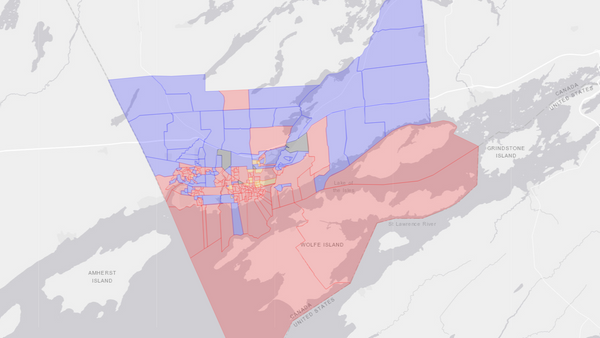
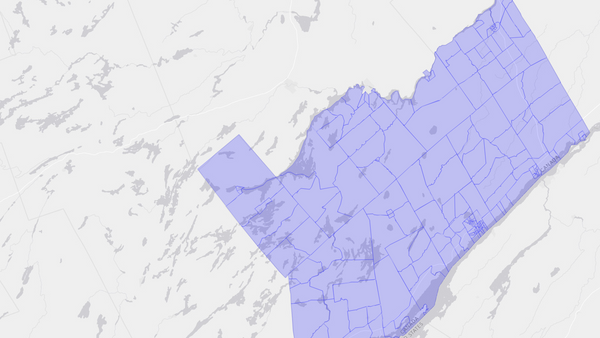
Lanark—Frontenac—Lennox and Addington, ON — 2008 Federal Election Results Map
Lanark—Frontenac—Lennox and Addington — 2008 Election Results
📌 The Canadian federal electoral district of Lanark—Frontenac—Lennox and Addington was contested in the 2008 election.
🏆 Scott Reid, the Conservative candidate, won the riding with 30,272 votes (55.9% of the vote).
🥈 The runner-up was David Remington (Liberal) with 11,809 votes (21.8%), defeated by a margin of 18,463 votes.
📊 Other notable candidates: Sandra Willard (NDP-New Democratic Party, 13%) and Chris Walker (Green Party, 9%).
Riding information
Auto generated. Flag an issue.Lanark—Frontenac—Lennox and Addington
Fifteen municipalities spread across three eastern Ontario counties were stitched into this riding, which covered roughly 8,500 square kilometres and ranked among the largest in southern Ontario. It began in Ottawa's commuter belt at Carleton Place and Beckwith, ran southwest through Perth and Smiths Falls, crossed the granite ridges and lakes of Frontenac County, and finished on the Lake Ontario shoreline at Bath and Amherstview.
Candidates
Scott Reid (Conservative) — Reid was the sitting MP and had been deputy government House leader since the Conservatives took office. Born in Hull, Quebec, in 1964, he holds a political science degree and a master's in Russian history from Carleton University. He wrote for the American journal Liberty and reported from Ottawa for Alberta Report in the early 1990s, publishing two books in that period, Canada Remapped and Lament for a Notion. His father, Gordon Reid, founded the Giant Tiger discount retail chain. First elected in 2000 in Lanark—Carleton, where he was one of just two Canadian Alliance MPs to win in Ontario, he ran Stephen Harper's Ontario organization during the 2002 Alliance leadership contest, took part in the 2003 merger negotiations, and moved to this riding when it was created in the 2004 redistribution.
David Remington (Liberal) — Remington lived in Napanee and worked as a program supervisor with the Ontario ministry responsible for children and youth services.
Sandra Willard (NDP) — Willard was a home care worker from Bath.
Chris Walker (Green Party) — Walker taught at the college level and lived at Inverary, north of Kingston.
Ernest Oliver Rathwell, a stationary engineer from Carleton Place, also appeared on the ballot under the Radical Marijuana label.
About the Riding
Smiths Falls dominated local economic news through the campaign. Hershey had announced in February 2007 that it would close the chocolate plant it had run in the town for decades as part of a North American supply-chain realignment. More than 650 people worked there, the shutdown was set for the end of 2008, and the wind-down was in its final weeks when voters went to the polls. What would replace that payroll was the central local question.
Perth, a short drive west along the Tay, kept the limestone commercial blocks of its early years as a military settlement and served as the Lanark County seat. Carleton Place and Beckwith, at the northeastern corner, were growing quickly as Ottawa commuter towns.
Frontenac County produced the riding's sharpest dispute. From late June 2007 members of the Ardoch Algonquin and Shabot Obaadjiwan communities, joined by local opponents of uranium mining, occupied an exploration site at the former Robertsville mine north of Sharbot Lake, arguing that Frontenac Ventures Corporation had been granted claims over land subject to unresolved Algonquin title and without adequate consultation. Injunctions, contempt proceedings and attempts at mediation followed, and the question of who must be consulted before mineral exploration on Crown land was still open when the writs were issued.
At the Lake Ontario end, the largest employer in Greater Napanee was the Goodyear tire plant, operating since 1988 and building passenger tires for the North American market, leaving the town exposed to the automotive downturn deepening that autumn. The villages of Loyalist Township looked to Kingston for work; Stone Mills and Addington Highlands to the north were farming and bush country.
Visitors carried much of the remainder, drawn by the Rideau Canal, listed by UNESCO in 2007, and by the cliffs above Mazinaw Lake at Bon Echo Provincial Park. Local federal concerns were those common to thinly settled country — patchy cellular and internet coverage, health care measured in driving time, and infrastructure money for municipalities with small tax bases.