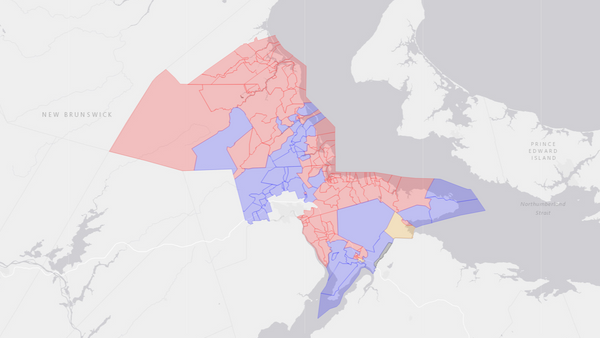
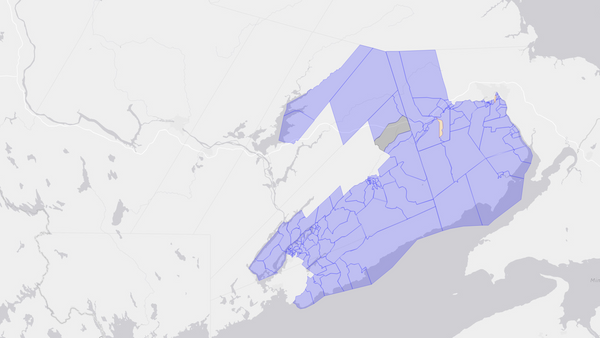
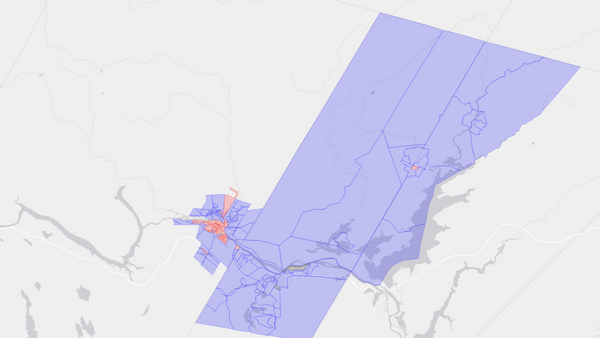
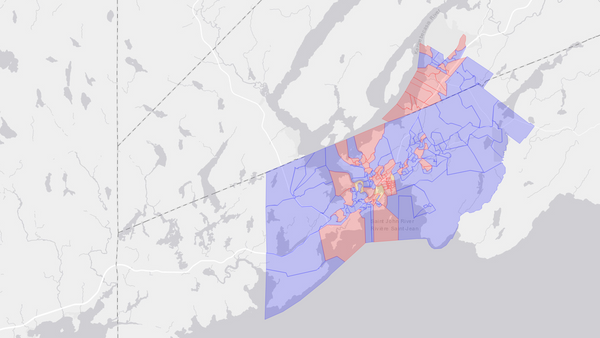
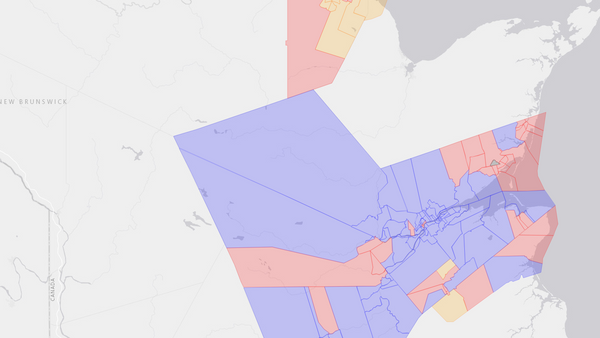
Moncton—Riverview—Dieppe, NB — 2008 Federal Election Results Map
Moncton—Riverview—Dieppe — 2008 Election Results
📌 The Canadian federal electoral district of Moncton—Riverview—Dieppe was contested in the 2008 election.
🏆 Brian Murphy, the Liberal candidate, won the riding with 17,797 votes (39.1% of the vote).
🥈 The runner-up was Daniel Allain (Conservative) with 16,297 votes (35.8%), defeated by a margin of 1,500 votes.
📊 Other notable candidates: Carl Bainbridge (NDP-New Democratic Party, 16%) and Alison Ménard (Green Party, 9%).
Riding information
Auto generated. Flag an issue.Moncton—Riverview—Dieppe
Statistics Canada designated Greater Moncton a census metropolitan area in the 2006 count, which also confirmed that it had passed Greater Saint John as New Brunswick's largest urban region. The federal riding covers the core: the entire city of Moncton, most of the town of Riverview across the Petitcodiac, and the city of Dieppe apart from its northeast corner beyond Melanson Road. About 89,300 people lived inside those lines at the 2006 census, just over 64,000 of them within Moncton itself. Close to two-thirds of residents report English as a mother tongue and about a third French, which makes this one of the most evenly bilingual constituencies in the country.
Candidates
Brian Murphy (Liberal) — Murphy was the sitting member, elected in 2006 to succeed Claudette Bradshaw. A Moncton lawyer, born in the city in March 1961, he won a council seat in 1992, unseated the incumbent mayor Leopold Belliveau in 1998 and was acclaimed for a second term in 2001, staying in the chair until 2004. Moncton declared itself officially bilingual in 2002 on his watch, the first Canadian city to do so. He backed Bob Rae in the 2006 Liberal leadership contest.
Daniel Allain (Conservative) — Allain had run the downtown business improvement organization Downtown Moncton Centre-ville Inc. as its executive director since 2004, and took a leave of absence to contest the seat. He had earlier worked as an assistant to Premier Bernard Lord, which gave him a grounding in provincial Progressive Conservative organizing in the city.
Carl Bainbridge (NDP) — Bainbridge, a driver contractor from Moncton, carried the New Democratic nomination.
Alison Ménard (Green Party) — Ménard, a Moncton lawyer, was the Green Party candidate.
About the Riding
Moncton's modern economy is the product of a forced reinvention. Railway employment in the city ran to about 6,000 in the steam era and the Canadian National shops were the reason Moncton took the industrial shape it did. Their closure in 1988 put roughly 4,500 people out of work. What replaced them, from the early 1990s, was customer-contact and back-office work, built on a labour force that could serve English and French markets out of the same building. By the 2000s dozens of contact centres employed several thousand people across the metro area, alongside a growing information technology sector.
Geography did the rest. Moncton sits where the Trans-Canada Highway meets the main rail corridor through the Maritimes, with roughly 1.3 million people inside a two-and-a-half-hour drive, which made it the natural distribution point for Atlantic Canada. The Greater Moncton International Airport handles passenger and freight traffic. Dieppe, majority francophone and the fastest-growing of the three municipalities, absorbed much of the region's new residential construction, while Riverview stayed largely residential on the south bank of the Petitcodiac.
Language shapes federal politics here more than any single industry does. The Université de Moncton, the centre of Acadian higher education, is a major institution and employer, and official-languages policy, funding for French-language institutions and Ottawa's posture toward Acadian cultural organizations are permanent local questions. Federal cuts to arts and culture programs announced in the summer of 2008 drew attention accordingly, and the Conservative campaign spent much of the autumn answering for them in francophone communities. Those arguments sat alongside the ones being made across the region that fall: how quickly the government would respond to a deteriorating economy, and how the competing tax and climate proposals would land in a metro area built on trucking, warehousing and highway freight.