Flap Jack

Jack Layton, in his own words:

Given that our obligations in Afghanistan will end in 10 months, Parliament should soon debate and vote on a new deployment. Can the Prime Minister tell us when the government will inform the House of its intentions concerning our troops in Afghanistan after February 2007? What is the timetable? (link)

I will ask the Prime Minister a simple question. Will he keep his promise to Canadians to ensure that there will be a vote on any further deployments, following February 2007, in Afghanistan? (link)

Will he now agree that there shall be a debate and vote in the House regarding any future troop deployment beyond February 7 in Afghanistan? (link) (on May 9th)

A vote should be held in this House on whether or not our troops should be deployed. There are questions about our role in Afghanistan, and there should be a vote on this, as we have been requesting for weeks. (link) (May 10th)

and here’s NDP foreign affairs critic Alexa McDonough:

There are increasing numbers of Afghans who are being killed, and I think we need to have a full debate and a vote on how we can best ensure that our troops have an achievable mission and that the people of Afghanistan are best served by the contribution we make. (link)

Stephen Harper, faced with calls for a debate and vote on an extension of the Afghan mission, said this today:

Members of this house have had five years to decide what their position is on this mission. We want to be sure that our troops have the support of this Parliament going forward.

What is the motion that MPs will be voting upon?

“that this House support the government’s two-year extension of Canada’s diplomatic, development, civilian police and military personnel in Afghanistan and the provision of funding and equipment for this extension.”

and the NDP response?

Appearing on CBC, Ms. McDonough called the move “premature” and said scheduling a vote immediately on the matter was “almost unprecedented.”

“This is a kind of Rambo-style approach to what is a deadly serious issue, and I think not respectful either of Canadians wanting to be engaged in this debate because they’re struggling with it … It’s certainly not respectful of our troops and others who are in harm’s way in Kandahar.” — Alexa McDonough

The Conservative move took the members of the Opposition off guard this week. Canada’s current mission in Afghanistan is scheduled to end in February, 2007. If the motion passes, that will be extended to February, 2009.

The NDP demanded a vote and now they’re getting one. Before, they demanded a take note debate and they got one. If a vote on extending the Afghan mission was so critical to Flap-Jack et al., then why are they so upset now?

The motion is clearly worded and the NDP has been asking for a vote for a while. Now they’re calling the move “not respectful of our troops”?

It’s time for the NDP to show their cards. Are they supportive of the work that is ongoing in Afghanistan? Will they vote to “bring home the troops” as some of their constituents demand?

The Conservative Party has been unambiguous in their support for the troops and their support of the mission in Afghanistan. Now Stephen Harper is giving the NDP what they wanted (regarding a vote). Was their interest in a vote merely a method to frame the PM as undemocratic on the issue of troop deployment? Now that the Conservatives are giving Parliament a chance to be counted on the issue, the NDP is angry that Harper has done so. Is the NDP being disingenuous?

UPDATE: Staples has more
100 days

Today marks the 100th day since Canadians voted for change on January 23rd. A friend asked me the other day whether Canadians voted to remove the Liberals or were they enticed to elect a new government. I pondered this question for a short time and found that the answer is a healthy mix of both. The Liberals under former Prime Minister Paul Martin had a shameful record while in government and during their first 100 days in power the Conservatives have provided Canadians with reassurance that the correct decision was made on that pivotal day in late January.

Let’s contrast the first 100 days of Conservative government (February 6th, 2006 – May 16th, 2006) with the first 100 days of the Liberal government under Paul Martin (December 12th, 2003 – March 21st, 2004):

In the first 100 days, the Conservative government can check off the following accomplishments.

When the Liberals were elected, the PMO under Paul Martin promised “100 days of action”. Unfortunately, they didn’t even live up to this promise.

  • Martin promised to address the ‘democratic deficit’. After only six days in office, his government invoked closure to cut off debate in the House of Commons and subsequently used time allocation in the Senate to force through the bill to allow for electoral re-distribution, to allow for an early election.
  • Of the legislation introduced by Martin’s government in the first 100 days, 21 one of the bills were exact duplicates of bills introduced by Chretien, just re-introductions of Chretien legacy legislation. The only ‘new’ legislation was a customs tariff bill and a bill on MP health benefits. The legislation had to be re-introduced after the Liberals prorogued Parliament, because Jean Chretien and Paul Martin couldn’t sit in the House together.
  • Martin’s Throne Speech commitments included promises that dated back to 1993 – such as replacing the Sea Kings or appointing an independent Ethics Commissioner. Similarly, the Martin Throne Speech reiterated many commitments made by the Chretien government – such as the Stryker purchase or the $2 billion for health care. In all, at least 39 promises outlined in Martin’s Throne Speech repeated, fully or in part, promises made in the 2002 Throne Speech.
  • Martin promised to increase Western representation, but had one fewer Western minister in his cabinet than Jean Chretien had.
  • Martin and his team spent their first 100 days in office continuing their war with their fellow Liberals, working to push out Liberal MPs who did not support Martin in the leadership race.
  • Martin was forced to call the Gomery Inquiry into Liberal corruption in the fallout from the sponsorship scandal
  • Martin’s advisors promised 100 days of action (National Post, October 20, 2003) and decision as they criticized the drift of the Chretien era. Instead, they delivered 100 days of scandal, 100 days of indecision, 100 days of spin and damage control, and 100 days of broken promises.

Tracking the trends

Google, the leading online search provider in the world, has released a new service called Google Trends. The service summarizes all Google searches by region and over time and plots the rising and falling trends.

This service will likely prove useful to many different organizations from music groups who might plan a special concert to the region with the greatest number of fans per capita (searching for them online) to political parties who’d like to track the buzz surrounding various issues in different regions and even that which surrounds themselves.

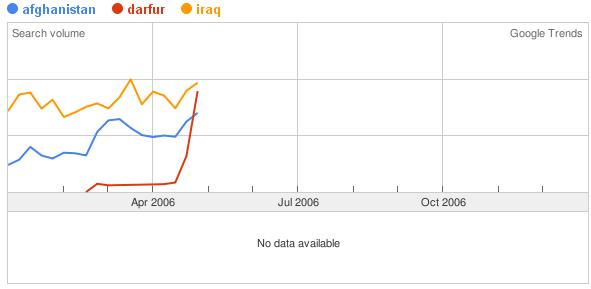
Armed conflict is always a hot topic among pretty much anyone, let alone Canadians that search Google. According to the search engine there are three particular armed conflicts that have Canadians looking for more information: Afghanistan, Darfur and Iraq. The Canadian military is currently involved in Afghanistan and recently the opposition parties have been trying to press the Conservative government to send troops to Darfur. The Conservative party has promised to come up with a plan for the troubled region with the international community and will likely promise action as long as it doesn’t come at the expense of our other international commitments (namely Afghanistan).

On first glance, it appears that the Sudanese region of Darfur is within the mindset of a greater number of Canadians than Afghanistan.

iraq-darfur-afghanistan.JPG

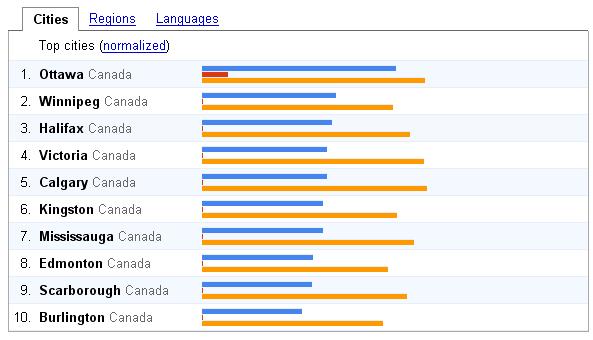
However, on closer inspection, it appears that Darfur is really only being researched in Ottawa rather than by the rest of the country. Certainly others in Canada are interested in Darfur, however, in reference to Canadians that search for information on Afghanistan; those that search for Darfur are in Ottawa.

Further, this data’s range only extends to approximately April 21st and opposition pressure on Darfur has only been significant in the past couple of weeks.

iraq-darfur-afghanistan-regional.JPG

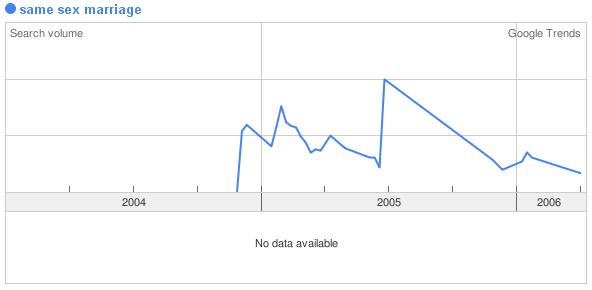
Same-sex marriage was a particularly contentious issue that peaked when the Liberal government extended the definition of marriage to include same-sex couples in 2005. During the previous election campaign, Stephen Harper was wise to inoculate the sensitive and extended campaign by putting the issue on the table during the first day and to do it on his own terms. After the campaign, the Conservatives said that a vote to determine if same-sex marriage should be re-opened would come ‘sooner rather than later’ in the new Parliament. According to historical Google search data, the issue is currently at an all-time low on the minds of Canadian (or at least those that use Google) and it is currently trending downwards. Would it be wise for the Conservative government to keep the issue off of the minds of Canadians while they present their case for a majority government?

same-sex-marriage-trend.JPG

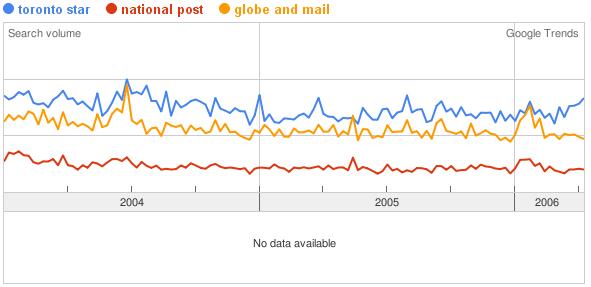
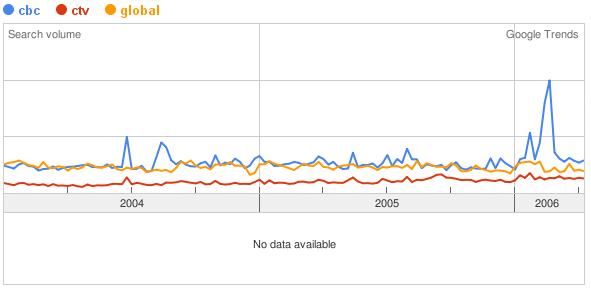
Here are a couple of interesting media comparisons:

star-post-globe.JPG

cbc-ctv-global.JPG

Surprisingly, the economically beleaguered Toronto Star leads in Google searches among Canadians while the Globe and Mail (which proclaims itself as Canada’s National Newspaper) trails the Star with the National Post in 3rd place. Perhaps the Globe and the Post should do more to reach out towards an online audience, however, online readership doesn’t necessarily translate into actual market share or profitability. This very issue will determine the new winners and losers of the news industry as the business model shifts.

Concerning television, it appears that CTV has less market share (at least among Googlers) than I thought, while CBC takes the top spot among the Canadian mindset with Global appearing to challenge until at least 2006. Then again, “global” means a lot more to Canadians than just TV and “Canwest” hardly registers on the graph because it hasn’t been properly branded as a television product (in my humble opinion). “Global” perhaps is too generic while “Canwest” is what’s on David Asper’s business card, not what’s on the minds of Canadians.

From the Aspers, to the Desmarais and all the Liberal kingmakers in between (that’s it, isn’t it?), let’s take a closer look at the Liberal leadership race.

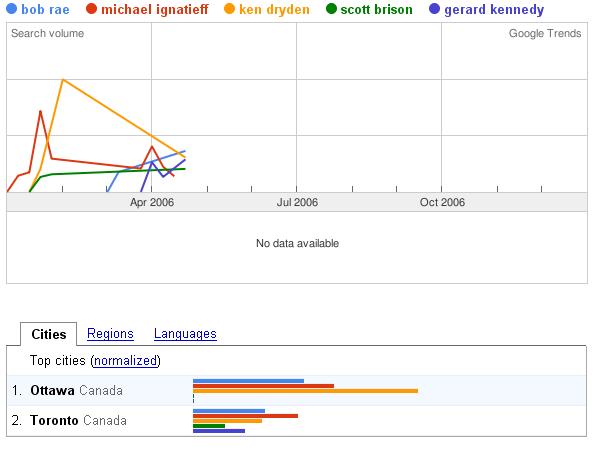
Google Trends only accepts five comparisons at one time, so I will compare the top five according to Google: Bob Rae, Michael Ignatieff, Ken Dryden, Scott Brison, and Gerard Kennedy.

lib-leadership-trends-1.JPG

As we can see from the graph, the race is certainly too early to call but there are a couple of interesting trends that we can discern from the graph. First, it appears that Michael Ignatieff may have burned out a lot of his ‘look at me, I’m important’ fuel a little too early on in the election. However, the data that is shown does not include Ignatieff’s launch on April 26th. Therefore, the data is quite incomplete. I am also particularly surprised by the amount of searches Ken Dryden has received so far in 2006. His name is certainly his best asset and it will be interesting to see if he can generate enough excitement (tip: don’t talk) to get enough delegates. A Dryden campaign should be based heavily on others promoting and speaking for Dryden. Scott Brison’s buzz appears as an insignificant plateau and therefore this Kyoto-hating Liberal enviromental critic needs to generate more buzz about his leadership campaign. Finally, from this data, we see that Rae and Kennedy are the only two that are increasing in their Google market share.

I’ve included the cities breakdown because it represents an interesting problem for the Liberals as well. The only two cities that Google finds as significant in regards to the Liberal leadership race are Ottawa and Toronto.

Finally, to get everybody arguing, here’s Google opinion on where the most hockey fans are (normalized per capita over the years 2004, 2005 and 2006).

hockey-fans.JPG