How refreshing!

Having spent a number of years at a Canadian university, it can often feel that one’s wandering through a parallel world when it comes to politics. Rational thought and reason are often be replaced by misinformed emotional appeal. Even though modern liberalism is generally the status quo in this country, some students still feel that they go against the grain of mainstream society when they buy local organic groceries, attend a Naomi Klein lecture on American “Imperialism”, volunteer under the OPIRG umbrella of “activism” or have a “squat-in” to raise awareness about poverty as they huddle together in their MEC fleece warmed by their Venti Chai Tea Lattes from Starbucks.

Anyway, I almost missed this but I found it heartening to see this release from my Alma Mater. It’s sure to ruffle a few progressive feathers and may inspire another student take-over of the principal’s office.

Statement by Principal Karen Hitchcock on the academic boycott of Israeli universities being considered by Britain’s University and College Union
Friday July 06, 2007

Academic freedom is deeply enshrined in the culture of Queen’s University. Its core tenets – freedom in research and publication, freedom of expression in the classroom and freedom from censorship for speaking out – are basic to the university’s central purpose and ingrained in our history and traditions.

The academic boycott of Israeli universities being considered by Britain’s University and College Union (UCU) is antithetical to the core value of academic freedom, which is cherished by Queen’s and other universities around the world.

Freedom of inquiry and expression carries with it responsibilities – to encourage open debate and dialogue, and to listen to and learn from the views of others. We must defend these freedoms of speech and inquiry even as we engage with those whose views may differ greatly from our own. Contemporary society calls for leadership that respects but can also bridge social, cultural, economic and geopolitical divides. I therefore denounce the actions of the UCU and absolutely reject its approach.

Those of us who devote ourselves to the learning and discovery that characterizes the academy must defend the freedom of individuals to study, teach and carry out research without fear of harassment, intimidation or discrimination.

Accordingly, I join with many of my colleagues from universities around the world in stating that, if the British UCU pursues its ill-advised course, we will have no choice but to ask the British UCU to add our name to their boycott list. We are proud to align ourselves with those who deplore the UCU’s unacceptable attack on the values and principles that define us.

July 6, 2007

As another school year starts, it’s good to see that the adults are still in charge and that the children… only win at sandbox politics.


Liberal candidate of record is a Conservative on the books

Meet Louise Boulanger, the Liberal candidate for the Quebec by-election in the riding of Roberval–Lac-St-Jean.

boulanger_headshot.jpg

Here is a picture of Jean-Pierre Blackburn, the Conservative federal government’s minister of labour:

blackburn.jpg

Here is a picture of Denis Lebel, the Conservative candidate for the same by-election for the riding of Roberval–Lac-St-Jean:

20070808-Lebel-Bio.jpg

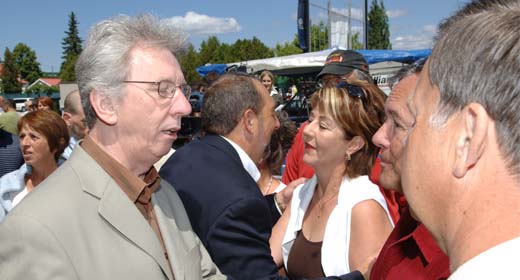
Here is a picture of Louise Boulanger, Denis Lebel, and Jean-Pierre Blackburn from the photo gallery of Denis Lebel’s website.

20070822-lebelgallery.jpg

The photo shows Lebel and Boulanger embracing with Blackburn in the foreground. Nothing too out of the ordinary, no?

There’s nothing wrong with a bit of friendly exchange between Conservative and a Liberal, of course. However, Boulanger is actually a Conservative Party member as suggested by the cover of La Presse this morning which contains the headline “ELECTION PARTIELLE: Louise Belanger, la candidate libéale dans Roberval est membre en règle du Parti… conservateur (By-election: Louise Belanger, the Liberal candidate in Roberval is technically a member of the Conservative Party)”

If true, Boulanger would have signed a form that includes the statement that she “actively support[s] the founding principles of the CPC” which are listed here.

However, Stephane Dion later “nominated” Boulanger to contest the riding of Roberval–Lac-St-Jean for the upcoming by-election, as a Liberal!.

Consider this quote from Boulanger concerning the Liberal Party having its affairs in order:

Je suis contente d’arriver à ce moment-ci parce que le ménage a été fait. Le parti est plus rigoureux sur la sélection des candidats. Notre chef Stéphane Dion est exigeant envers lui-même et exigeant envers les autres. Il désire s’entourer de gens fonceurs. Le Parti libeacute;ral est à son meilleur pour servir la population

(I am happy to have come to this moment here because the cleanup has been done. The party is more rigorous in the selection of candidates. Our leader Stephane Dion is demanding of himself and of others. He wants to be surrounded by go-getters. The Liberal Party is at its best to serve the population.)

If Boulanger is a member of the Conservative Party, that rigorous selection process must be in need of review.

Does the Liberal Party Constitution forbid members of other parties from contesting elections for the Liberal Party?

Republican story from ’72

Take a look at the following video from CBS’ evening news from 1972. There should be a few interesting elements for any viewer, no matter their political leanings.

First, we notice that the topic of election strategy has always been good fodder for news reporters. Often, the horse race and how it’s run can be more compelling than the policies or platforms forwarded by the candidates.

Of course, there is also the gem of a Dan Rather piece from 1972. Rather’s thesis on the Republicans this time? That they’ve set up a front operation for show. The purpose? To demonstrate that Nixon isn’t running too hard for re-election. Possible, I suppose. After all, news media was hardly as ubiquitous in those days and perhaps such deliberate steps were taken to fool Rather. But, thankfully, he’s not fooled.

Next, at the RNC, envelope cutters are opening cheques from a quarter of a million people for $2.5 million. The ‘grassroots’ ma ‘n pa cheques that come in is a strategy employed by today’s Conservative Party in Canada. The direct mail lists and personal greetings customized by computer based on issue is interesting and it’s fascinating to know the sophistication of the operation involving these tools back to 1972. Some American politicians still bank heavily on direct mail appeals. Once, when describing blogging to a senior republican, I told him it was like the next version of direct mail. Thankfully, he didn’t press me further on the comparison, but I felt that the generational analogy was cogent enough, if on some levels not at all.

Next, in the report we see, by today’s standards, laughable privacy concerns which may well have enraged people watching Rather back in ’72. A ‘computer’ stores the names of mail-order Idaho steak customers? Most definitely a frightful thought to more than a few back in the early 70s.

Robert Odell Jr. is interviewed and describes these methods as the way of the future for campaign finance, and while we can forgive him for not foreseeing the netroots appeals of Howard Dean and those that would follow in the use of blogs and social media in this first decade of the 21st century, Odell could be a certified futurist.

We then see an obligatory note to show that the broad ma ‘n pa appeal isn’t exactly perfect yet as ‘fat cats’ still pay hundreds of dollars for Nixon fundraising dinners.

And then those that went home early will be sorely disappointed as we see a chance interview between Dan Rather and a 21-year old Karl Rove who holds up a bumper sticker for the GOP reading Generation of Peace. At the time of the interview, Rove was charged with “embarrassing pundits” and to help the Republican Party appeal to youth. It’s interesting to see how small a family of political operatives can exist, even in countries like the US.

All in all, a fascinating story about the ‘future’ of political financing from direct mail, to personalized letters aimed at specific constituents based on targeted issues. One wonders how the current cutting-edge methods of voter identification, fundraising and media balancing will be viewed 35 years from now.