Announcing GIS.tools!

I want to tell you about a new website I’ve made called GIS.tools.

Many of you may know that I enjoy making maps. Online maps. Maps that show us about our world and the data that defines it. I know that puts me in a bit of a rare category of nerdism, but I do enjoy creating them.

My political mapping project continues to gather interest and I often get complimented on it when I go to political conventions. It’s an easy way to find the other political map nerds who travel.

Yes, there’s maybe a couple of dozen of us in Canada – maybe it’s time to start a group chat?

Until then, I continue to scratch the itch and push new frontiers of learning. And that is this project that I’ve been working on with my AI co-workers.

What I’ve built is an extensive online tools website for map makers and I even landed it on GIS.tools.

Yes, that’s the domain name.

I always say the best name for a product is exactly what it is!

For those not in the know, GIS is Geographical Information Systems – the framework for capturing, managing, analyzing, and displaying all types of spatial or location-based data. People who make maps work in the field of GIS.

As you can imagine, there are lot of data in map making, and there’s a lot of file manipulation – often between different file standards from different eras. From Shapefiles, to KML, to GeoJSON – every map nerd has their preference.

Since I never paid for any expensive mapping software, or bothered to learn more than the basics of some of the free products, I’d keep finding myself googling specific online converters, calculators, and raster tools and finding them on a hodgepodge of various websites.

And sometimes the tools just weren’t out there.

So, I’ve been using AI to code these tools and collect them in one place.

I built a Swiss Army knife for map makers.

The result of that effort is GIS.tools.

It has more than 100 GIS tools. From Shapefile to GeoJSON converters, to GeoJSON validators, linters, and fixers, to Hillshade generators, the site probably has what you’re looking for.

And because we live in the current age, I also quite easily translated the website into six different languages. So, French, Spanish, German, Japanese, Korean, and Chinese mapmakers aren’t left out either.

So whether you need an EPSG Reprojector, a CRS Metadata Inspector, an MBTiles validator, or a Heatmap renderer, or are just learning about the tools of the trade, please do check out the site.

Most tools even have example data so you can get an idea of what they do!

You’re probably a fellow map nerd if you’ve read this far. And knowing my people, you probably have a website too. If you appreciate this sort of thing being out in the world for free, I’d appreciate a link so that others can discover it too!

Commissioner of Canada Elections is flooded with complaints

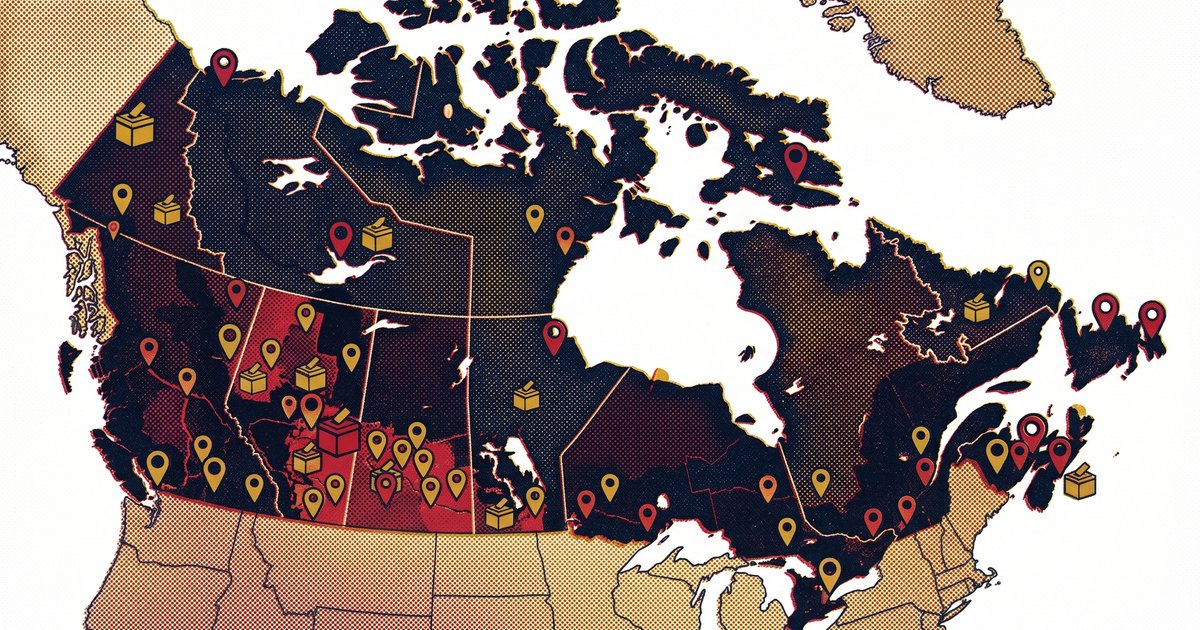
The Commissioner of Canada Elections has released statistics about complaints received during the 45th general election, which saw Mark Carney’s Liberal party elected as to a minority government.

The office responsible for ensuring compliance with and enforcement of the Canada Elections Act received 700% more complaints than in the previous election. That’s 650 complaints per hour during the campaign!

Canadians filed 16,115 grievances with the office. These ranged from allegations of foreign interference to reports of unauthorized election advertising, voters posting images of their ballots on social media, and failures by third-party advertisers to register. Third-party advertisers are allowed to promote during elections but must first file the proper forms with Elections Canada.

Amusingly—and perhaps predictably—the vast majority of complaints reviewed so far have been deemed out of scope for the Commissioner. That’s a more technical way of saying the complainants didn’t have a case.

Due to the high volume, most complaints remain unprocessed. As of June 25, the office had only reviewed 2,330 of the 16,115 complaints.

The Commissioner noted that many complaints were the result of a general ignorance of the law.

As an interesting aside, the office had expected far more complaints related to artificial intelligence and disinformation, but such concerns turned out to be overblown in the lead-up to the election.

In case you were worried: so far, the Commissioner has found no evidence that any of the complaints processed to date had an effect on the final results of the election.

Elbows Down for Mark Carney on the Digital Services Tax

A late-night, long-weekend post from the GC Newsroom X account indicates that the Government of Canada is backing down on the Digital Services Tax, following an explicit threat from U.S. President Donald Trump.

The US President threatened to immediately cease all trade negotiations with Canada until the tax issue was resolved.

During this year’s general election, Carney famously adopted an “Elbows Up” approach to Donald Trump, reassuring Canadian boomers that he would defend national sovereignty and stand up for Canadian interests.

For his part, Trump mused that Canada would be better off as America’s “51st state” and breathed life into the Liberal Party, instilling just enough fear in Canadians to buy into Carney’s promise to stand up to Trump.

But the election is over – and now Carney appears to have rolled over on a core Liberal policy.

The Digital Services Tax would have imposed a 3% levy on revenue from digital services like online advertising, social media, and user data sales by large tech companies.

It was originally set to be retroactive to 2022, with the first payments due on June 30, 2025. The tax targeted firms like Amazon, Google, and Meta, and U.S. companies faced an estimated $2-3 billion bill.

Both Donald Trump and former President Joe Biden have opposed the DST, viewing it as discriminatory against American firms.

On June 27th, this came to a head with Trump announcing the immediate termination of all U.S.-Canada trade talks, calling the DST a “direct and blatant attack” on the U.S. He threatened new tariffs within seven days, citing Canada’s refusal to pause the tax.

Earlier this month, Canadian Foreign Minister Francois Phillipe Champagne promised that the DST would go through as planned.

Rick Tachuk, President of the American Chamber of Commerce in Canada advocated for a pause of the Digital Services Tax in an op-ed published just five days ago.

The Liberals promised to introduce the tax during the 2019 general election and the Parliamentary Budget Officer had projected it could raise $7 Billion from US companies over 5 years. Its implementation had been delayed to bring others – in particular the EU – onside.

Canada has faced renewed pressure from its primary trading partner since re-electing Donald Trump as President in 2024. Trump argues he’s simply correcting a trade imbalance between the U.S. and Canada. His trade policy has had significant effect on key Canadian industries such as steel, aluminum, and auto manufacturing.

Meanwhile Canadian Prime Minister Mark Carney – elbows up or not – is finding that Canadians are starting to question his ability to handle the pressure – given how quickly this collapse has come.