Mark Carney helped write the playbook that just sank Keir Starmer
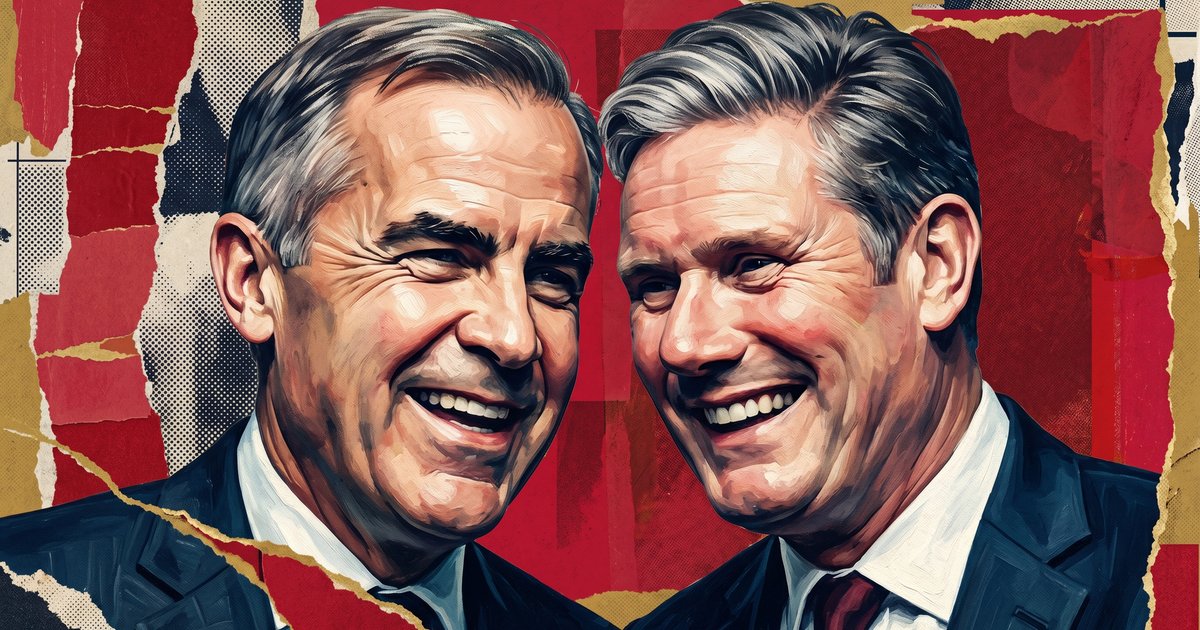
Keir Starmer resigned as British prime minister on June 22, the worst-polling Labour leader on record, undone by a program of tax rises, paternalism, and managed decline. Mark Carney endorsed the chancellor who built that program, sat on the task force that delivered its centrepiece, and is now running a version of it in Canada.
Keir Starmer resigned as prime minister of the United Kingdom on Monday, less than two years after winning a political landslide. His favourability rating sits among the lowest YouGov has recorded for any prime minister, beaten only by Liz Truss in her final days. His party lost roughly 1,500 council seats and 35 councils in May, surrendered the Welsh Senedd after a century of Labour control, and watched Reform UK turn a protest vote into a governing threat. Andy Burnham will likely take the keys to a government that has nowhere left to fall.
The British press is writing the story as a personal failure: a dour lawyer who could not communicate, outflanked by populists he did not understand. That account misses the part Canadians have a direct stake in. The program Starmer governed by — the assumptions about taxation, the climate planning, the digital paternalism, the reorientation of an economy by ministerial direction — was not improvised in Downing Street. Mark Carney helped assemble it, blessed the people who ran it, and is now governing Canada from the same blueprint.
For deeper analysis and exclusive posts, subscribe to my Substack.
How Mark Carney helped build Labour's economic program
In October 2023, with Labour still in opposition, Carney appeared by video at the party conference in Liverpool to endorse Rachel Reeves as the next chancellor of the exchequer. He called her "a serious economist" who "understands the big picture," and the endorsement did real work: it rubber-stamped Reeves's "iron chancellor" pitch with the authority of a former Bank of England governor. The month before, Carney had met Starmer in Montreal at a progressive summit to discuss economic policy. After Labour won, he joined the task force that produced the government's National Wealth Fund, the state-capital vehicle meant to direct money into politically chosen industries. By early 2026, British government sources were citing Carney's worldview as a template for Starmer himself.
The relevance for a Canadian voter is direct. The man now running Canada vouched for the British experiment's architects and helped lay one of its foundation stones. When it collapsed, it collapsed on policies he had endorsed in public.
Starmer's hollow majority and Carney's floor-crossing majority
Starmer's 2024 victory looked overwhelming at 412 seats, but it rested on 33.7% of the vote, the lowest share ever to produce a Commons majority. Two-thirds of the people who voted had backed another party. Labour kept its 412 seats, but within eighteen months the public support behind the government had collapsed.
Carney's mandate is thinner still, and cynically assembled. The Liberals won 169 seats in April 2025, three short of a majority. Rather than govern as a minority answerable to the House, the government went shopping for the votes it had failed to win. Five opposition members crossed the floor in what the CBC called a wave "unmatched by other recent minority governments": four Conservatives in Chris d'Entremont, Michael Ma, Matt Jeneroux, and Marilyn Gladu, plus New Democrat Lori Idlout. Conservative members have said the Liberals were working on them too, one of them caught admitting it on a hot mic. Asked about it, Carney offered that he is "often the last to know."
Starmer's supermajority was hollow because voters never really gave it. Carney's majority is synthetic because voters never consented to it — it was stitched together after the election from members elected under other banners. Both rest on the same presumption. Each man is sure he already has the right answers, which makes a real mandate feel optional: get the votes however you can, then govern as planned. Britain has just shown how that ends when voters disagree.
Carney's "build big" agenda and Starmer's tax-and-spend record
Rachel Reeves, Starmer's chancellor of the exchequer, was the figure Carney had endorsed for the job a year earlier. Her first budget, in October 2024, delivered the largest tax rises at a single fiscal event since 1993, roughly £40 billion, and pushed Britain's tax burden to the highest level in its recorded history. The centrepiece was a rise in employers' National Insurance, a tax on the act of hiring, sold as a way to protect "working people" that fell on the firms that employ them. Weeks earlier the government had stripped the winter fuel payment from around ten million pensioners with no warning, a £1.4-billion saving announced out of the blue that it later reversed after the damage was done. The pattern was constant: extract revenue, direct it from the centre, retreat under pressure, and call the whole arrangement a plan for growth.
Carney's Canadian program works the same way under a more appealing name. The British National Wealth Fund he helped design has a Canadian twin: the $25-billion Canada Strong Fund, which he unveiled as the country's first sovereign wealth fund and said was modelled on Norway. As I argued when he announced it, the label does not hold up. A sovereign wealth fund saves a surplus; Ottawa was, at the time, running a $78-billion deficit, so the Canada Strong Fund is borrowed money dressed up as national savings. The rest of the pitch is "build big": major projects greenlit from Ottawa and a promise to double exports to non-American markets within a decade. The assumption is identical to the one that sank Reeves: that a sufficiently clever centre can allocate capital better than the people who earned it, and that the bill can be deferred indefinitely. The Globe's John Rapley, no conservative, warned Carney directly to learn from Starmer — that promising better services, more spending, and no painful taxes at once is the contradiction that hollowed out the British government from the inside. Britain's reward for trying was government borrowing costs that became the most expensive in the G7.
Carney's net-zero central banking and carbon-price agenda
Where Carney's worldview is most fully his own is climate. Long before Canada, as governor of the Bank of England, he used the central bank to enlist the financial system in net-zero planning. His 2015 Lloyd's speech recast climate change as a threat to financial stability that justified central-bank action — climate disclosure rules, climate stress tests, and a call for governments to set a carbon-price "corridor" with floors and ceilings. It was the founding text of a movement to govern emissions through unelected financial authorities rather than through voters. Not everyone in Britain was persuaded that the governor was even minding his actual job; Jacob Rees-Mogg's verdict on his monetary record was that he was "hopeless".
The same instinct now shapes Canadian industrial policy. Carbon pricing raises costs that voters would reject if they were asked directly. They are not asked: the decisions sit with officials and regulators no one can vote out, and the targets are dated so far ahead that no election can assess whether they will be met. In Britain, high energy costs and a stagnant economy were exactly the conditions Reform UK fed on. The assumption that citizens can be planned toward a target they did not choose does not become more popular for being administered by a man with a Davos pedigree.
Bill C-34 and the UK's under-16 social media ban
The clearest evidence that this is one program in two countries arrived this month, and it was not a coincidence of timing. On June 10, Carney's government tabled Bill C-34, the Safe Social Media Act, barring Canadians under sixteen from social media, requiring platforms to verify the age of every user, and creating a new Digital Safety Commission to police the regime, on penalty of fines up to 3% of global revenue. Five days later, on June 15, Starmer announced the British equivalent — an under-16 ban covering the same platforms, enforced by age checks on all users. Carney and Starmer weren't operating in silos. Starmer said he expected to raise online safety with other leaders at the G7 summit in France, and Carney noted that countries would be on the same page about acting on artificial intelligence and child safety. The bans are one front in a coordinated push among like-minded governments: Australia first, then Canada, Britain, France, Spain, and the European Commission's coming Digital Fairness Act, each lending the others the cover of consensus. The point of coordinating is precisely that no single electorate gets to weigh the measure on its own; by the time it reaches any one Parliament, it arrives as what everyone is already doing.
The British version drew a warning Canadians should read before C-34 reaches committee. Verifying that a user is over sixteen requires verifying everyone, which means submitting identification to open an account and ending anonymous use of the internet. Big Brother Watch called it the imposition of ID checks as "the price of admission to the internet," a step "authoritarian regimes can only dream of," and 438 security and privacy researchers from 32 countries signed a joint statement calling for a moratorium on age-assurance technology. Starmer defended it as a parent rather than a prime minister — the tell of every government-knows-best measure, the appeal to emotion that excuses the reach for control. C-34 carries the same architecture and will require the same surveillance to enforce. It arrives in a Parliament whose government is already advancing a lawful-access bill to lower the threshold for police to obtain Canadians' subscriber data, Bill C-22.
Canada is importing the EU's digital regulation rulebook
The model Canada is importing is European in origin and design — the architecture of the EU's Digital Services Act, the same age-assurance regime, the same standing regulator. The countries adopting it did not arrive at it independently; they took a common template off the shelf. Bill C-34 creates a Digital Safety Commission, a Brussels-style permanent bureaucracy with the power to police speech and access on an ongoing basis, and the European Commission's coming Digital Fairness Act is the next template in the queue. Carney's broader posture has been a deliberate tilt toward Europe and away from the United States. Digital regulation is a clear example of it, with Canada adopting the European rulebook clause by clause.
The rulebook reaches well beyond children. The EU's digital regime doubles as industrial policy by other means. In 2025, every euro of the bloc's €3.77 billion in Big Tech fines fell on American firms, Google, Apple, Meta, and X, because Europe builds almost no large platforms of its own to fine. Across 2024 and 2025 the penalties topped $7 billion, all of it levied on companies headquartered in the United States. Europe regulates the industry it could not create, and the rules are written so the bill lands on the Americans.
For Canada the sovereignty cost runs in two directions at once. Adopting a regime authored in Brussels, for European purposes, subordinates Canadian regulatory judgment to an agenda set by a bloc Canadians do not vote in. And aiming that regime at the platforms Canadians actually use means picking a regulatory fight with the country's largest trading partner at the precise moment a trade war with Washington is counterproductive to say the least. A government that markets itself as the defender of Canadian sovereignty is busy outsourcing the country's internet governance to a foreign capital — and importing that capital's quarrel with American technology as though it were Canada's own.
Why Carney's popularity won't outlast the Starmer playbook
The obvious objection is that Carney is popular, around 62% approval where Starmer was radioactive, so the comparison must be wrong. Starmer also began with positive numbers and a landslide. What separates the two leaders is timing and circumstance; their governing substance is the same. Anxiety about Donald Trump has bought Carney a long honeymoon and given voters a reason to look past the contradictions in the plan, which is more than Starmer ever had. Honeymoons end when the bills arrive.
Look to Britain for the receipt of what this program costs. The same assumptions — that the centre allocates capital better than citizens, that climate targets justify reaching around the electorate, that adults require the state's permission to use the internet, that a mandate is a technicality — were tested in a comparable Western democracy and rejected within two years. Mark Carney helped write that program and endorsed the people who ran it. He is now running it here, with a majority the voters never granted him. The only open question is whether it will be sooner or later that Canadians see the tab, and the democratic debt, that Carney is racking up on this side of the Atlantic.
Related Posts

Trump Has Carney on a Leash
Mark Carney was elected to stand up to Donald Trump. But Trump controls the policy levers that determine the value of Carney's largest financial interest. The…

The surveillance powers the Canadian left condemns abroad and builds at home
The U.S. Supreme Court is weighing whether police can force Google to hand over the location of every phone near a crime scene. American licence-plate cameras…
Airlines owe Brookfield's partners rent. The government just sent $150 million to keep them paying.
The fuel crisis has doubled jet fuel prices. Airlines are cutting routes and requesting lease deferrals from their lessors. Today the government announced $150…