Airlines owe Brookfield's partners rent. The government just sent $150 million to keep them paying.
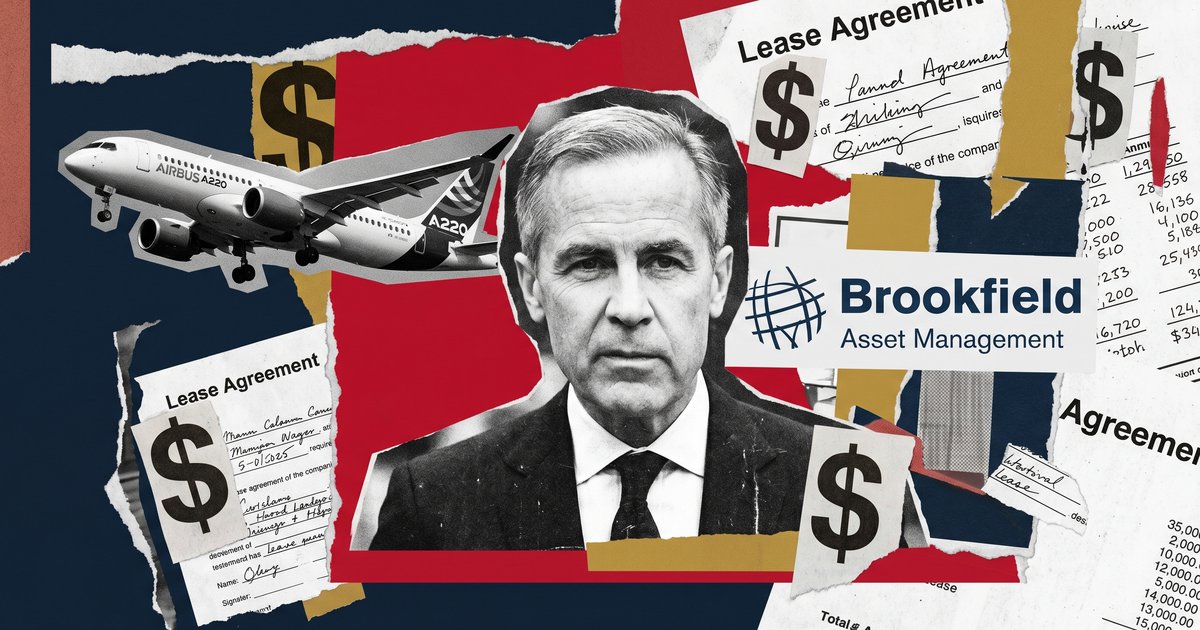
This post is part of an ongoing series on Brookfield and Mark Carney's conflict of interest. Previously: the ethics screen, the lobbying data, the policy matrix, the international precedents, the enforcement office, and the aviation deal at Mirabel.
Jet fuel has doubled since February. Canadian airlines are cutting routes, requesting lease deferrals, and bleeding cash. Today the government announced $150 million in bailout loans for the airline sector — the second intervention in a sector Carney's ethics screen flags for scrutiny. Meanwhile, the airlines receiving this money lease their jets from Brookfield's aviation partner SMBC Aviation Capital — the same company that holds the order book for every A220 that Brookfield has on order at Mirabel. The government is propping up Brookfield's customers with public money. Fasten your seatbelts.
On June 8, 2026, Finance Minister François-Philippe Champagne announced the Liquidity for Airline Sector Resilience program — $150 million in repayable loans for Canadian airlines experiencing "significant financial pressures resulting from elevated jet fuel costs." Airlines that take the money must keep flying Canadian routes, protect jobs, cap executive pay, and meet "Buy Canadian" obligations. The loans are administered through the Canada Enterprise Emergency Funding Corporation — the same body that bailed out Air Canada during COVID.
For deeper analysis and exclusive posts, subscribe to my Substack.
Five weeks earlier, on May 6, Prime Minister Mark Carney stood in the Airbus hangar at Mirabel to announce 150 new A220 orders from AirAsia. Four weeks before that, Brookfield completed its acquisition of Air Lease Corporation — one of the world's largest A220 customers.
Carney's conflict-of-interest screen comes with a checklist — an "Assessment Tool" maintained by the Privy Council Office, the department that supports the Prime Minister — and that checklist flags "the airline industry" as one of six sectors requiring case-by-case scrutiny. Two major airline-sector interventions in five weeks. Here's the connection.
The fuel crisis
The Strait of Hormuz crisis — triggered by the US-Israeli air campaign against Iran in late February — has cut off roughly a quarter of the world's seaborne oil trade. Jet fuel prices have surged more than 120% since the onset of hostilities, reaching $1,838 per tonne in early April before stabilizing above $1,500 — more than double pre-war levels.
The impact on airlines has been immediate. IATA forecast on June 7 — one day before the government's announcement — that global airline profits would be halved in 2026 — from $45 billion in 2025 to $23 billion this year. Industry fuel costs are expected to rise from $252 billion to $350 billion.
Canadian carriers have already started cutting. Air Canada suspended routes it described as "no longer economically feasible." WestJet cut flight capacity by up to 6% through June. Air Transat reduced flights. In the United States, Spirit Airlines ceased all operations in May, citing fuel costs.
The government's $150 million loan program responds to a real crisis. That is not in dispute. What matters for the conflict-of-interest analysis is who else benefits when the airline industry receives a government lifeline.
The lease deferral problem
Airlines don't own most of their aircraft. They lease them. When fuel costs double and airlines cut routes, the first thing that happens — before layoffs, before restructuring — is that airlines ask their lessors for rent deferrals.
Ishka, the aviation intelligence firm, reported on April 24 that lessors were confirming rising deferral requests from airlines hit by high fuel prices and the Strait of Hormuz disruption. Extended flight cancellations and route reductions weaken airline cash flows, raising the risk of rent deferrals, restructuring requests, and lease defaults — particularly among carriers without fuel hedging protection.
Morgan Lewis, in a May 2026 analysis, warned that "as airlines come under pressure from rising fuel costs and operational disruption, their ability to meet lease obligations is increasingly under strain."
This is a lessor problem. Airlines that can't pay their lease obligations cost their lessors money. When airlines defer rent, the lessor's revenue drops. When airlines default entirely, the lessor repossesses aircraft at depressed values. The fuel crisis is not just an airline crisis — it is an aircraft leasing crisis.
Enter Brookfield, where Prime Minister Mark Carney holds stock options and carried interest. The world's newest major aircraft lessor is Sumisho Air Lease, in which Brookfield holds an 18.75% economic interest worth approximately $5.3 billion.
Who leases jets to Canadian airlines
On April 8, 2026, the Brookfield-Apollo-Sumitomo-SMBC consortium completed its $28.2 billion acquisition of Air Lease Corporation, renamed Sumisho Air Lease. As part of the deal, Air Lease's order book — including 76 firm A220 orders, all Mirabel-built — transferred to SMBC Aviation Capital. SMBC now services the majority of Sumisho Air Lease's 490-aircraft portfolio. The combined platform covers over 1,700 aircraft serving more than 170 airline customers.
Two weeks later, on April 24, SMBC Aviation Capital delivered its first Airbus A321XLR to Air Canada — the start of a 15-aircraft lease agreement. Air Canada's total A321XLR order is 30 aircraft: 15 leased from SMBC, 15 purchased directly from Airbus.
SMBC also leases aircraft to WestJet.
To be precise about the ownership structure:
| Partner | Voting Rights | Economic Interest |
|---|---|---|
| Sumitomo Corporation | 47.51% | 37.51% |
| SMBC Aviation Capital | 4.99% | 24.99% |
| Apollo | 23.75% | 18.75% |
| Brookfield | 23.75% | 18.75% |
Brookfield and SMBC Aviation Capital are consortium partners in Sumisho Air Lease. SMBC services the fleet. SMBC holds the order book. SMBC delivers aircraft to Air Canada and WestJet. These are the same Canadian airlines that are now eligible for $150 million in government support.
The financial mechanism is direct: government support keeps airlines solvent. Solvent airlines pay their lease obligations on time. Lease revenue flows to Sumisho Air Lease. Brookfield holds 18.75% of the economic interest. Mark Carney is keeping those wheels greased.
When airlines request rent deferrals, Brookfield's aviation holdings lose value. When the government intervenes to prevent that, Brookfield's aviation holdings are protected.
Castlelake — again
The Brookfield aviation exposure does not end with Sumisho Air Lease.
As documented in my previous post, Brookfield holds a 51% stake in Castlelake's fee-related earnings, a Minneapolis-based alternative investment manager with $21 billion in aviation investments, more than 650 aircraft acquired, and relationships with approximately 200 airlines. Castlelake also operates Merit AirFinance, which provides debt capital to airlines and leasing companies.
Castlelake's business model is explicitly about financing airlines and lessors. When the airline industry is in crisis, Castlelake's entire portfolio is under pressure. When governments step in to stabilize airlines, Castlelake's portfolio is protected.
Combined, Brookfield's aviation footprint through Sumisho Air Lease and Castlelake encompasses roughly 500 owned aircraft, 650+ aircraft acquired through Castlelake's funds, and an order book of hundreds more. CreditSights noted that the fuel shock is accelerating a two-tier recovery, with lessors holding new-generation, fuel-efficient fleets best positioned. Sumisho Air Lease's A220 fleet — the newest narrowbody on the market — falls squarely on the winning side of that divide.
"Buy Canadian"
The government's airline support facility includes a condition that participating airlines meet "Buy Canadian" obligations. The announcement does not define what this means for fleet procurement decisions. But the A220 is a Canadian-designed, Canadian-built aircraft. Air Canada operates over 40 A220-300s with more than 20 still on order from a total firm order of 65, all assembled at Mirabel.
If "Buy Canadian" extends to fleet renewal decisions — and it would be unusual for an airline bailout condition to exclude the largest single procurement category — it could channel future orders toward Mirabel-built aircraft. Every A220 order benefits the production line that builds Brookfield's Sumisho Air Lease fleet.
The government attached the same phrase — "Buy Canadian" — to a sector where Brookfield's interests are directly engaged. Whether PCO considered this when drafting the conditions is not known.
The CEEFC precedent
The Canada Enterprise Emergency Funding Corporation is not new to airline bailouts. During the pandemic, CEEFC administered the Large Employer Emergency Financing Facility, which provided:
| Year | Airline | Amount |
|---|---|---|
| 2021 | Air Canada | ~$5.9 billion |
| 2021 | Sunwing Vacations / Sunwing Airlines | $375 million |
| 2021 | Transat A.T. | $700 million |
Those were pandemic loans. Today's program responds to a fuel crisis. The amounts are smaller — $150 million versus billions — but the institutional mechanism is identical: government loans to airlines through a Crown corporation intermediary.
During the pandemic, Brookfield did not hold a leasing portfolio of 490 aircraft. Sumisho Air Lease did not exist. The Castlelake acquisition had not closed. Brookfield's aviation exposure was a fraction of what it is today.
The CEEFC is administering a second airline bailout at the precise moment when Brookfield's aviation holdings are larger than at any point in the company's history.
The Assessment Tool — again
The Privy Council Office's Assessment Tool — the framework designed to determine whether Carney's financial interests in Brookfield create a conflict — identifies "the airline industry" as one of six sectors where Brookfield's interests are "largely concentrated" and where "case-by-case assessment" is required. The tool specifically references "investments in airlines/aviation; airline ownership rules/industry consolidation as well as fare pricing."
A $150 million government loan program for the airline sector is, by definition, a policy decision related to investments in airlines. It involves fare pricing (the fuel surcharges airlines are passing to consumers). It involves industry consolidation (Spirit Airlines has already ceased operations; others may follow). It involves the financial health of the exact airlines that lease aircraft from Brookfield's consortium partner.
In my previous post, I applied the Assessment Tool's seven questions to the Mirabel announcement and found that most produced uncomfortable answers. The same exercise applied to the airline bailout yields similar results:
Question 1: Is the Prime Minister involved? The announcement was made by the Finance Minister, not the PM. But the CEEFC reports through CDEV, a Crown corporation. The decision to deploy $150 million in public funds through CEEFC is a cabinet-level decision.
Question 3: Are the interests of one of the Companies involved? The airline industry is a flagged sector. Brookfield holds 18.75% of Sumisho Air Lease, which services more than 170 airline customers through SMBC Aviation Capital, including Air Canada and WestJet — airlines eligible for these loans.
Question 5: Broad class? Canadian airlines eligible for the loans include Air Canada, WestJet, Porter, and Air Transat. This is a small group. SMBC Aviation Capital has an active leasing relationship with at least two of them.
Question 6: Disproportionate? SMBC Aviation Capital is the world's largest aircraft lessor by fleet count. Sumisho Air Lease holds 490 aircraft. Any government action that stabilizes their airline customers benefits the consortium disproportionately relative to smaller lessors.
Five weeks, two interventions
The timeline:
| Date | Event | Sector |
|---|---|---|
| April 8 | Brookfield completes Air Lease acquisition | Aviation |
| April 24 | SMBC delivers first A321XLR to Air Canada | Aviation |
| May 6 | Carney announces 150 AirAsia A220 orders at Mirabel | Aviation |
| May 8 | EDC confirms AirAsia financing talks | Aviation |
| June 7 | IATA forecasts global airline profits halved | Aviation |
| June 8 | Government announces $150M airline support | Aviation |
Every one of these events involves the airline industry — a sector the government's own ethics framework says requires scrutiny when the Prime Minister is involved. The ethics screen has been triggered six times. We don't know whether any of those six times involved aviation.
What we don't know
The questions from my previous post remain unanswered. To those, I add:
Was the Assessment Tool applied to the airline bailout decision? The $150 million loan program is a direct policy intervention in the airline sector — one of six flagged sectors. If PCO did not run the assessment, the tool is not worth the paper it's written on. If they did, the analysis and its conclusions should be disclosed.
Do the "Buy Canadian" conditions apply to fleet procurement? If "Buy Canadian" extends to aircraft purchasing or leasing decisions, it would directly channel airlines toward Mirabel-built A220s — the aircraft built on the production line where Brookfield's Sumisho Air Lease has 34 orders pending.
Was the SMBC-Air Canada delivery flagged? SMBC Aviation Capital, Brookfield's consortium partner, delivered its first A321XLR to Air Canada on April 24 — two weeks after the Sumisho Air Lease acquisition closed. Was PCO aware that Brookfield's consortium partner was actively delivering aircraft to a Canadian airline when the bailout was being designed?
Has Annex A been updated to include Sumisho Air Lease? The public Annex A was set when Carney's blind trust was established in March 2025 — before the Brookfield/Air Lease acquisition was even announced. Neither Sumisho Air Lease nor SMBC Aviation Capital appears on the list. If the first line of defence — the Annex A name-check — hasn't been updated, neither the Mirabel announcement nor the airline bailout would have triggered it. The Prime Minister's government is making policy in a sector where he has billions in exposure, and the screening system designed to catch it may be broken.
What we do know
The fuel crisis is real and the government's response addresses a real economic shock. Canadian airlines are under genuine financial pressure, and $150 million in repayable loans is one approach to address it.
But the Assessment Tool exists for a reason. It flags the airline industry because Brookfield's interests are concentrated there. Brookfield's consortium partner SMBC Aviation Capital is delivering aircraft to the same Canadian airlines eligible for government support. SMBC services the Sumisho Air Lease fleet in which Brookfield holds an 18.75% economic interest. Airlines in crisis request rent deferrals from their lessors. Government support that prevents those deferrals protects Brookfield's revenue.
Five weeks ago, the Prime Minister personally championed a 150-jet deal that benefits Brookfield's production line interests. Today, the government is sending $150 million to keep the airlines that pay Brookfield's lessors solvent. Both events occur in a sector the PCO's own Assessment Tool says requires case-by-case scrutiny.
Since Brookfield closed the Air Lease deal, every time the federal government has touched the airline industry, Brookfield has come out ahead. The ethics screen exists to catch exactly this kind of pattern. Has anyone at PCO noticed it?
That is still a question for Parliament.
The full Brookfield series: The Ethics Screen · The Lobbying · The Policy Matrix · The International Precedents · The Watchdog · The Jets
For more, subscribe to the Substack.
Related Posts
Brookfield bought a fleet of Canadian-made jets. Then Carney sold 150 more.
On April 8, Brookfield completed its acquisition of one of the world's largest A220 customers. Four weeks later, Carney personally attended the announcement of…
Where Brookfield sits in every room
Fourteen Carney-era policy decisions, mapped against Brookfield's portfolio. Some confirm the thesis. Some cut against it. Both matter.
Mark Carney's ethics screen has a huge hole
Most coverage of Mark Carney's conflict-of-interest arrangements is secondhand. This is what the actual document says — line by line — and what the law…