Carney government puts Canadian sovereignty in mothballs
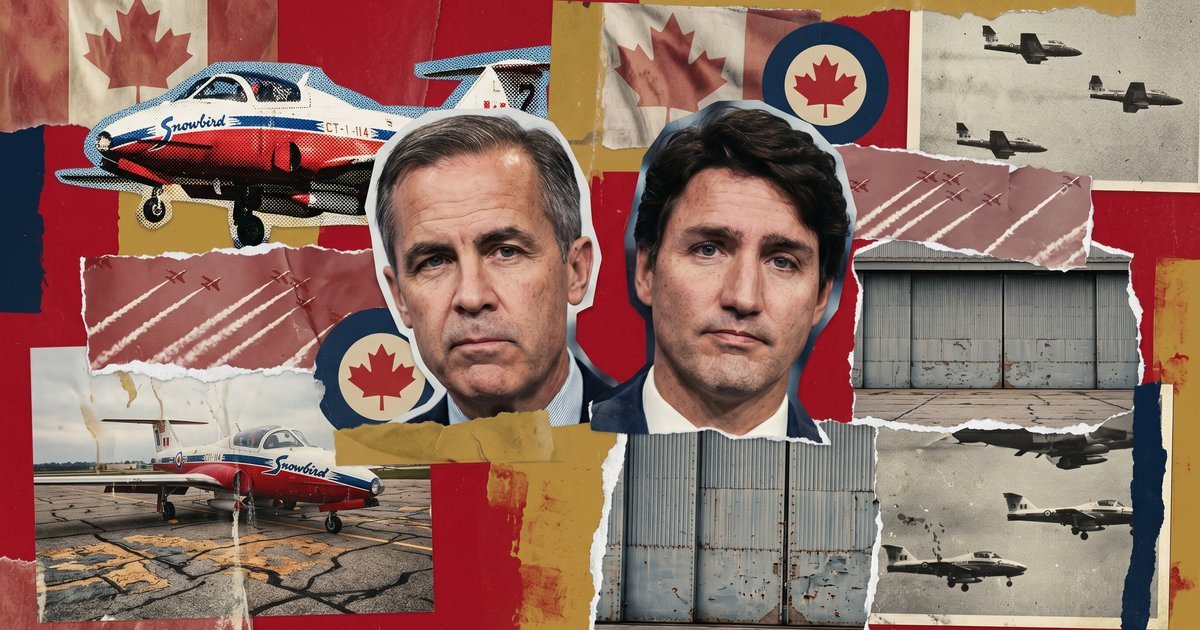
Today, Defence Minister David McGuinty announced that 2026 will be the final season for the Snowbirds' CT-114 Tutor jets. The 431 Air Demonstration Squadron will be grounded until replacement aircraft — the Swiss-made Pilatus PC-21, designated the CT-157 Siskin II — are operational in the early 2030s. Prime Minister Carney acknowledged the emotional significance but said: "I inherited this situation where the planes are literally at the end of their lives."
He inherited it from the Liberals.
The CT-114 Tutor was designed by Canadair — the first aircraft the company designed from scratch. It entered RCAF service in 1963 and has been flying with the Snowbirds since 1971. The aircraft are now over sixty years old. They have performed over 2,700 shows for 140 million spectators. Ten Canadian Forces members have died flying them, most recently Captain Jennifer Casey, killed in Kamloops in May 2020 after a bird strike.
For deeper analysis and exclusive posts, subscribe to my Substack.
A 2003 study by the Director of Major Service Delivery Procurement warned that the Tutor's lifespan would expire by 2010 and recommended replacement "immediately." That was under the Chretien Liberal government. No action was taken. The Harper years saw a $755 million RCAF proposal that didn't proceed — but the Trudeau Liberals then governed from 2015 to 2025, nearly a decade, during which no replacement procurement was initiated either. A 2019 RCAF briefing examined three interim options and rejected all of them without documented explanation. Instead, $30 million was allocated to keep the Tutors flying until 2030. That life extension has now failed early due to the aircraft's age.
Mark Carney was advising Trudeau on economic recovery in 2020. He chaired the Liberal Party's Task Force on Economic Growth in 2024. He won the Liberal leadership in March 2025 and was sworn in as prime minister. The Carney government is the Trudeau government with a new paintjob on the fuselage. And the Snowbirds have been stalling under its watch for a generation.
As Conservative MP Fraser Tolmie put it: "The Liberal government has had more than ten years to prepare to replace the jets."
Canada's F-35 delay: the only partner nation with zero deliveries
Grounding the Snowbirds is embarrassing. The failure to replace the CF-18 Hornet is dangerous.
Canada purchased 138 CF-18 Hornets beginning in 1982. The oldest airframes are now forty-four years old. In July 2010, the Harper government announced it would purchase 65 F-35 Lightning IIs, with deliveries starting in 2016.
Justin Trudeau campaigned in 2015 on scrapping that deal and buying a cheaper alternative. It was a crowd-pleaser on the campaign trail. He won. His government launched an open competition in 2017. That competition took five years. The winner, announced in March 2022: the F-35. The same aircraft Trudeau had pledged to reject — five years and billions of dollars in process costs later, having accomplished nothing but delay. A contract for 88 F-35As at $19 billion was signed in January 2023.
Then Carney became prime minister and put the deal under review in March 2025 — the second Liberal leader in a row to use the F-35 as a political prop, this time citing trade tensions with the United States. As of today, no timeline has been set for a decision on the remaining 72 aircraft. Defence Minister McGuinty told a Senate committee that the review is open-ended.
Consider the numbers. Only about 40% of RCAF aircraft are assessed as serviceable. Norway — population 5.6 million — has received all 52 of its F-35s. Australia has all 72. Canada, population 41 million, an original partner in the Joint Strike Fighter program since the 1990s, has received zero. It is the only original JSF partner nation that has not taken delivery of a single aircraft.
Meanwhile, in order to fill the gap created by its own delays, the Liberal government announced the purchase of 18 used F/A-18 Hornets from Australia at a total project cost of $360 million — the same vintage of aircraft Canada already had. By late 2020, most were still not in service. The gap-filler needed its own gap-filler.
US Ambassador Pete Hoekstra has warned that if Canada does not follow through on the F-35, the United States would need to fly American jets into Canadian airspace to address threats approaching from the north. America isn't invading Canada, merely bypassing it — we've become an ally too enfeebled to patrol its own sky.
Canadian military procurement is in a death spiral
The Snowbirds and the fighter jets fit a pattern that runs across every branch of the Canadian military.
The CH-124 Sea King helicopter entered service in 1963. A replacement was sought in 1983. The Chretien Liberals cancelled the EH-101 Merlin contract in 1993 at a cost of nearly $500 million in penalties. The replacement — the CH-148 Cyclone — was not selected until 2004, existed only on paper at the time, and was not delivered until 2015. The last Sea King retired in 2018 — fifty-five years of service. Thirty-five years from the day a replacement was first sought.
Canada's four Victoria-class submarines — purchased used from Britain by the Chretien government in 1998 — have spent more time in repair yards than at sea. HMCS Corner Brook hit the seafloor in 2011 and spent fourteen years being repaired. In 2019, all four submarines spent zero days at sea. The government announced plans for 12 new submarines in July 2024, then allocated no money for them in Budget 2025.
The National Shipbuilding Strategy has seen costs soar by up to 181% on some projects. The Canadian Surface Combatant frigate program has ballooned from an original $26.2 billion budget to an estimated $84.5 billion, with steel-cutting pushed to 2024 and no frigates expected for a decade. The Harry DeWolf-class Arctic patrol ships were criticized as too slow, too lightly armed, and too expensive — and by November 2023, personnel shortages meant only one was actually being crewed at any time.
The Polar Icebreaker Project was announced in 2008 to replace the CCGS Louis S. St-Laurent by 2017. It is now not expected until 2030, at an estimated cost of $8.5 billion for two ships. Canada's current heavy icebreakers date to the 1960s and 1970s.
The average time to acquire a new piece of military equipment in Canada is sixteen years. Two-thirds of defence projects face delays of at least one year. Defence Minister Bill Blair himself described the Canadian Armed Forces as being in a "death spiral." The CAF is short 16,000 personnel. Fifty-four percent of navy equipment, 55% of air force equipment, and 46% of army equipment is unserviceable. Only 58% of forces were assessed as prepared to respond to a crisis. Former Chief of Defence Staff Rick Hillier called the 1990s Liberal cuts to the military a "decade of darkness." The 2020s are looking worse.
Canada's lost aerospace industry: from the Avro Arrow to the Snowbirds
Canada was once an aerospace power.
In 1949, the Avro Canada C102 Jetliner became North America's first jet-powered airliner — just thirteen days behind the British de Havilland Comet and years ahead of the Boeing 707. It carried the world's first jet airmail from Toronto to New York. Six airlines and the US military expressed interest. The St. Laurent Liberal government, at C.D. Howe's direction, forced Avro to prioritize military work instead, and the sole prototype was cut up for scrap.
The Avro Arrow — the CF-105 — was a supersonic interceptor that broke four world speed records, reaching Mach 1.98 at 50,000 feet on interim engines that weren't even its intended powerplant. The Canadian-designed Orenda Iroquois engine was the most powerful jet engine in the world at the time. The program was cancelled on February 20, 1959 — "Black Friday" — as the Cold War calculus shifted from manned bombers to ICBMs and the costs of a single-customer program escalated. Within two months, all five completed airframes, all engines, all tooling, and all technical data were destroyed. Fourteen thousand workers were laid off immediately, rising to 25,000. Many of the best were recruited by NASA. Jim Chamberlin designed the Gemini spacecraft. Owen Maynard worked on the Apollo Lunar Module. Canadians have always had the right stuff, even if our governments couldn't put it into service.
De Havilland Canada built the DHC-2 Beaver in 1947 — voted one of the top ten Canadian engineering achievements of the twentieth century. The US Army ordered 970 of them. The Twin Otter, first flown in 1965, remains in production today and is used for Arctic operations worldwide. The Dash 8 became one of the most successful regional turboprops in history. World-leading aircraft, designed and built in Canada for Canadian conditions, exported globally.
Canadair built 1,815 F-86 Sabres in Montreal between 1950 and 1958 — fitted with Canadian-designed Orenda engines that made them the finest Sabres ever produced. Twelve Canadian squadrons deployed to NATO bases in France and Germany. Canadair's CL-215 water bomber, first flown in 1967, was the world's first purpose-built aerial firefighter. The Canadair Regional Jet became the most successful regional jet in history, with 1,945 built and nearly 190 operators in 57 countries. Pratt & Whitney Canada's PT6 engine, designed in 1958, became the world's most popular turboprop engine — over 51,000 produced, logging 400 million flight hours.
The world's first jet airmail carrier. The world's most advanced interceptor. The world's most popular turboprop engine. The world's most successful regional jet. The world's first purpose-built water bomber. Canada was a hotbed of aerospace engineering. Now the country that built these marvels cannot buy a replacement for sixty-year-old trainer jets without a multi-year gap in capability.
Ketchup Chip nationalism: the Toronto Air Show and Liberal patriotism
Every Labour Day weekend, the Canadian International Air Show flies over Toronto's waterfront. It has done so since 1949, born when RCAF pilots fresh from the war showed Canadians what their air force could do. In 1952, a Canadian Sabre — the kind built in Montreal, with an Orenda engine — broke the sound barrier over the CNE.
The show has become a reliable source of outrage for an elbows up type of downtown Torontonian. Mayor Olivia Chow wrote to organizers in 2023 expressing concern that jet noise triggers trauma. A city councillor called for the show's cancellation. The anti-war group World Beyond War organized a coalition of 51 organizations to campaign against the show in 2024, in what Yahoo News described as a push to end a "traumatizing event." Multiple Change.org petitions demand its cancellation. The objection, fundamentally, is to military aircraft existing in the sky above their progressive city.
The same political culture that objects to the sight of fighter jets over Toronto of course has no objection to the fact that Canada cannot field functional fighter jets at all. The sound of a CF-18 overhead is intolerable so 60% of the RCAF's fleet sitting unserviceable in hangars merits no comment. An air show — a living connection to the country's aviation heritage, to the war that earned Canada its seat at the table of nations — provokes outrage. The hollowing out of actual air defence capability provokes indifference.
Mark Carney campaigned on this kind of nationalism. Call it Ketchup Chip nationalism — a cynical pivot from a decade of post-national Liberal governance into kitschy consumer patriotism. Remember that this is the same Liberal Party whose previous leader declared Canada the world's "first post-national state" with "no core identity." They spent ten years telling Canadians that national identity was passé. Then Trump showed up and suddenly the maple leaf was everywhere. The campaign wrapped itself in the maple leaf: 500 BeaverTails at the victory party, Tim Hortons photo ops, "Never 51" hockey jerseys, Mike Myers in a Team Canada sweater telling Canadians to keep their "elbows up." The branding was aggressively Canadian. The substance? Empty calories.
In 2025, millions of Canadians joined Facebook groups to boycott American products. Provincial governments pulled American whiskey from shelves. The symbolic resistance was enormous. But while ordinary Canadians were scanning price tags for made-in-Canada, Carney was surrendering to American tech giants at Trump's demand — the White House publicly declared that Canada had "caved." He unilaterally lifted most retaliatory tariffs on September 1, 2025 with no reciprocal American concession. He refused to use energy — Canada's strongest card — as trade leverage, despite his own energy minister publicly saying it was exactly that. He called Trump "a transformational president" at the White House. As one headline put it: "Elbows Up. Pants Down."
Ketchup Chip nationalism for the voters. Capitulation at the negotiating table. The girders of actual sovereignty — the fighters, the ships, the Snowbirds — rusting while the country argues about which bourbon to pull from the shelf.
Canada's Arctic sovereignty is backed by nothing
Boycotts don't patrol airspace. Hashtags don't sail the Northwest Passage. Booing the American anthem at a hockey game doesn't keep Russian bombers from probing Canadian air defence identification zones.
Canada once had the ability to do all of this — and to build the machines that made it possible. It built Lancasters at the rate of one per day at Victory Aircraft in Malton. It trained over 130,000 Allied aircrew on Canadian soil — FDR called Canada the "aerodrome of democracy." It deployed twelve Sabre squadrons to NATO bases in Europe. It designed the Arrow and the Iroquois. It opened the North with bush planes built in Downsview.
Today, Canada cannot keep its sixty-year-old demonstration jets in the air. Its forty-year-old fighters are 60% unserviceable. Its submarines spent a year unable to go to sea. Its icebreakers are older than many of the sailors who would crew them. Its Arctic sovereignty claim — that the Northwest Passage is Canadian — is backed by no meaningful military presence, while the US considers it an international strait and US nuclear submarines have traversed it unannounced.
Mark Carney says he inherited the Snowbirds problem. He did — from his own party, during his own tenure as advisor and party chair. The Liberals have held power for the last 11 years. The warnings were issued in 2003. Twenty-three years later, the Tutors will finally fall silent.
The Conservatives launched a campaign called "Let the Snowbirds Fly." My friend Senator Denise Batters, who represents Saskatchewan — the Snowbirds' home province — has been one of the fiercest advocates for the team's survival. She urged the government to begin replacement procurement as early as 2022, pressed Defence Minister Blair in 2023 to commit to ongoing funding, and in March 2026 — two months before today's announcement — warned in Question Period that the government's plan to "retire selected fleets" sounded like "a plan to ground the Snowbirds forever." She was right. Retired military pilots have warned that a prolonged grounding will erode irreplaceable institutional knowledge — pilots, technicians, and ground crews whose expertise cannot be rebuilt from scratch. Given that the average Canadian defence procurement takes sixteen years, "early 2030s" is a best case.
The Snowbirds are a symbol of a country that once took its own capabilities seriously. Grounding them is a confession.
For more, subscribe to the Substack.
Related Posts

The Conservative Party of Canada has a new logo
Erin O’Toole is making his mark as the new leader of the Conservative Party of Canada by launching the first re-design of the party’s logo and first…
F-35s and lifecycle accounting
While we’re looking at lifecycle costs of the F-35 program, we should look at some other costs over their “lifecycle”. The CBC (which looks like it’ll be…

Mark Carney helped write the playbook that just sank Keir Starmer
Keir Starmer resigned as British prime minister on June 22, the worst-polling Labour leader on record, undone by a program of tax rises, paternalism, and…