Doug Ford slams ‘weak kneed’ judges

Some of Toronto’s brightest criminals tried to steal Ontario Premier Doug Ford‘s car out of his driveway this morning.

Two police cruisers gave chase and officers arrested four suspects including a 16 year old and a 17 year old.

While giving credit to the police, Ford went on what he described as a rant, slamming the Canadian justice system and ‘weak kneed’ judges.

Ontario Premier Doug Ford makes comments about bail reform and the Canadian Justice System

Here’s a rough transcript, clean up a bit.

Here’s my rant.

First of all, Chief Nish, Chief Demkiw, and all the chiefs are absolute champions. They just did a massive bust — 500 kilos of cocaine. These drug dealers wanted to poison our kids and our people. Just imagine that — 500 kilos. They worked with the DEA, the U.S. Drug Enforcement Agency, border patrol, and other police agencies. The OPP Commissioner, Commissioner Carrique, is amazing on the joint task force.

But guess what? These weak-kneed judges let them back out on the street. It was the biggest drug bust in Peel’s history, and except for one person, they were all released. Can you believe that? The largest drug bust in Peel’s history — 500 kilos of cocaine that could kill people — and the judges gave them a slap on the wrist. “Okay, little Johnny, go out and deal more drugs.” Why not just hand them more?

The system is broken. I’ll be all over the Prime Minister and the federal government until we get bail reform. These people are terrorizing our neighbuorhoods and feeding drugs to our citizens. The Criminal Code needs to be changed. Bail reform must happen. I’ll keep pushing until it gets done. Enough with the 10 years of dithering — “We’re going to do it, we’re not going to do it.” The Prime Minister gave me his word — now it has to happen.

Then, yesterday, there was another bust — 15 people. These were the tow truck guys and others intimidating and extorting people. They’d call and say, “Pay up or we’ll shoot up your house.” And then they actually went and did it. But again, the kind-hearted judges let them all out on bail — even though some were already on bail or probation. What is happening to this country? These criminals are running amok and terrorizing neighborhoods. It’s disgusting. Something has to change.

And then there was the guy whose car was about to be stolen. These thugs came up in masks. He was a hunter or something, and he fired a shot into the air — I don’t recommend that, by the way. But he got charged. I want to find out who he is and raise funds for his legal fees. He should get a medal. We need something like the Castle Law in the U.S. If someone breaks into your home, threatening your family, you’re going to fight like never before — with anything you have. These thugs shouldn’t be in your house.

Now I’ll tell you a story — maybe I’ll get in trouble for this. You know those “stupid criminals” shows? Four thugs came racing down my street in masks, ready to steal the car in my driveway. But at 12:30 a.m., two police cars were there. The chase was on. One guy fled but got caught. They got the others too.

But just imagine the people who don’t have security at their homes. These guys had all the tools to break in. And guess what’s going to happen? They’ll be back out again. I might as well invite them for a barbecue — I’d treat them better than the justice system does.

Thank God the police got them and not me.

I’m sick and tired of the weak justice system. It needs a backbone. We need to start throwing these people in jail. This is turning into a lawless society.

That’s my rant.

Ontario Premier Doug Ford – June 17th, 2025

A couple of interesting items to note. In Ottawa, Federal Conservative leader Pierre Poilievre has been pushing the same message for years now regarding Canada’s broken justice system — in particular the need for bail reform.

Tow truck crime and chaos

First, Ford mentions tow truck driver extortion and crime.

Conservative MP Tim Uppal tabled Bill C-381 – Protection Against Extortion Act to re‑establish mandatory minimum sentences for extortion in the Criminal Code, including harsher penalties when firearms or criminal organization involvement are present. The opposition has argued extortion has surged under the Liberals: +218% nationwide since 2015, with Ontario, Alberta, B.C. particularly hit.

What is Castle Law in Canada?

Next, Ford advanced the idea of Castle Law – the American legal doctrine that designates a person’s home (and sometimes their vehicle or workplace) as a place in which they have special rights to use force, including deadly force, to defend themselves against intruders, without a duty to retreat.

This is a significant policy suggestion by the Premier. Ontario is dealing with more crime and homeowners must fend for themselves while waiting for police to arrive. Worse, the revolving door of the justice system often sees violent offenders released the same day to re-offend.

Ontario home defence

Recent cases have highlighted the discussion on homeowner defence.

In Milton, police charged Ali Mian with second-degree murder after fatally shooting an armed intruder who broke into his home in 2023 while his mother was present.

Mian, a licensed firearm owner, fired a single shot during the attempted home invasion that involved multiple masked intruders.

Police arrested and charged Mian, but the Crown prosecutors later withdrew the murder charge in July of that year, concluding there was no reasonable prospect of conviction. Prosecutors decided Mian’s actions were consistent with lawful self-defence under Section 34 of the Criminal Code.

Ali Mian and lawyer
Ali Mian celebrates with his lawyer – from Instagram

While the justice system worked and Mian went free, many see this as a lucky outcome for the 22 year old man. The Liberal government in Ottawa who oversees the definition of the criminal justice system has sought to eliminate firearms from Canadian society, placing significant burdens on gun owners and the most trivially breached criminal liability those who don’t follow every rule to the absolute letter.

While Ford doesn’t have direct input into the criminal code of Canada and blow off some steam by slamming judges, his Attorney General has more power by selecting which cases to prosecute in the future.

And certainly, and criminal defence lawyer who argues on behalf of a client who used a firearm to protect their property in Ontario – will cite the Premier’s words today.

Wikisplash is for trending people and topics

I’m excited to share a new project I’ve just released: Wikisplash.com. It’s a web-based tool that uses Wikipedia data as a proxy for public attention – at both the global and national level.

Wikisplash is like Google Trends for who’s looking at Wikipedia pages.

Some of you know that, alongside my interest in politics, I’m also a web and software developer. I originally shared this weekend project in a group chat with colleagues via a development URL. One noted it was useful enough to deserve a proper home – so Wikisplash.com was born.

What is Wikisplash?

Wikipedia has articles on nearly every named entity – people, places, and things. Wikisplash lets you see the number of pageviews those articles have received, going back years.

Because Wikipedia links often appear at the top of Google search results, its pageview stats serve as a reasonable proxy for global search interest. This is the case not only on Wikipedia but indirectly through Google as well.

Wikisplash is for trending topics
Interest in a selection of countries in the last two years

As I’ve suggested, Google Trends does something similar though in a more limited way. Reflecting actual Google search traffic, Google Trends shows search interest only as relative percentages. Wikisplash shows absolute pageviews by date. That makes it easier to compare attention over time and across topics.

Why trending topics matter

If you work in politics, media, or marketing, you already know that attention is insight. Tracking what people are curious about helps you stay ahead of conversations.

Even though writing for SEO has become less of a newsroom priority, search interest remains a strong signal of public curiosity. Editors, strategists, and political communicators have always used trending topics as a cheat code to tap into what people care about – whether via Google or social platforms like X.

Global English Wikipedia mindshare of Donald Trump and Elon Musk

Wikisplash breaks down trending topics by recency “yesterday”, “last 7 days”, and “last 30 days”, while also doing this by country. If you really want to be specific, you can look at global trends by the language of Wikipedia (en.wikipedia.org vs fr.wikipedia.org)

I’ve been fascinated by predictive analytics for some time, for the same reason as anyone would be – getting to the future before others confers its obvious advantages. Website newsletters like Exploding Topics curate trending topics that interest its authors. Tools like Ahrefs and SEMrush are mostly used for SEO, though more are using these sites to anticipate market demand and social direction.

Snapshot of the most visited Wikipedia articles by Canadians in the last 7 days

I’ve also added easy ways to share this data and visualizations of the same. You can easily download chart images, embed them on your own website, or link to the topics on social media.

Which social media platforms dominate?

Wikispash aims to provide tools to interpret the raw data so you can come to your own conclusions and for your own purposes. I hope that it is useful for you! Tell me what you think of it on X/Twitter.

Wikisplash is for trending topics! – Wikisplash.com

Mapping the results of the 2022 Ontario Provincial Election

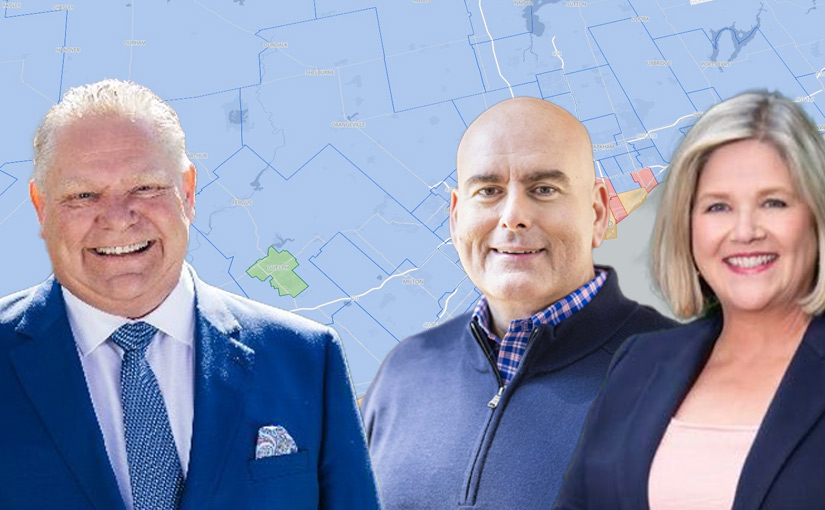
I just finished mapping out Doug Ford’s Progressive Conservative election win from 2022. On June 2 of that year, the voters of Ontario returned the PC leader with a majority government with 83 seats. The Progressive Conservatives defeated the Ontario Liberals led by Steven Del Duca and the Ontario NDP which was helmed by Andrea Horwath. Both defeated party leaders would move on from provincial politics and have since become the mayors of Vaughan and Hamilton, respectively.

The results of this pandemic-era election were very much similar to the 2018 provincial election – another majority for the PC under Ford – but the election saw a strenghthened mandate for the Premier. One independent candidate was elected in Haldimand–Norfolk.

This is the sixth election I’ve mapped out for the province of Ontario. You can review all of those elections here and drill down on the results of this one using the provincial map.

The mapped results of the 2022 Ontario Provincial election

Clicking/tapping on a riding will zoom you into the map for a poll-by-poll breakdown. You can dive into your own riding and find out how your neighbours voted! Hovering over ridings or neighbourhood polls will show a pie chart breakdown of the proportion of votes in a particular area. Expanding the tile at the bottom right and switching to the “Turnout” tab will show voter turnout rates on a riding level or can show poll-by-poll rates of partipation.

Scarborough Centre coloured by poll winner.

You can also use the search bar at the top of the page to search for any candidate or riding over the last 6 elections. Some candidates appear more than once and you can track their electoral history (no matter which riding they may have contested). Clicking on a riding will also show a “related content” button at the top of the page which you can use to find the results of nearby ridings. A few of those ridings are also summarized below the map.

Green party win in Guelph shaded by the strength of the Progressive Conservative vote (ironically the colour green showing strongest PC areas here). Mike Schreiner, the Green Party leader won the party’s only seat.

If you’re wondering how to take these screenshots to put these images in your own posts or tweets, click the camera at the top left of the map. This will download an image of the map.

Zooming around the map is a lot of fun. It’s vector-based, so zooming in and out is smooth and looks great.

Clicking the “Up to 2022 Provincial Election” button in the top right zooms the map out to the provincial riding context, while clicking on a riding zooms in to show the local breakdown.

A particularly strong neighbourhood poll for PC candidate Doug Ford in Etobicoke North.

I’ve integrated building footprints for all of Ontario (and Canada) into my map, so you can see grouping of houses on cul-de-sacs, apartment buildings, and in some cases even the house numbers.

NDP leader Andrea Horwath best poll in Hamilton Centre.

Visualizing these building footprints in neighbourhoods for various polls is a new feature of this iteration of these maps. I’ve also extended this feature to my previous maps (both federal and provincial). It can be useful to consider different zoning and dwelling types when appreciating party strength in a riding.

Liberal leader Steven Del Duca did not have a great showing in his riding of Vaughan–Woodbridge.

I enjoy pulling these maps together for the broader political community and to help voters further engage with our democratic process. I’ll be mapping other provincial elections as that data becomes available from the relevant provincial elections agencies.

York South–Weston showing a diversity of voting preferences throughout the riding.