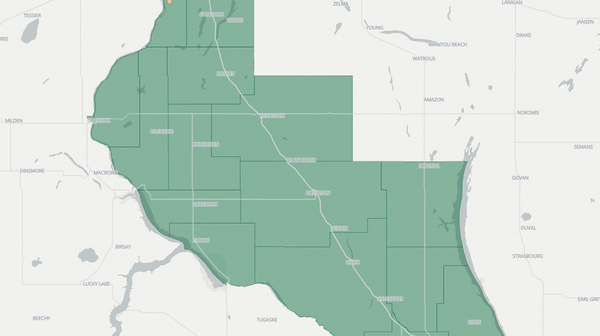
Humboldt-Watrous — 2024 Saskatchewan Provincial Election Results Map
Humboldt-Watrous — 2024 Election Results
Poll-by-poll results for Humboldt-Watrous in the 2024 Saskatchewan election. The Saskatchewan Party candidate won this riding. Explore detailed voting data, candidate results, and turnout statistics at the poll level.
Riding information
Auto generated. Flag an issue.Humboldt—Watrous
Humboldt—Watrous covers a broad stretch of central Saskatchewan farmland, anchored by the city of Humboldt and the town of Watrous. The riding was held for twenty-five years by Donna Harpauer, who served as Finance Minister and Deputy Premier and became the longest-serving female cabinet minister in Canadian history. In February 2024, Harpauer announced she would not seek re-election, citing a desire for a new chapter after a quarter-century in the legislature. Her departure triggered a contested Saskatchewan Party nomination that drew three candidates, underscoring the seat's significance within the governing caucus.
Candidates
Racquel Hilbert (Saskatchewan Party) — Hilbert is a founder of Wolverine Drilling Inc., a Humboldt-based company that provides water solutions for municipalities, agricultural operations, and industrial clients across multiple provinces. Before launching the business, she spent more than twenty years as a special education teacher. She won the Saskatchewan Party nomination over two other contestants to succeed the retiring Harpauer.
Kevin Fallis (NDP) — Fallis has spent thirty-five years in the healthcare field, working in long-term care, addiction services, mental health, and most recently in a dialysis clinic in Saskatoon. A member of SEIU-West for over two decades, he received the Saskatchewan Federation of Labour's Bob Sass Award in 2021 for his advocacy on behalf of healthcare workers. Fallis cited the healthcare system's staffing crisis and the erosion of services in rural communities as the central motivations for his candidacy.
Rose Buscholl (Progressive Conservative) — Buscholl is the leader of the Progressive Conservative Party of Saskatchewan, a position she has held since 2022. A resident of the constituency for two decades, she holds a degree from the University of Saskatchewan with a major in anthropology and a minor in psychology. She is a former Rural Municipality councillor from the Colonsay area and remains an active member of her local volunteer fire department. This was her second consecutive run in the riding, having also stood as the PC candidate in 2020.
Carrie Ann Hradecki (Saskatchewan United Party) — Hradecki grew up on a mixed farm in Lake Lenore and completed a Bachelor of Education at the University of Saskatchewan in 1994. She has worked as a teacher and substitute teacher in the Horizon and Saskatoon Catholic school divisions for more than twenty-five years and currently resides in Bruno.
Local Issues
The retirement of Donna Harpauer after a quarter-century as the riding's representative marked a watershed moment for Humboldt—Watrous. As Finance Minister, Harpauer had steered the province through pandemic-era emergency spending and the return to balanced budgets, and her departure left the constituency without the direct pipeline to cabinet influence it had long enjoyed. The contested nomination reflected the riding's importance within Saskatchewan Party politics and the stakes of choosing her successor.
Healthcare staffing remained the most pressing local concern. Rural facilities across central Saskatchewan faced ongoing service disruptions, with emergency rooms and laboratories subject to temporary closures when the Saskatchewan Health Authority could not fill nursing and physician shifts. Fallis, drawing on his decades of frontline healthcare work, argued that the crisis required a fundamental change in how the province recruited and retained workers, while Hilbert pointed to the government's Health Human Resources Action Plan and its investment of more than three hundred million dollars since 2022.
Education policy generated sharp debate in the riding. The Saskatchewan Party government's Parents' Bill of Rights, passed in October 2023 with the invocation of the notwithstanding clause, required parental consent before students under sixteen could use different pronouns at school. The policy energized supporters who framed it as defending family authority, but it drew criticism from teachers' organizations, human rights advocates, and the provincial child advocate, adding a layer of social policy tension to a riding that had historically focused on fiscal and agricultural issues.