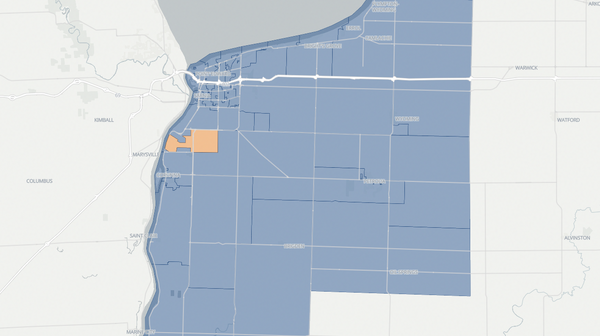
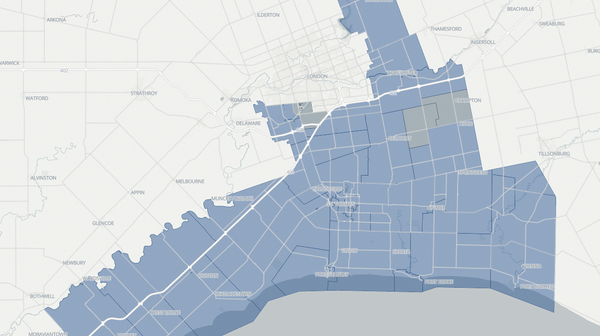
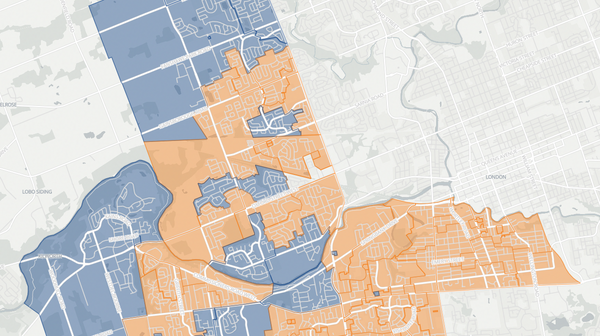
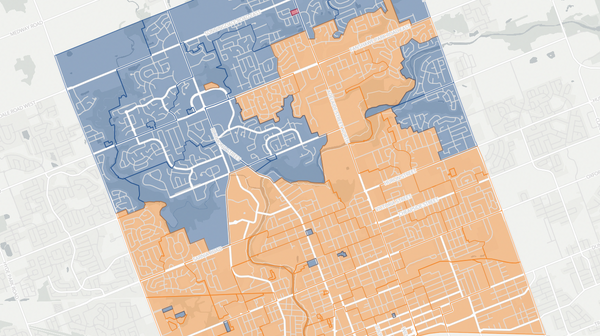
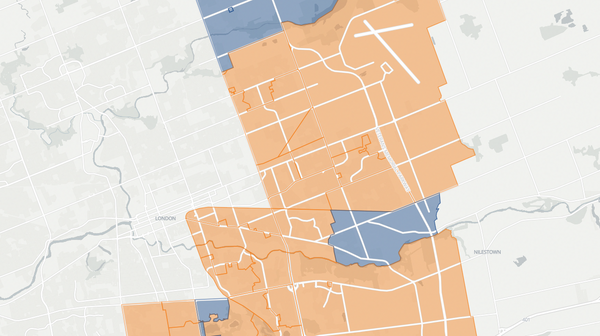
Lambton—Kent—Middlesex — 2025 Ontario Provincial Election Results Map
Lambton—Kent—Middlesex — 2025 Election Results
📌 The Ontario electoral district of Lambton—Kent—Middlesex was contested in the 2025 election.
🏆 Stephen Pinsonneault, the Progressive Conservative candidate, won the riding with 25,297 votes (53.6% of the vote).
🥈 The runner-up was Cathy Burghardt-jesson (Liberal) with 12,397 votes (26.2%), defeated by a margin of 12,900 votes.
📊 Other notable candidates: Kathryn Shailer (NDP, 12%).
Riding information
Auto generated. Flag an issue.Lambton—Kent—Middlesex
Lambton—Kent—Middlesex is a sprawling rural riding in southwestern Ontario that encompasses agricultural communities, small towns, and the petrochemical corridor around Sarnia's outskirts. The seat became vacant in September 2023 when Monte McNaughton, who had served as Minister of Labour, Immigration, Training and Skills Development, resigned from the legislature to take a private-sector position with Woodbine Entertainment Group. The Progressive Conservatives held the riding in a May 2024 by-election, electing Steve Pinsonneault, a veteran Chatham-Kent municipal councillor with seventeen years of service on local council. Pinsonneault then faced the challenge of defending the seat just nine months later when Premier Ford called the February 2025 snap election.
The riding's economy is rooted in agriculture, food processing, and energy, with corn, soybean, and livestock operations forming the backbone of the rural landscape. Communities such as Strathroy, Dresden, Wallaceburg, and Lucan anchor the riding's civic life.
Candidates
Stephen Pinsonneault (Progressive Conservative) — A seventeen-year veteran of Chatham-Kent municipal council who won the May 2024 by-election to succeed Monte McNaughton. Pinsonneault brought extensive local government experience to Queen's Park, having served on numerous municipal committees and championed economic development in the Chatham-Kent area. He sought re-election on a platform of rural economic growth, health care access, and infrastructure investment.
Cathy Burghardt-jesson (Liberal) — A three-term mayor of Lucan Biddulph and three-time warden of Middlesex County, Burghardt-Jesson had run against Pinsonneault in the 2024 by-election and finished second. A former small business owner with more than a decade of municipal leadership experience, she first joined local council in 2010 as deputy mayor and has served in elected municipal office continuously since then.
Kathryn Shailer (NDP) — A lifelong educator with more than twenty years of experience as a senior administrator at postsecondary institutions across Canada and a further two decades of teaching. Based in Alvinston, Shailer is active in the Brooke-Alvinston Optimist Club, Friends of Campbell Park, and the Lawrence House Centre for the Arts, and organizes the Alvinston Arts and Music Festival. She also ran in the 2024 by-election.
Minor candidates included Andy Fisher (New Blue Party) and Andraena Tilgner (Green Party).
Local Issues
The proposed reopening of a long-dormant landfill near Dresden emerged as one of the most contentious local issues during the 2022-2025 term. A Mississauga-based waste management company sought approval to receive up to six thousand tonnes of construction and demolition waste per day at a site located roughly a kilometre from the town, with projections of hundreds of daily truck trips. The site sits adjacent to Molly's Creek, which feeds into the Sydenham River, a recognized biodiversity hotspot that supports dozens of species at risk. Community opposition was fierce, and all candidates in the 2024 by-election and the 2025 general election voiced opposition to the project. The province initially promised a full Environmental Assessment, though the long-term outcome remained uncertain.
Health care access in rural southwestern Ontario remained a critical concern. Residents across the riding reported difficulty finding family physicians, and small-town hospitals and emergency departments faced staffing challenges that threatened service continuity. The distance to larger medical centres in London or Sarnia compounded the problem for residents in the riding's more remote communities, and the recruitment of health care professionals to rural postings remained an ongoing struggle.
Agricultural viability and rural economic development were persistent themes. Farmers contended with rising input costs, supply chain disruptions, and the uncertainty created by international trade tensions. The riding's existing burden of hosting two major landfills receiving waste from the Greater Toronto Area fed into broader frustrations about rural communities bearing disproportionate environmental costs. Broadband internet access remained incomplete in many areas, limiting economic opportunity and access to services for residents and businesses.