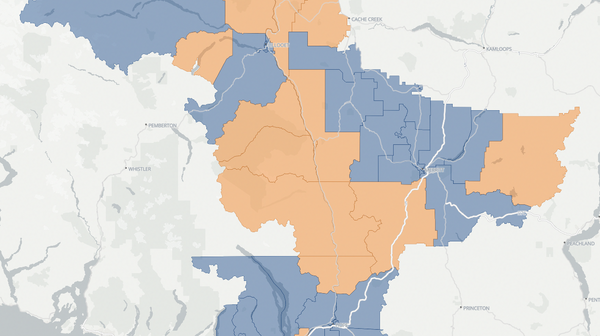
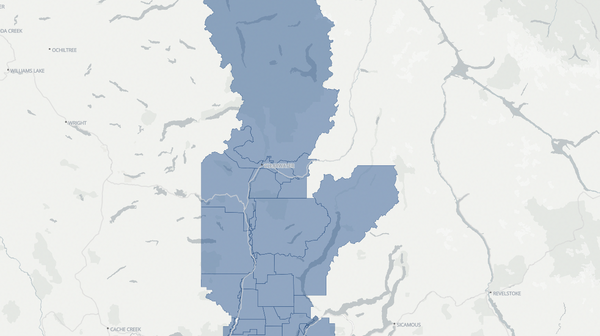
Kamloops Centre — 2024 British Columbia Provincial Election Results Map
Kamloops Centre — 2024 Election Results
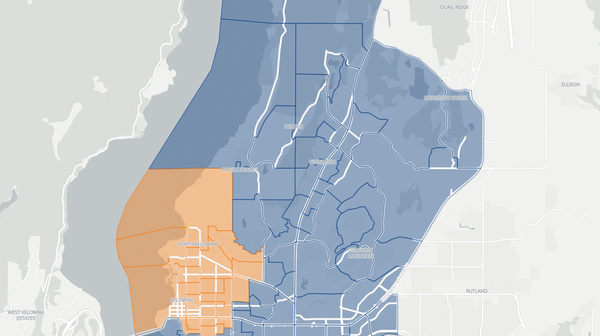
Poll-by-poll results for Kamloops Centre in the 2024 British Columbia election. The Conservative Party candidate won this riding. Explore detailed voting data, candidate results, and turnout statistics at the poll level.
Riding information
Auto generated. Flag an issue.Kamloops Centre
Kamloops Centre is a newly configured riding created through the 2023 redistribution, replacing the former east-west split of Kamloops along the Thompson Rivers with a configuration that combines the city's downtown core, the North Shore and Brocklehurst neighbourhoods north of the river, and the Sahali, Aberdeen, and Dufferin areas on the benchlands to the south. Thompson Rivers University — the city's largest post-secondary institution and a major employer — sits within the riding, as does the downtown commercial district, the provincial courthouse, and Royal Inland Hospital. Kamloops, with a population approaching 100,000, serves as the service and transportation hub for a vast surrounding region at the confluence of the North and South Thompson rivers, with an economy built on healthcare, education, transportation and logistics, mining services, ranching, and tourism.
Former Kamloops mayor and two-term BC Liberal MLA Peter Milobar — who had represented the old Kamloops-North Thompson riding since 2017 — sought re-election in the new riding under the Conservative banner after joining the Conservative Party following the collapse of BC United. He faced NDP candidate Kamal Grewal and Green candidate Randy Sunderman in a contest shaped by downtown revitalization challenges, the housing crisis, and healthcare pressures at Royal Inland Hospital.
Candidates
Peter Milobar (Conservative Party of BC) — Milobar was born in Edmonton and raised in Kamloops, where he and his wife operated a small business together. He entered municipal politics at thirty-two, winning a seat on Kamloops city council, and went on to serve as mayor for three consecutive terms from 2008 to 2017, becoming the city's longest-serving mayor. He also chaired the Thompson-Nicola Regional District from 2006 to 2011 and the Thompson Regional Hospital District from 2011 to 2017. Elected to the provincial legislature as a BC Liberal in 2017 and re-elected in 2020 by fewer than 200 votes, he served as the official opposition critic for Finance and held several other critic portfolios. He joined the Conservative Party in 2024 as BC United dissolved.
Kamal Grewal (BC NDP) — Grewal moved to Canada from India at the age of sixteen and made Kamloops her home fifteen years before the election. She held a bachelor of business administration in economics and finance from Thompson Rivers University, where she had previously worked as an international student advisor. At the time of the campaign, she worked as an account manager for an international insurance firm and served on the board of directors of the Canadian Mental Health Association's Kamloops branch. She was also involved with Kamloops Immigrant Services and campaigned on affordability, human rights, and healthcare access.
Randy Sunderman (BC Green Party) — Sunderman grew up in Kamloops and Clearwater and held degrees in biology and economics from what is now Thompson Rivers University and the University of Victoria. He worked for more than thirty years as an economist specializing in economic development, land-use planning, and impact assessments, with extensive experience working with Indigenous communities, municipalities, and governments across British Columbia, Alberta, and the Yukon. He served on numerous community boards in Kamloops, including Community Futures, and was president of the Aberdeen Neighbourhood Association. He identified healthcare — particularly the shortage of family physicians in the city — as his priority issue.
Local Issues
Homelessness and public safety in the downtown core were the most visible and politically charged issues in Kamloops Centre during the 2020–2024 period. Homelessness had been growing in the city, with the proportion of women among the homeless population rising in recent years. The most commonly cited barrier to housing was high rental prices, followed by low income and addiction issues. The NDP government announced more than 500 new homes and shelter spaces for Kamloops, including a sixty-unit supportive housing project for seniors and people with disabilities, modular supportive housing units, and a shelter primarily for seniors and older adults. The Conservatives argued that the NDP's approach prioritized harm reduction over public order and that visible homelessness and open drug use were driving customers away from downtown businesses.
Healthcare capacity at Royal Inland Hospital and the shortage of family physicians across the city were top-of-mind concerns for residents. Kamloops served as the referral centre for a vast surrounding region, and emergency department wait times had grown as demand increased. The city had a large population of residents without a family doctor, a problem that predated the pandemic but worsened as physicians retired and new graduates gravitated toward larger urban centres. All three candidates identified healthcare as a priority — Sunderman made it his signature issue, Grewal emphasized the need for expanded team-based care, and Milobar pressed the NDP government on wait times and specialist access from his position as opposition Finance critic.
Housing affordability extended well beyond the homeless population to affect working families and young professionals. The gap between housing supply and population growth had driven rental costs upward, and the city's relatively affordable real estate — compared to the Lower Mainland — attracted new residents from more expensive markets, further tightening supply. The NDP's densification policies and the BC Builds program were presented as responses, but Kamloops residents debated whether the pace of construction could keep up with demand.
The downtown revitalization challenge tied together several threads of the riding's political discourse. Kamloops Centre encompassed both the historic downtown commercial district along Victoria Street and the Tranquille corridor on the North Shore — areas that had experienced economic strain as retail shifted to suburban big-box centres and as visible social challenges deterred investment. Candidates debated whether provincial policy on supportive housing siting, mental health services, and policing was helping or hindering downtown renewal.