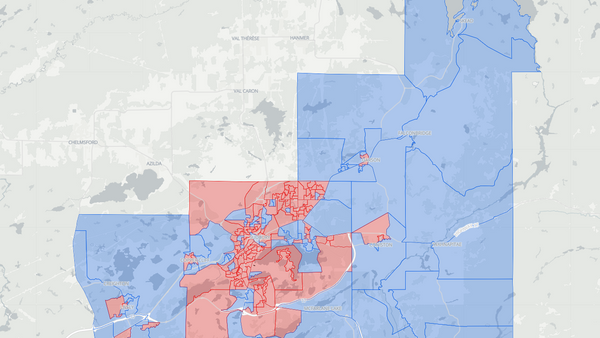
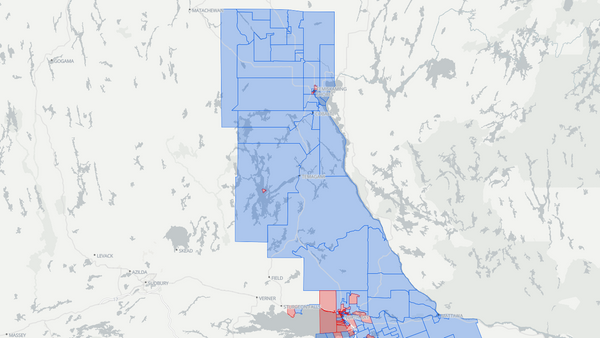
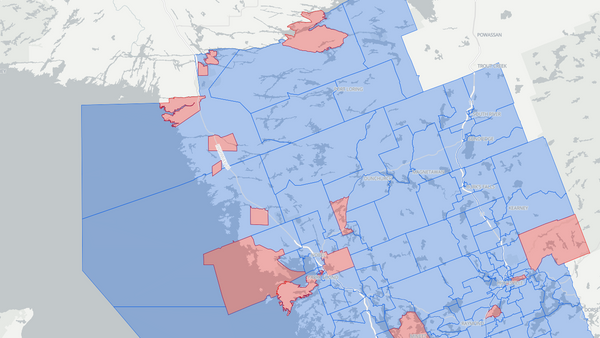
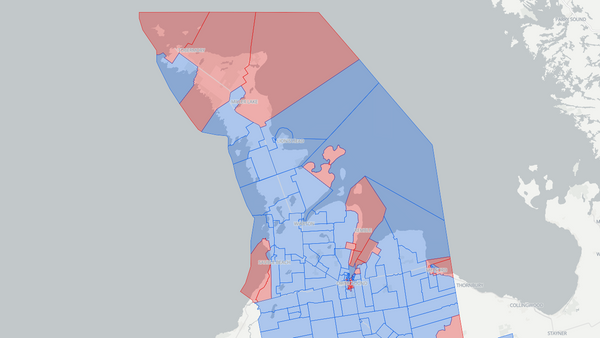
Sudbury East—Manitoulin—Nickel Belt, ON — 2025 Federal Election Results Map
Sudbury East—Manitoulin—Nickel Belt — 2025 Election Results
📌 The Canadian federal electoral district of Sudbury East—Manitoulin—Nickel Belt was contested in the 2025 election.
🏆 Jim Belanger, the Conservative candidate, won the riding with 29,156 votes (48.3% of the vote).
🥈 The runner-up was Marc G. Serré (Liberal) with 25,075 votes (41.6%), defeated by a margin of 4,081 votes.
📊 Other notable candidates: Andréane Chénier (NDP-New Democratic Party, 8%).
Riding information
Auto generated. Flag an issue.Sudbury East--Manitoulin--Nickel Belt
Sudbury East--Manitoulin--Nickel Belt is a vast new federal riding in northeastern Ontario, created through the 2022 redistribution and contested for the first time in 2025. Spanning more than 32,000 square kilometres, the riding was assembled from parts of the former Nickel Belt, Algoma--Manitoulin--Kapuskasing, and Sudbury ridings. It encompasses the communities surrounding Greater Sudbury's urban core, including Azilda, Chelmsford, Dowling, Val Caron, and Hanmer to the west and north, as well as Coniston, Wahnapitae, and Skead to the east. The riding extends south and west to include Espanola, Massey, Manitoulin Island, and the communities of the north shore of Lake Huron. With a population of roughly 100,000, it is a mix of mining towns, francophone communities, First Nations reserves, and rural and island settlements.
Candidates
Jim Belanger (Conservative) won the riding in a historic result, becoming the first Conservative elected at the federal or provincial level in the Sudbury area since 1981. A lifelong resident of the riding, Belanger was raised in Azilda, a community named after his great-grandmother, Azilda Belanger, whose family settled there in 1886. He attended the University of Ottawa, earning a Bachelor of Business Administration. His career has spanned the mining industry, logging, agriculture, and the fuel sector, where he currently operates as a self-employed petroleum wholesaler and delivery worker.
Marc G. Serre (Liberal) is the former three-term MP for Nickel Belt, first elected in 2015 and re-elected in 2019 and 2021. He is the son of Gaetan Serre, who represented Nickel Belt as a Liberal MP from 1968 to 1972, and the nephew of former Liberal MP Benoit Serre. Before entering politics, Serre was manager of business services for EastLink's Ontario operations and served on the municipal council of West Nipissing and the Conseil scolaire de district catholique du Nouvel-Ontario.
Andreane Chenier (NDP) holds a Master's degree in microbiology and immunology from the University of Ottawa and a PhD in biomolecular sciences from Laurentian University. She works as a bilingual CUPE National Health and Safety Representative, a position she has held for over a decade. She lives in Hanmer, where she and her husband raise their children, keep bees, and run a farm. She previously ran for the NDP in Nickel Belt in 2021.
Sharilynne St. Louis (People's Party) and Himal Hossain (Green Party) also stood as candidates in the riding.
About the Riding
Sudbury East--Manitoulin--Nickel Belt is defined by its resource economy and its vast, sparsely populated geography. The mining communities north and east of Sudbury, including Azilda, Chelmsford, Val Caron, and Coniston, grew up around the nickel, copper, and precious-metals deposits of the Sudbury Basin. Many residents work in the mines or in the mining supply and services companies clustered in Greater Sudbury. Espanola, a town of roughly 5,000 on the Spanish River, was historically a pulp-and-paper town and remains a regional service centre for the area west of Sudbury.
Manitoulin Island, the world's largest freshwater island, is a distinctive part of the riding with a strong tourism economy, a significant Indigenous population including the Wikwemikong Unceded First Nation, and a rural character shaped by farming, fishing, and seasonal recreation. The island is connected to the mainland by a single-lane swing bridge at Little Current and by the Chi-Cheemaun ferry to Tobermory on the Bruce Peninsula.
The 2025 election in this riding was shaped by the new boundary configuration, which created confusion among voters accustomed to the former riding names. The US trade dispute and its implications for the mining and forestry sectors were acute concerns. Healthcare access, including physician shortages and long travel distances to hospitals, was a persistent issue across the riding's scattered communities. Affordability, rural broadband connectivity, and infrastructure investment, particularly highway improvements, were additional priorities. The riding's francophone population, concentrated in communities like Azilda, Chelmsford, and Espanola, brought French-language services and minority-language education into the local conversation.