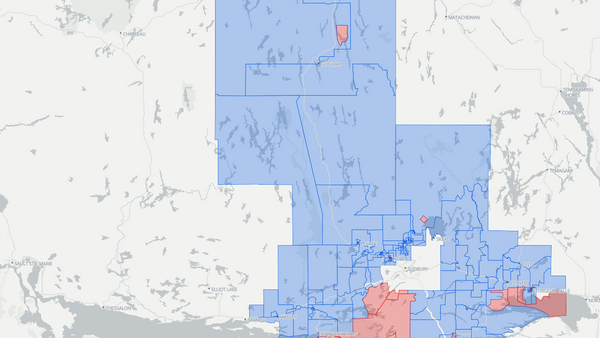
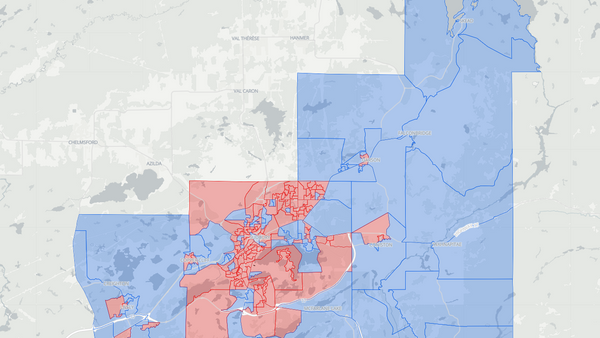
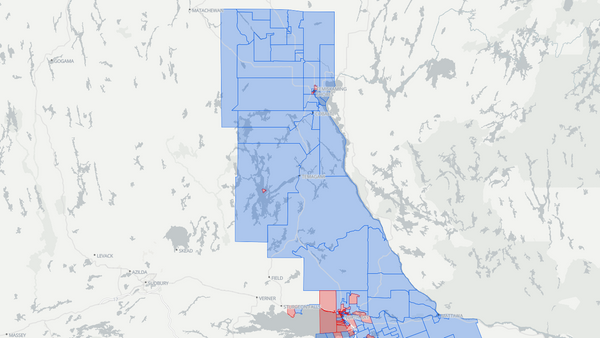
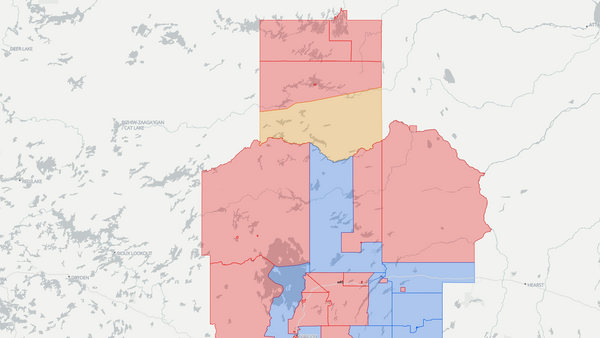
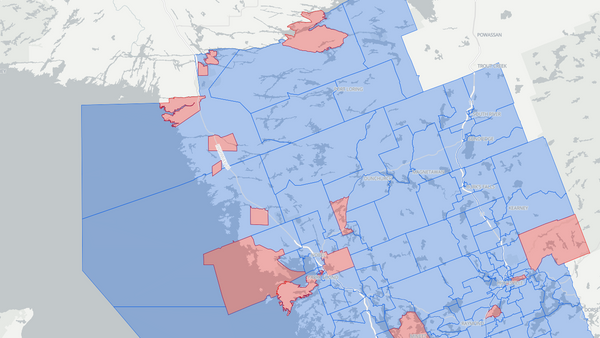
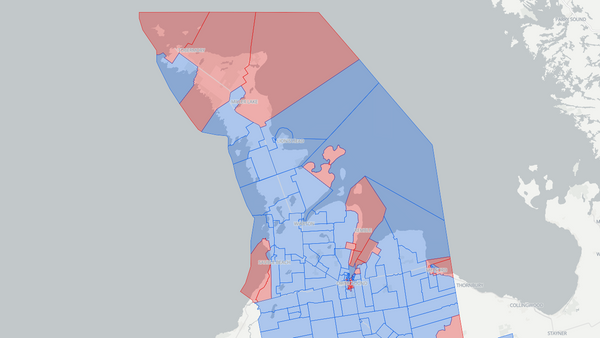
Sault Ste. Marie—Algoma, ON — 2025 Federal Election Results Map
Sault Ste. Marie—Algoma — 2025 Election Results
📌 The Canadian federal electoral district of Sault Ste. Marie—Algoma was contested in the 2025 election.
🏆 Terry Sheehan, the Liberal candidate, won the riding with 30,936 votes (47.4% of the vote).
🥈 The runner-up was Hugh Stevenson (Conservative) with 29,208 votes (44.7%), defeated by a margin of 1,728 votes.
📊 Other notable candidates: Laura Mayer (NDP-New Democratic Party, 7%).
Riding information
Auto generated. Flag an issue.Sault Ste. Marie--Algoma
Sault Ste. Marie--Algoma is a vast Northern Ontario riding created under the 2022 redistribution by merging the city of Sault Ste. Marie with a large portion of rural Algoma District previously part of Algoma--Manitoulin--Kapuskasing. The riding stretches from Hornepayne and White River in the north, through Wawa and Dubreuilville, south to the Sault and St. Joseph Island, and east to Elliot Lake, Blind River, and Spanish. It encompasses dozens of townships, several First Nations communities, and two cities -- Sault Ste. Marie (population roughly 75,000) and Elliot Lake (population approximately 11,000). The riding's vast geography and dependence on steel, forestry, and mining make it one of Northern Ontario's most economically significant constituencies.
Candidates
Terry Sheehan (Liberal) is the incumbent, first elected in 2015 and seeking a historic fourth consecutive term -- the first MP to achieve that in the riding's history. Before entering federal politics, Sheehan served as a Sault Ste. Marie city councillor for Ward 2 from 2003 to 2015, and before that spent two terms on the Huron-Superior Catholic District School Board. He has served as parliamentary secretary to multiple ministers during his time in Ottawa.
Hugh Stevenson (Conservative) is the former Chief of Police of Sault Ste. Marie, bringing 38 years of policing experience across three police services. He resigned from his position as police chief to contest the riding, and was considered a high-profile recruit by Conservative leader Pierre Poilievre. During the campaign, Stevenson faced criticism for declining to attend all-candidates forums and for limited engagement with local media.
Laura Mayer (NDP) is a first-time federal candidate and a proud Anishinaabekwe from Mississauga First Nation. An Osgoode Hall Law School graduate, Mayer has worked in advisory and management roles with First Nations organizations and serves as a councillor for Mississauga First Nation and as executive director of the National Council of Indigenous Midwives. Her campaign focused on health care, food costs, and northern infrastructure.
Robyn Kiki Eshkibok (Green Party) is from Wiikwemkoong and Bawating, born and raised in Sault Ste. Marie. An Ojibwe Ogichidaa and mother of three, Eshkibok campaigned on environmental accountability and Indigenous issues, expressing particular concern about the health effects of industrial emissions in the Algoma district.
About the Riding
Algoma Steel -- the second-largest steel producer in Canada and the Sault's largest employer -- is the economic anchor of the riding. The company's transition from coal-fired blast furnaces to electric arc steelmaking, a multi-year project backed by hundreds of millions in federal and provincial funding, was a dominant theme in the 2025 campaign. The conversion promises to reduce carbon emissions by up to 70 percent while preserving thousands of jobs, but required massive new electricity infrastructure including a 230-kilovolt transmission line.
Beyond steel, the riding depends on forestry, mining, and tourism. Elliot Lake, once a uranium mining hub, has reinvented itself as a retirement community. Wawa and the communities along the Trans-Canada Highway corridor rely on tourism and outdoor recreation. The newly expanded riding brought rural concerns -- road maintenance, broadband access, physician shortages -- into sharper focus.
The US trade dispute loomed over the 2025 campaign. Algoma Steel exports significant volumes to the American market, and the threat of tariffs on Canadian steel added urgency to the company's modernization plans. Health-care access was the other defining issue: physician shortages, long emergency-room wait times, and the challenge of delivering services across a riding that spans hundreds of kilometres of boreal landscape were persistent concerns for voters in both urban and rural communities.