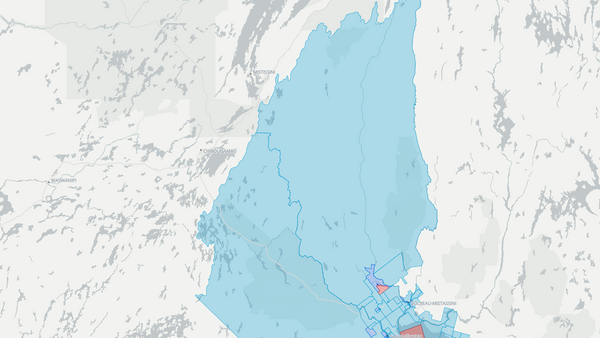
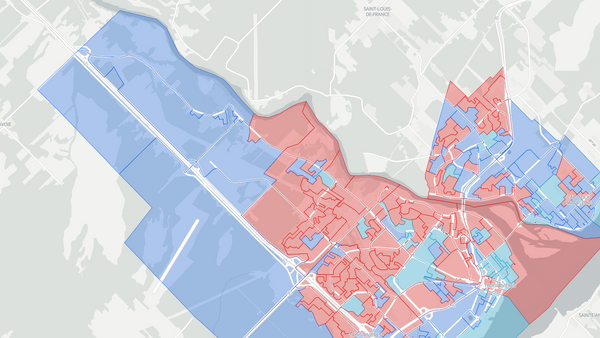
Saint-Maurice—Champlain, QC — 2025 Federal Election Results Map
Saint-Maurice—Champlain — 2025 Election Results
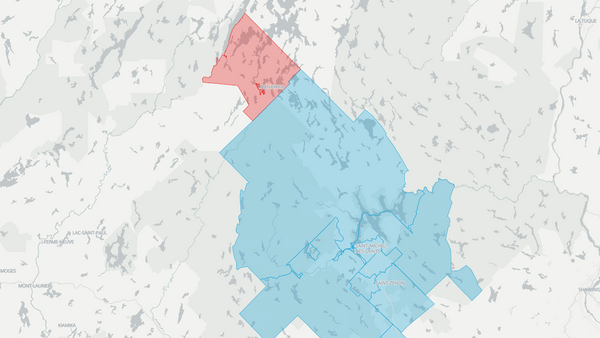
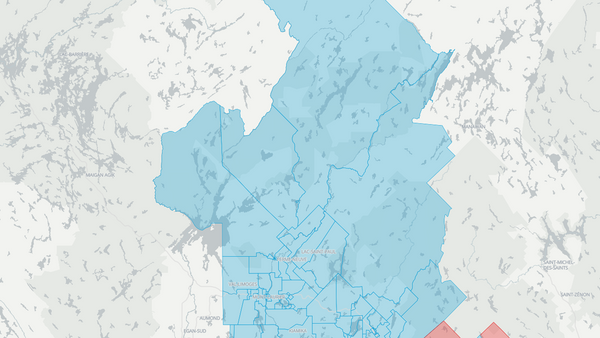
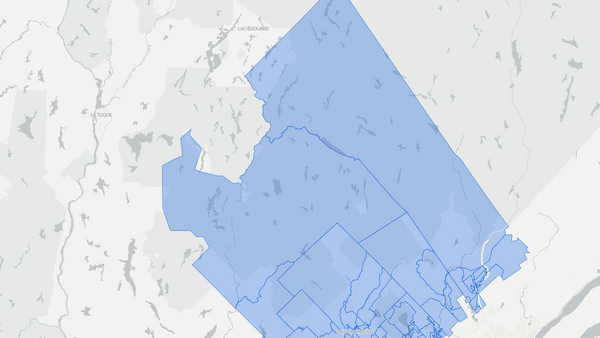
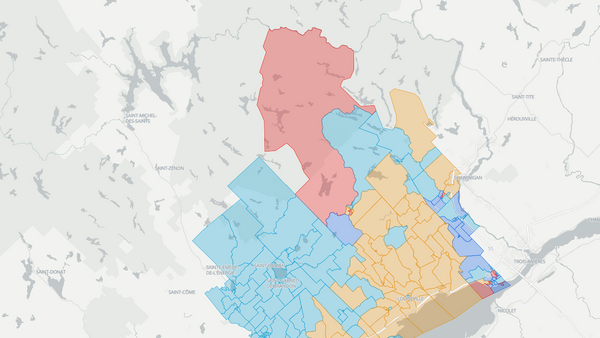
Poll-by-poll results for Saint-Maurice—Champlain in the 2025 Canadian federal election. The Liberal candidate won this riding. Explore detailed voting data, candidate results, and turnout statistics at the poll level.
Riding information
Auto generated. Flag an issue.Saint-Maurice—Champlain
Saint-Maurice—Champlain is a sprawling federal riding in the Mauricie region of Quebec, centred on the city of Shawinigan but extending far northward through the regional county municipalities of Le Haut-Saint-Maurice, Mékinac, and Les Chenaux into the boreal wilderness. The riding has deep roots in Quebec's political history—Shawinigan was the hometown of former Prime Minister Jean Chrétien, and the Mauricie region has long been a bellwether in federal politics. The population is overwhelmingly francophone and the economy has been transitioning from its traditional industrial base.
Candidates
François-Philippe Champagne (Liberal) — Born in Shawinigan, Champagne holds a bachelor of laws from the Université de Montréal and a master of laws from Case Western Reserve University. Before entering politics, he spent more than 20 years as an international business lawyer and executive, serving as vice-president and senior counsel at ABB Group and as strategic development director and chief ethics officer at Amec Foster Wheeler. First elected in 2015, he has held a remarkable succession of cabinet portfolios: Minister of International Trade, Minister of Infrastructure and Communities, Minister of Foreign Affairs, and Minister of Innovation, Science and Industry. He was appointed Minister of Finance in March 2025.
Pierre-Augustin Allard (Conservative) — A native of Shawinigan, Allard holds a bachelor's degree in communication and politics from the Université de Montréal and is pursuing graduate studies at the École nationale d'administration publique. He works as coordinator at the Regroupement des gens d'affaires for Shawinigan-Sud and Grand-Mère. He campaigned on Conservative priorities including tax cuts, housing affordability, and support for local industry.
Thierry Bilodeau (Bloc Québécois) — A communication consultant from La Tuque, Bilodeau holds two university degrees in social communication and public relations. He spent approximately four years as a political adviser at the National Assembly of Quebec before returning to Mauricie in 2022. He previously served as president of the Chamber of Commerce and Industry of the Upper Saint-Maurice and ran as the Bloc candidate in Louis-Saint-Laurent in 2021.
Nathalie Garceau (NDP) — Garceau represented the NDP in the riding, campaigning on the party's platform of workers' rights, healthcare access, and support for seniors.
Marie-Claude Gaudet (Green Party) — Gaudet carried the Green Party banner, emphasizing environmental protection and sustainable development in the resource-rich Mauricie region.
David Rioux (People's Party) — Rioux represented the People's Party of Canada in the riding, running on the PPC's platform of fiscal restraint and reduced government intervention.
About the Riding
Shawinigan was once a powerhouse of Quebec's pulp and paper industry, but the city has undergone significant economic restructuring as traditional manufacturing has declined. The region has worked to diversify into aluminum production, clean energy, and tourism, with the Mauricie's extensive rivers, forests, and La Mauricie National Park drawing outdoor enthusiasts year-round. The northern portion of the riding includes remote, sparsely populated communities in the Saint-Maurice River valley that face challenges common to rural Quebec: aging populations, outmigration of young people, and limited access to healthcare and public services.
In 2025, the riding's federal campaign was dominated by the candidacy of Champagne, one of the most senior cabinet ministers in the Liberal government. His role as Finance Minister gave the riding outsized national significance. Local issues centred on economic development and job creation in a region still recovering from deindustrialization, healthcare workforce shortages, housing affordability, and the impact of US tariffs on Quebec's manufacturing and resource sectors. The northern communities also raised concerns about broadband connectivity and infrastructure investment.