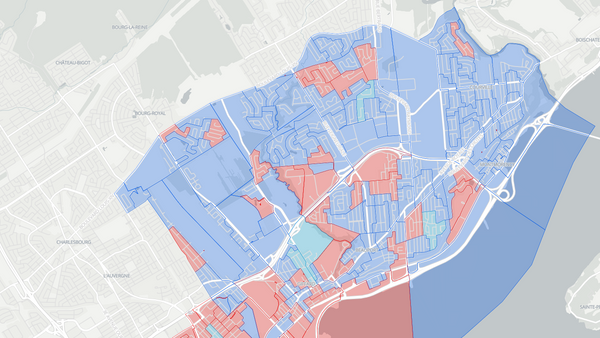
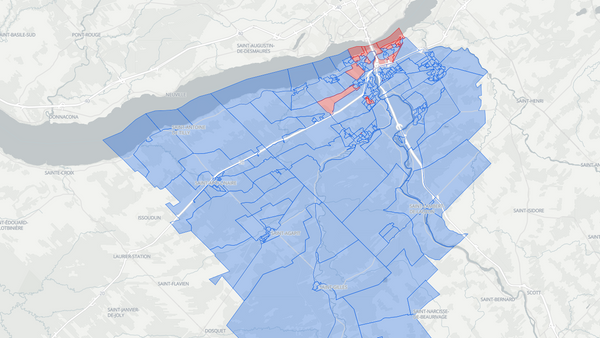
Portneuf—Jacques-Cartier, QC — 2025 Federal Election Results Map
Portneuf—Jacques-Cartier — 2025 Election Results
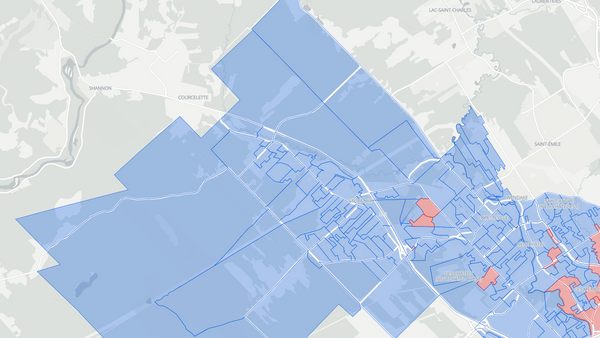
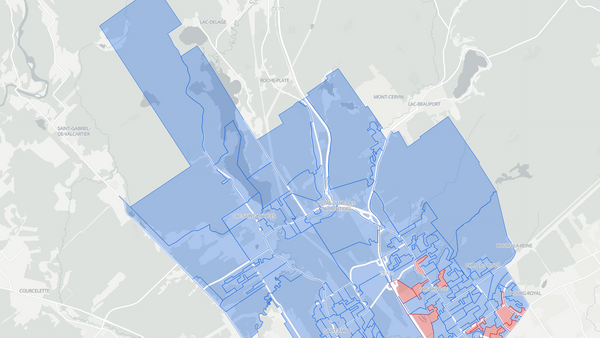
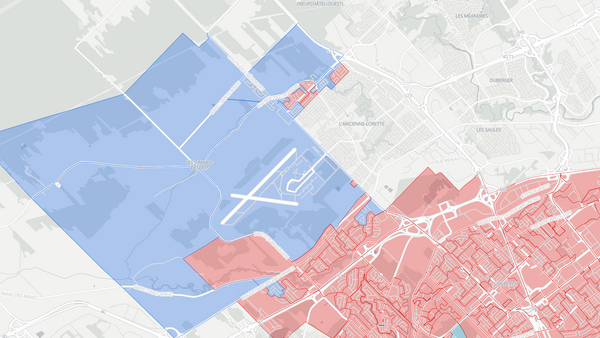
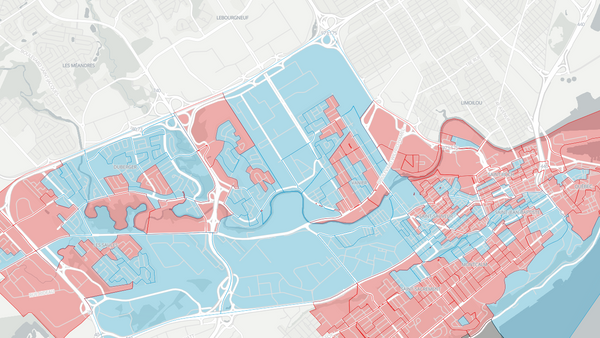
Poll-by-poll results for Portneuf—Jacques-Cartier in the 2025 Canadian federal election. The Conservative candidate won this riding. Explore detailed voting data, candidate results, and turnout statistics at the poll level.
Riding information
Auto generated. Flag an issue.Portneuf—Jacques-Cartier
Portneuf—Jacques-Cartier is a large riding northwest of Quebec City that straddles the St. Lawrence lowlands and the Canadian Shield, encompassing the Regional County Municipalities of Portneuf and La Jacques-Cartier as well as the suburb of Saint-Augustin-de-Desmaures. Its principal communities include Donnacona, Pont-Rouge, Shannon, Lac-Beauport, Stoneham-et-Tewkesbury, Saint-Raymond, and Sainte-Catherine-de-la-Jacques-Cartier. More than 80 percent of the riding’s territory is forested owing to the rocky Precambrian geology of the Shield, though productive agricultural land along the St. Lawrence supports dairy farming and orchard operations. The riding’s population is overwhelmingly francophone, with an anglophone presence in the military community of Shannon.
Candidates
Joël Godin (Conservative) — First elected in 2015, Godin sought a fourth consecutive term. Born in 1965, he is a former municipal councillor in Saint-Joachim and a self-described progressive conservative. He has served as Vice-Chair of the Standing Committee on Official Languages and is a member of the Assemblée parlementaire de la Francophonie. During the 2022 Conservative leadership race he endorsed Jean Charest, though he subsequently worked within Pierre Poilievre’s caucus.
Antonin Leroux (Liberal) — Acclaimed as the Liberal candidate, Leroux holds a bachelor’s degree in administration from HEC Montréal, a master’s in economics from the Université de Montréal, and completed doctoral coursework in administration at Université Laval. He co-founded an insurance firm specializing in surety bonds in 2013, which he sold to a national group in 2020. He has also worked at Export Development Canada and in the research office of the National Liberal Caucus.
Christian Hébert (Bloc Québécois) — An agricultural entrepreneur from Deschambault-Grondines, Hébert owns Domaine Hébert, the first cidery in the Portneuf region, and co-owns Verger du Roy with his wife. He is also a beekeeper and master cellar keeper, and has been decorated as a Knight of the National Order of Agricultural Merit. This was his third candidacy for the Bloc Québécois in the riding.
Félix Couture (NDP) — Couture carried the NDP banner in Portneuf—Jacques-Cartier, campaigning on the party’s platform of pharmacare, housing affordability, and workers’ rights.
Johann Queffelec (Green Party) — Queffelec represented the Green Party of Canada in the riding, running on environmental protection and electoral reform.
Simon Frenette (People’s Party) — Frenette ran for the People’s Party of Canada on the party’s national platform of reduced government spending, lower immigration, and fiscal conservatism.
About the Riding
The southern portion of the riding, anchored by Saint-Augustin-de-Desmaures, functions as a prosperous suburb of Quebec City with newer residential developments and proximity to major employers. Further north, the landscape transitions into the Laurentian foothills, where forestry, outdoor recreation, and the tourism economy of ski resorts and cottage communities drive local employment. Stoneham-et-Tewkesbury is home to a popular ski resort, while Saint-Raymond serves as a gateway to the Jacques-Cartier River valley.
Agriculture remains important in the St. Lawrence corridor, where dairy farms, orchards, and artisanal food producers contribute to Portneuf’s growing reputation as a culinary destination. The defence of the federal supply-management system, which protects local dairy farmers from import competition, was a particularly resonant issue in the 2025 campaign as US trade pressures threatened to reopen market-access concessions.
Other key 2025 issues included housing affordability in suburban communities experiencing spillover growth from Quebec City, the preservation of French-language rights, and infrastructure investments for municipalities stretched between the demands of suburban expansion and the maintenance of rural services.