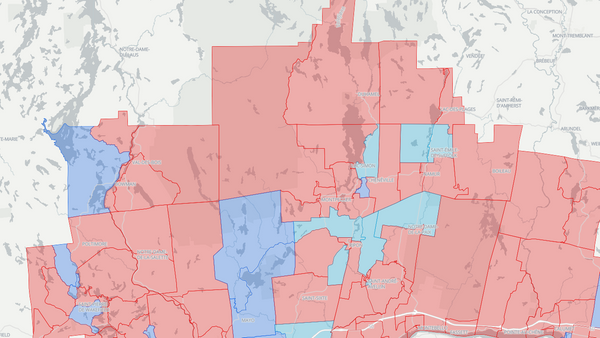
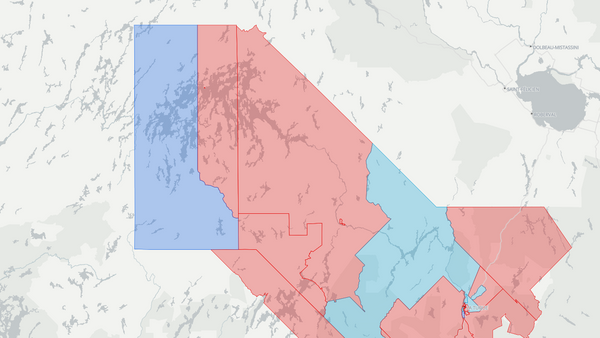
Abitibi—Témiscamingue, QC — 2025 Federal Election Results Map
Abitibi—Témiscamingue — 2025 Election Results
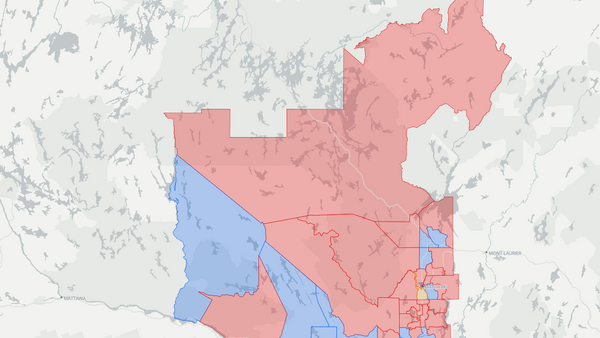
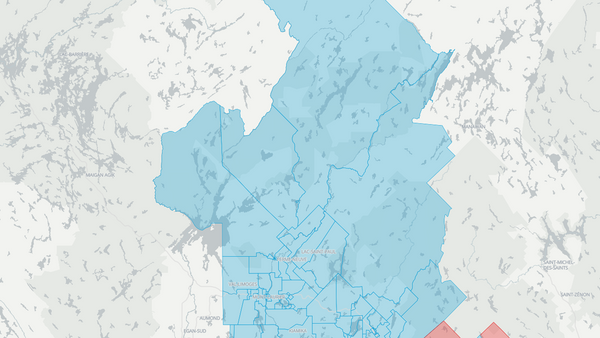
Poll-by-poll results for Abitibi—Témiscamingue in the 2025 Canadian federal election. The Bloc Québécois candidate won this riding. Explore detailed voting data, candidate results, and turnout statistics at the poll level.
Riding information
Auto generated. Flag an issue.Abitibi--Temiscamingue
Abitibi--Temiscamingue covers the western flank of Quebec along the Ontario border, taking in the cities of Rouyn-Noranda and Val-d'Or as well as the Temiscamingue region to the south. The riding spans roughly 57,000 square kilometres of boreal forest, lakes, and mineral-rich Canadian Shield terrain. Its approximately 90,000 residents depend heavily on mining and forestry, the two economic pillars that have shaped the region since the early twentieth century. Rouyn-Noranda, founded in 1926, and Val-d'Or, established in 1934, grew up around gold and base-metal deposits along the geologically significant Cadillac Fault.
Candidates
Sebastien Lemire (Bloc Quebecois) is the incumbent, first elected in 2019 and now serving his third consecutive term. A long-time sovereigntist activist, he previously served as president of the youth wing of the Parti Quebecois. In Parliament, Lemire has been the Bloc's spokesperson on agriculture, agri-food and supply management, sports, public accounts, and regional economic development.
Jonathan Andresen (Liberal) ran as the Liberal candidate in the riding, seeking to challenge the Bloc's hold on the seat.
Steve Tardif (Conservative) ran as the Conservative Party candidate, bringing a centre-right perspective to the resource-dependent riding.
Jeremie Juneau (NDP) represented the New Democratic Party in the race, campaigning on workers' rights and environmental issues relevant to the mining region.
Vincent Palin-Bussieres (Parti Rhinoceros Party) ran under the satirical Rhinoceros Party banner, a tradition of protest candidacies in Canadian federal elections dating back to the 1960s.
About the Riding
Mining is the dominant economic force in Abitibi--Temiscamingue, accounting for more than a third of the region's GDP. Gold mining along the Cadillac Fault between Val-d'Or and Rouyn-Noranda remains highly productive, while new exploration for lithium, copper, nickel, and rare earth elements has positioned the region as a resource frontier for critical minerals essential to the energy transition. The forestry sector, once equally prominent, has contracted under the pressure of softwood lumber tariffs, mill closures, and shifting global demand.
Rouyn-Noranda has faced persistent environmental controversy over emissions from the Horne copper smelter, operated by Glencore. Elevated arsenic levels in the air near the smelter prompted public health concerns and calls for stricter regulations, a debate that pitted environmental and health advocates against the economic reality of a facility that employs hundreds of workers in a region with limited alternatives.
Labour shortages have become a defining challenge for the region. Mining and forestry companies struggle to recruit skilled workers, and the remoteness of the riding makes retention difficult. Housing availability in Rouyn-Noranda and Val-d'Or tightened significantly as mining activity increased, pushing up costs for a population accustomed to affordable living. Health-care access in rural communities, the cost of living, and reliable transportation links across the riding's enormous distances were central concerns heading into the 2025 election.