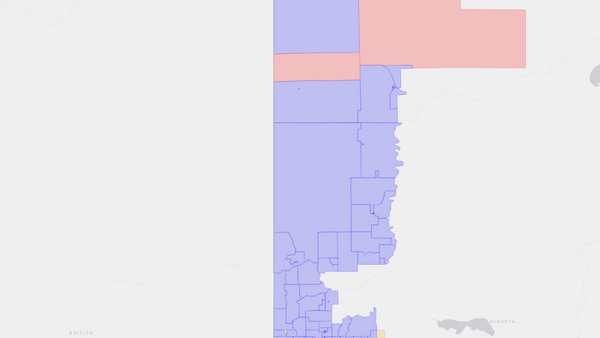
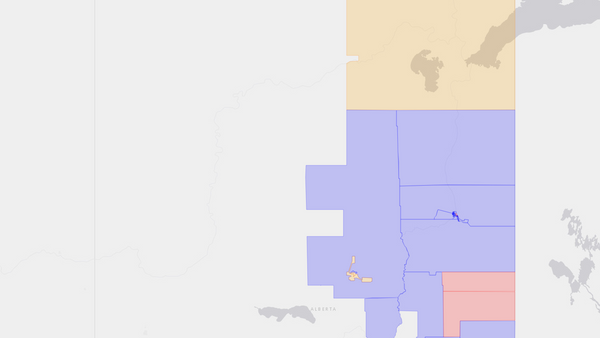
Peace River—Westlock, AB — 2021 Federal Election Results Map
Peace River—Westlock — 2021 Election Results
📌 The Canadian federal electoral district of Peace River—Westlock was contested in the 2021 election.
🏆 Arnold Viersen, the Conservative candidate, won the riding with 29,486 votes (63.0% of the vote).
🥈 The runner-up was Gail Ungstad (NDP) with 6,019 votes (12.9%), defeated by a margin of 23,467 votes.
📊 Other notable candidates: Darryl Boisson (PPC, 13%), Colin Krieger (Maverick Party, 5%) and Leslie Penny (Liberal, 5%).
Riding information
Auto generated. Flag an issue.Peace River—Westlock
Peace River—Westlock covers 105,095 square kilometres of north-central Alberta—an area slightly larger than Iceland—stretching from the town of Westlock, just north of Edmonton, to the communities near the 60th parallel that divides Alberta from the Northwest Territories. The riding, created in the 2012 redistribution, includes the towns of Peace River, High Prairie, Slave Lake, Athabasca, Barrhead, and Westlock, as well as Fort Vermilion and numerous First Nation and Métis communities. With a population of approximately 113,900, it is one of the most sparsely populated ridings in the country. The terrain is predominantly boreal plains—the northern extension of the prairies—with relatively flat topography and limited precipitation, as the Rocky Mountains to the west block most moisture-bearing weather systems. Fort Vermilion and communities near the riding's northern boundary experience nearly 18 hours of daylight at the summer solstice and as few as six hours in midwinter.
Candidates
Arnold Viersen (Conservative) Born in 1986 in Barrhead and raised in the rural community of Neerlandia, Viersen attended Covenant Canadian Reformed School from Grade 1 through Grade 12. He apprenticed as an auto service technician at NAIT, earned his journeyman ticket, and later obtained a business degree from the University of the Fraser Valley while continuing his automotive career. First elected in 2015, he served on the Indigenous and Northern Affairs Committee and as the Official Opposition's Deputy Critic of Rural Affairs. In 2016, his Motion M-47 on the public health effects of online sexually explicit material was unanimously adopted by the House of Commons.
Gail Ungstad (NDP) A social worker based in Slave Lake who spent more than 40 years living and working across northwestern Alberta, Ungstad holds two bachelor's degrees and two master's degrees from the universities of Alberta, Calgary, Graceland (USA), and Loma Linda. She operated a private counselling practice specializing in Indigenous trauma and residential school survivors. Her campaign priorities included mental health services, affordable housing, and supports for families in remote communities.
Darryl Boisson (PPC) A fourth-generation farmer and trapping business owner from the High Prairie area, Boisson had previously run provincially for the Wildrose Party. Married for 40 years with two grown children and four grandchildren, he joined the People's Party after disagreeing with Conservative leader Erin O'Toole's carbon pricing position.
Colin Krieger (Maverick Party) A long-time Valleyview oilfield operator, Krieger was new to politics when he was drawn to the Maverick Party's stance on western independence and stronger western representation within Confederation. He subsequently became leader of the Maverick Party in May 2022.
About the Riding
Peace River—Westlock's economy is built on oil and gas extraction, agriculture, and forestry. The Peace Country region produces significant volumes of conventional oil and natural gas, with drilling and pipeline activity providing employment across the riding's western and northern reaches. The agricultural sector is diverse, with grain farming, cattle ranching, and mixed operations spread across the riding's southern half. The Peace River district's long summer days and fertile grey luvisol soils support surprisingly productive canola and grain crops at latitudes where farming might seem improbable.
Forestry operations, including pulp mills and lumber facilities, employ workers in communities such as Slave Lake, High Prairie, and along Highway 2 north of Athabasca. Slave Lake was devastated by wildfire in May 2011, when the town lost approximately one-third of its residential properties—roughly 374 homes and other structures—in what was then the second-costliest disaster in Canadian history. A decade later, the community had largely rebuilt but the experience left lasting scars on the town's collective memory and heightened awareness of wildfire risk across the boreal region.
The riding is home to a large Indigenous population, including multiple First Nations and Métis settlements. Communities such as Wabasca-Desmarais, Peerless Trout First Nation, and Bigstone Cree Nation in the northeast face acute challenges around housing, clean water, health care access, and educational attainment. The riding's cultural mosaic also includes French-Canadian farming communities in the south and east—part of Alberta's historic Francophone settlement corridor—and Mennonite and Hutterite German-Canadian farming communities to the north and northwest of the Town of Peace River. About 6% of the riding's population are immigrants, with the Philippines, the United Kingdom, and the Netherlands among the most common countries of origin.