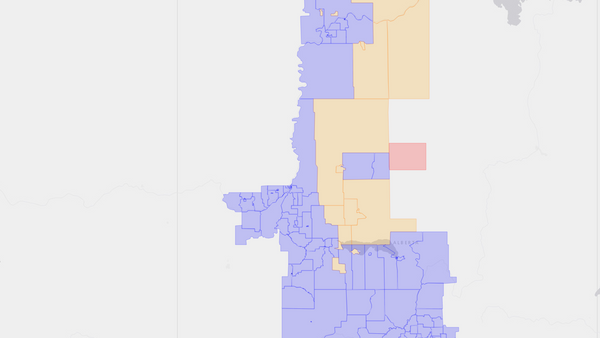
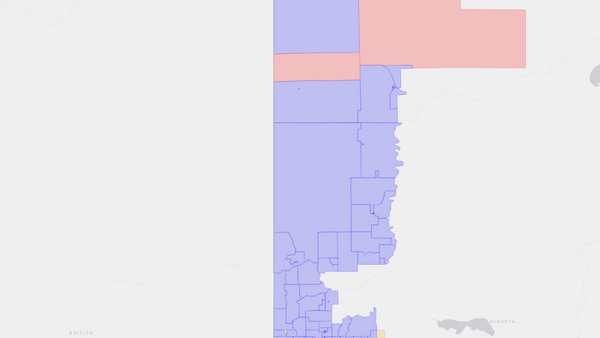
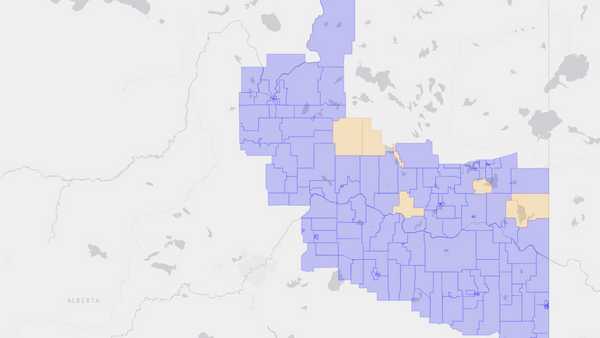
Fort McMurray—Cold Lake, AB — 2021 Federal Election Results Map
Fort McMurray—Cold Lake — 2021 Election Results
📌 The Canadian federal electoral district of Fort McMurray—Cold Lake was contested in the 2021 election.
🏆 Laila Goodridge, the Conservative candidate, won the riding with 29,242 votes (67.8% of the vote).
🥈 The runner-up was Shawn McDonald (PPC) with 5,481 votes (12.7%), defeated by a margin of 23,761 votes.
📊 Other notable candidates: Garnett Robinson (NDP, 10%) and Abdifatah Abdi (Liberal, 7%).
Riding information
Auto generated. Flag an issue.Fort McMurray—Cold Lake
Fort McMurray—Cold Lake covers a vast expanse of northeastern Alberta, taking in the Regional Municipality of Wood Buffalo, the City of Cold Lake, and Lac La Biche County. Created in the 2012 redistribution from portions of the former Fort McMurray—Athabasca and Westlock—St. Paul ridings, the district encompasses most of the Athabasca oil sands—the world's third-largest proven crude oil reserve—as well as Canadian Forces Base Cold Lake, one of Canada's busiest military air bases. Fort McMurray, the riding's population centre, recorded approximately 68,000 residents in its urban core in the 2021 census, while Cold Lake, roughly 300 kilometres to the southeast, is home to around 15,000 people.
Candidates
Laila Goodridge (Conservative) A lifelong Fort McMurray resident, Goodridge is fluently bilingual and holds a Bachelor of Arts from the University of Alberta's Campus Saint-Jean. She spent several years working in Alberta's oil sands sector and played a key role in provincial disaster recovery following the 2016 Fort McMurray wildfire. She served as MLA for Fort McMurray-Lac La Biche from 2018 to 2021, winning a 2018 by-election and subsequently serving as Parliamentary Secretary for the Francophonie in the Alberta legislature.
Shawn McDonald (PPC) Born and raised in Lac La Biche, McDonald is a lifelong Albertan who founded Black Scorpion Contracting in 1997. He originally sought the Conservative nomination but turned to the People's Party after the Conservative Party bypassed the local nomination process. The outgoing Conservative MP for the riding, David Yurdiga, publicly endorsed McDonald's candidacy.
Garnett Robinson (NDP) A social worker who moved to the Lac La Biche area in 1985 to work in child and youth care for the Alberta government, Robinson retired from that role shortly before the 2021 election. His campaign focused on bridging the economic, social, and technological gaps between small rural communities and larger urban centres, and he advocated for universal pharmacare and a guaranteed livable income.
Abdifatah Abdi (Liberal) The Liberal Party candidate for the riding, Abdi sought to offer an alternative voice in a region traditionally dominated by Conservative representation.
About the Riding
The Athabasca oil sands are the defining economic reality of Fort McMurray—Cold Lake. Major producers including Suncor, Syncrude, Canadian Natural Resources, and Imperial Oil operate surface mining and in-situ extraction facilities across the region, generating tens of billions of dollars in annual economic output and employing tens of thousands of workers directly and through contractors. The industry's boom-and-bust cycles shape virtually every aspect of life in the riding, from housing costs to municipal infrastructure.
The 2016 Horse River wildfire, which forced the evacuation of approximately 88,000 people from Fort McMurray and destroyed roughly 2,400 structures, remained a defining event for the community heading into 2021. Rebuilding efforts continued years later, and the experience shaped local attitudes toward emergency preparedness, insurance policy, and climate adaptation. In April 2020, major flooding along the Athabasca River caused further displacement and property damage, compounding the community's disaster fatigue.
Cold Lake, in the riding's southeast, has a dual identity as an energy town and a military community. CFB Cold Lake is home to 4 Wing, one of Canada's principal fighter aircraft bases, operating CF-18 Hornets and hosting international training exercises. The base is a major regional employer. The Cold Lake oil sands, extracted primarily through thermal in-situ methods such as cyclic steam stimulation and steam-assisted gravity drainage, support a significant petroleum production cluster around the city. The riding's Indigenous communities—including several First Nations and Métis settlements—have complex relationships with the energy sector, balancing employment opportunities against environmental and cultural concerns.