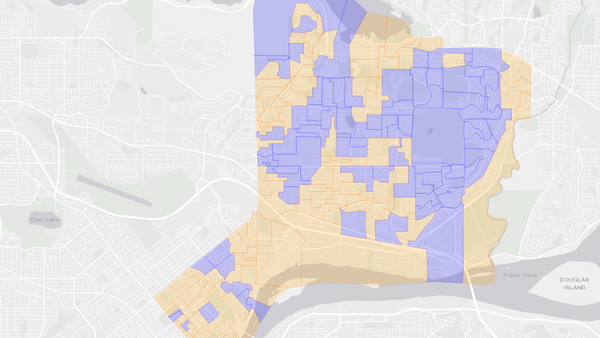
Langley, BC — 2011 Federal Election Results Map
Langley — 2011 Election Results
📌 The Canadian federal electoral district of Langley was contested in the 2011 election.
🏆 Mark Warawa, the Conservative candidate, won the riding with 35,569 votes (64.5% of the vote).
🥈 The runner-up was Piotr Majkowski (NDP-New Democratic Party) with 11,277 votes (20.5%), defeated by a margin of 24,292 votes.
📊 Other notable candidates: Rebecca Darnell (Liberal, 9%) and Carey Ann Poitras (Green Party, 5%).
Riding information
Auto generated. Flag an issue.Langley
Langley was a suburban riding in British Columbia’s Fraser Valley, situated east of Surrey and south of the Fraser River. The riding encompassed the Township of Langley and the City of Langley, featuring a mix of newer suburban subdivisions in Walnut Grove and Willoughby alongside agricultural lands, horse farms, and the historic community of Fort Langley. With a population that grew rapidly through the 2000s, Langley was one of the fastest-developing communities in Metro Vancouver.
Candidates
Mark Warawa (Conservative)* — Warawa was first elected to represent Langley in 2004 after serving as a city councillor in Abbotsford from 1990 to 2004. Born on May 7, 1950, he was named parliamentary secretary to the Minister of the Environment in 2006, a role he held until 2011, and served on numerous parliamentary committees dealing with the environment and sustainable development. A social conservative, he later drew national attention for a private member’s motion condemning sex-selective abortion. He lived in Langley with his wife Diane and their five children and won re-election in 2011 with approximately 35,500 votes.
Piotr Majkowski (NDP) — Majkowski was a 26-year-old nurse at Langley Memorial Hospital and with the Strathcona Mental Health team. He had come to Canada from Poland at age seven and studied nursing at Douglas College, where he was inspired to enter politics by one of his instructors. He had served as campaign manager for NDP candidate Kathleen Stephany in the 2009 provincial election and ran on a platform focused on health care issues.
Rebecca Darnell (Liberal) — Darnell was a lawyer who had served on the boards of the Langley Community Services Society, the Langley Memorial Hospital Foundation, and the Canadian Museum of Flight. She finished third with approximately 4,990 votes and later ran for Langley Township council.
Carey Ann Poitras (Green Party) — Poitras was a community volunteer and 4-H leader in Aldergrove who ran as the Green Party candidate. She and Liberal candidate Rebecca Darnell became friends during the campaign, and years later the two former rivals announced a joint run for Langley Township council together.
Craig Nobbs (Pirate Party) — Nobbs ran a zero-budget campaign for the Pirate Party of Canada, one of only ten Pirate Party candidates nationally in the party’s first general election.
About the Riding
Langley was a rapidly growing suburban constituency that reflected the expansion of Metro Vancouver’s eastern suburbs. The Township of Langley’s population surpassed 104,000 by the 2011 census, an increase of more than eleven percent from 2006, driven by families seeking more affordable housing than in Vancouver proper. Neighbourhoods like Willoughby, Walnut Grove, and Murrayville featured newer developments of single-family homes and townhouses, while big-box retail at the Willowbrook Shopping Centre served as a regional commercial hub.
Despite its suburban growth, the riding retained a significant agricultural character. The southern and southeastern portions of the township remained active farmland, and the local equine industry was valued at over sixty million dollars annually, earning Langley the unofficial title of Horse Capital of British Columbia. Fort Langley, a heritage village along the Fraser River, attracted tourists with its historic fur-trading post and artisan shops. The riding’s economy also benefited from light industrial operations, construction trades, and proximity to the Trans-Canada Highway and the Canada–U.S. border crossing at Aldergrove.
Demographically, Langley’s population was predominantly English-speaking, with roughly 83 percent reporting English as their mother tongue in 2011. The riding had a younger family profile than much of Metro Vancouver, with nearly 19 percent of residents under the age of 15. Married-couple families made up about 76 percent of census families, and single-detached homes were the dominant housing type.
Politically, Langley was among the safest Conservative seats in British Columbia. Warawa had held the riding since 2004, and before him Reform and Canadian Alliance candidates had dominated. The NDP and Liberals struggled to gain traction in a riding whose suburban, family-oriented, and socially conservative electorate aligned closely with the Harper Conservatives. Warawa’s 2011 victory was decisive, continuing a pattern of overwhelming Conservative margins that would persist until the riding was redistricted as Langley—Aldergrove.