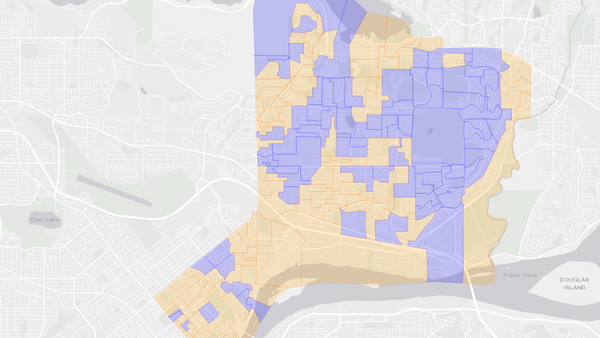
Surrey North, BC — 2011 Federal Election Results Map
Surrey North — 2011 Election Results
📌 The Canadian federal electoral district of Surrey North was contested in the 2011 election.
🏆 Jasbir Sandhu, the NDP-New Democratic Party candidate, won the riding with 14,678 votes (39.7% of the vote).
🥈 The runner-up was Dona Cadman (Conservative) with 13,181 votes (35.6%), defeated by a margin of 1,497 votes.
📊 Other notable candidates: Shinder Purewal (Liberal, 18%).
Riding information
Auto generated. Flag an issue.Surrey North
Surrey North was a federal electoral district in the northern portion of Surrey, British Columbia, bounded by the Fraser River to the north and west and extending south to approximately 88th Avenue. The riding encompassed the neighbourhoods of Whalley, Guildford, and parts of the City Centre area, forming part of one of the fastest-growing municipalities in Metro Vancouver. With a diverse, largely suburban population and significant South Asian community, Surrey North reflected the demographic transformation reshaping the Lower Mainland.
Candidates
-
Jasbir Sandhu (NDP) — Sandhu was born in Punjab, India, and emigrated to Canada as a child, growing up in Surrey. He graduated from Queen Elizabeth Secondary School, then worked his way through Simon Fraser University by waiting tables and driving a taxi before earning his bachelor's degree. He later obtained a Master of Business Administration from Royal Roads University. Beginning in the mid-1990s, Sandhu worked as an instructor and program coordinator at the Justice Institute of British Columbia, eventually becoming the program manager of TaxiHost, a mandatory training program for taxi drivers. He was active in the community, volunteering with the United Way and serving on the board of the Vancity Community Foundation, and was also a spokesperson for the Prof Mohan Singh Memorial Foundation, which lobbied for a federal apology for the 1914 Komagata Maru incident.
-
Dona Cadman (Conservative)* — Cadman was the incumbent MP, first elected in the 2008 general election after NDP incumbent Penny Priddy chose not to seek re-election. Cadman's late husband Chuck Cadman had been the beloved Independent MP who represented the area before his death from cancer in 2005. Born into a military family in Chilliwack, B.C., she lived on eleven different Canadian Forces bases during her youth. After their son Jesse was murdered by young offenders in 1992, Dona and Chuck founded CRY (Crime Responsibility and Youth), an advocacy organization pushing for tougher youth justice laws. She ran as a Conservative and won narrowly in 2008, serving as a government backbencher focused on public safety issues.
-
Shinder Purewal (Liberal) — Dr. Purewal was a professor of political science at Kwantlen Polytechnic University, having joined the faculty in 2001. He held a BA and MA from Simon Fraser University and a PhD from Queen's University in Kingston. An author of books including Sikh Ethnonationalism (Oxford University Press) and Tandoori Democracy, he had also served as a Citizenship Judge for British Columbia and Yukon. Purewal had previously run for Burnaby city council in 1999.
-
Bernadette Keenan (Green Party) — Keenan was the Green Party candidate who advocated for a balanced federal budget, elimination of subsidies for large corporations, and implementation of a carbon tax.
-
Jamie Scott (Independent) — Scott ran as an independent candidate in Surrey North.
-
Kevin Pielak (CHP) — Pielak represented the Christian Heritage Party in the riding.
-
Norris Barens (Libertarian) — Barens ran for the Libertarian Party of Canada.
About the Riding
Surrey North in 2011 was a riding defined by rapid population growth, cultural diversity, and the economic pressures facing working-class suburban communities. The riding's population was heavily multicultural, with a particularly large South Asian community that had transformed the area's cultural landscape over the preceding decades. Many residents were first- or second-generation immigrants who had settled in Surrey's more affordable housing market after being priced out of Vancouver proper. The average family income in the riding sat around $50,000, well below the Metro Vancouver average, and unemployment hovered near nine percent.
The local economy was driven by a mix of manufacturing, retail, and service-sector employment. Many residents commuted to jobs across Metro Vancouver, making transportation infrastructure a persistent concern. The South Fraser Perimeter Road and other Gateway Program projects were under construction, promising to reshape the area's transportation corridors. Kwantlen Polytechnic University's Surrey campus was a significant local institution, and Fraser Health was the region's largest employer. Small businesses, including many South Asian-owned shops and restaurants along the 128th Street corridor, formed the backbone of the local commercial landscape.
The dominant issue in the 2011 campaign was the deeply unpopular Harmonized Sales Tax, which had been introduced through an agreement between the Harper federal government and the B.C. Liberal provincial government. Incumbent MP Dona Cadman found herself in a difficult position on the HST—after telling constituents she believed 85 percent of them opposed the tax, she abstained from voting on it in Parliament, explaining that voting against it would have been "poking her party in the eye." This stance alienated many voters. Immigration policy, particularly the recognition of foreign credentials for doctors and nurses, was another important issue, as many highly trained immigrants in the riding were working in jobs far below their qualifications.
The 2011 election in Surrey North was one of the most dramatic contests in British Columbia, as the NDP's Orange Wave swept into what had been considered safe Conservative territory. Jasbir Sandhu defeated the incumbent Cadman by approximately 1,500 votes, riding the national surge in NDP support driven by Jack Layton's popularity. The result was part of a broader NDP breakthrough in Surrey, where the party had historically struggled, and reflected voter frustration with both the Conservatives on the HST issue and the collapsing Liberal vote, which split heavily toward the NDP in this election.