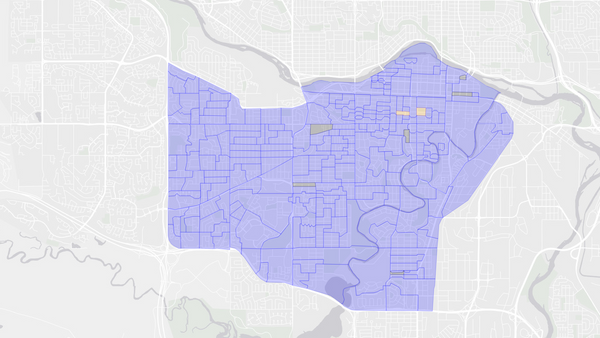
Red Deer, AB — 2011 Federal Election Results Map
Red Deer — 2011 Election Results
📌 The Canadian federal electoral district of Red Deer was contested in the 2011 election.
🏆 Earl Dreeshen, the Conservative candidate, won the riding with 37,959 votes (75.9% of the vote).
🥈 The runner-up was Stuart Somerville (NDP-New Democratic Party) with 7,566 votes (15.1%), defeated by a margin of 30,393 votes.
📊 Other notable candidates: Mason Connor Sisson (Green Party, 5%).
Riding information
Auto generated. Flag an issue.Red Deer
Red Deer is a federal electoral district in central Alberta centred on the City of Red Deer, the province’s third-largest city, situated midway between Calgary and Edmonton along the Highway 2 corridor. With a 2011 population of approximately 90,500 in the census agglomeration, the city serves as the commercial, health care, and service hub for the surrounding agricultural and energy-producing region of central Alberta. The riding extends beyond the city limits into portions of Red Deer County, encompassing nearby rural communities and farmland.
Candidates
Earl Dreeshen (Conservative) — Born in 1953, Dreeshen is a fourth-generation farmer from the Red Deer County area near Pine Lake. He earned a Bachelor of Education from the University of Alberta and taught mathematics and science at Innisfail High School for thirty-four years before retiring in June 2008 to enter politics. First elected in 2008, he won re-election in 2011 with over 75 percent of the vote, one of the highest margins in the country. He continued to serve as an MP until announcing his retirement ahead of the 2025 election.
Stuart Somerville (NDP) — Somerville ran as the NDP candidate in Red Deer during the 2011 election, finishing third in a riding where the party had limited traction despite the national Orange Wave. The NDP’s support in central Alberta was constrained by the region’s deep ties to the energy sector and its traditionally conservative political culture.
Mason Connor Woodruff Sisson (Green Party) — Sisson represented the Green Party in the Red Deer riding, running as part of the party’s effort to field candidates across Alberta’s constituencies.
Andrew Lineker (Liberal) — Lineker was the Liberal candidate in Red Deer, having also run for mayor in Edmonton’s 2010 municipal election. He was ill during a candidates’ debate and was represented by the local Liberal association’s vice-president. The Liberal Party struggled to find traction in a riding where Conservative dominance was overwhelming.
About the Riding
Red Deer occupies a strategic position at the geographic and economic centre of the Calgary-Edmonton corridor, Alberta’s most important economic axis. The city’s location roughly ninety minutes from each of the province’s two major cities has made it a natural hub for distribution, retail, health care, and services catering to central Alberta’s population. Red Deer Regional Hospital Centre serves as the primary health care facility for the region, and Red Deer College (now Red Deer Polytechnic) provides post-secondary education and workforce training.
The economy of Red Deer and its surrounding area is deeply intertwined with the oil and gas industry. The NOVA Chemicals petrochemical complex at Joffre, in Lacombe County east of the city and outside the riding, is a world-scale facility occupying 900 acres and employing over 800 permanent staff. The Joffre site produces billions of pounds of polyethylene annually and is one of the largest integrated petrochemical complexes in North America. Beyond petrochemicals, conventional oil and gas drilling, oilfield services, and pipeline operations provide significant employment throughout the riding. Agriculture remains a strong economic force, with the surrounding Red Deer County supporting mixed farming, cattle ranching, and grain production.
Demographically, Red Deer had a notably young population in 2011, with a median age of 34.7, well below the national average. The city’s youthful profile reflected the influx of workers drawn by energy sector employment and the relatively affordable cost of living compared to Calgary and Edmonton. The population was predominantly English-speaking, with approximately 87 percent reporting English as their mother tongue. Health care and social assistance, retail trade, and construction were among the largest employment sectors alongside the mining and oil and gas extraction industry.
Politically, Red Deer was a bedrock Conservative riding that embodied the party’s core western Canadian constituency. Earl Dreeshen’s 75 percent vote share in 2011 was typical of the riding’s electoral history, reflecting the deep alignment between central Alberta’s energy-dependent economy and the Conservative platform of resource development, low taxation, and fiscal discipline. Local issues in 2011 included energy sector regulation, the health of the petrochemical industry, infrastructure investment along the Highway 2 corridor, and agricultural trade policy. The riding was split ahead of the 2015 redistribution into Red Deer—Lacombe and Red Deer—Mountain View.