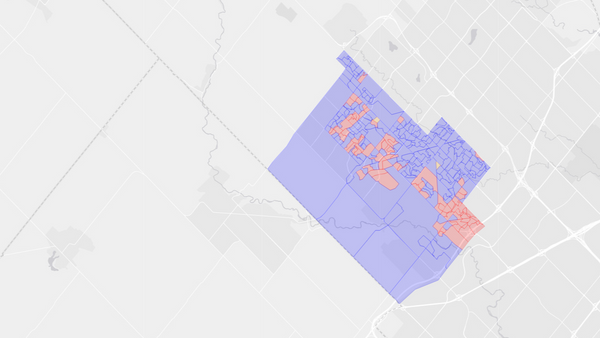
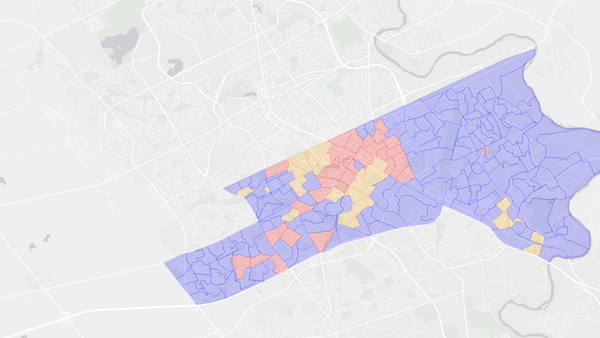
Wellington—Halton Hills, ON — 2011 Federal Election Results Map
Wellington—Halton Hills — 2011 Election Results
📌 The Canadian federal electoral district of Wellington—Halton Hills was contested in the 2011 election.
🏆 Michael Chong, the Conservative candidate, won the riding with 35,132 votes (63.7% of the vote).
🥈 The runner-up was Barry Peters (Liberal) with 9,034 votes (16.4%), defeated by a margin of 26,098 votes.
📊 Other notable candidates: Anastasia Zavarella (NDP-New Democratic Party, 13%) and Brent Bouteiller (Green Party, 6%).
Riding information
Auto generated. Flag an issue.Wellington—Halton Hills
Wellington—Halton Hills was a mixed rural and suburban riding in southwestern Ontario, spanning parts of Wellington County and the Regional Municipality of Halton. It included the Town of Halton Hills, with its principal communities of Georgetown and Acton, along with the townships of Centre Wellington, Guelph/Eramosa, and Puslinch and the Town of Erin in Wellington County. The riding stretched from the growing commuter suburbs on its southern edge, within the orbit of the Greater Toronto Area, northward into rolling agricultural country around Fergus and Elora.
Candidates
Michael Chong (Conservative) — Chong had represented the riding since its creation in the 2004 federal election. Born in Windsor, Ontario, in 1971, he was raised near Fergus and attended Centre Wellington District High School. He studied political science and history at the University of Toronto's Trinity College. Chong first ran for Parliament in the 2000 election as a Progressive Conservative candidate in Waterloo—Wellington. After the Conservative merger, he won the nomination in Wellington—Halton Hills and was elected in 2004. He served in Prime Minister Stephen Harper's cabinet as Minister of Intergovernmental Affairs, Minister of Sport, and President of the Queen's Privy Council from February to November 2006, when he resigned from cabinet over his opposition to a House of Commons motion recognizing the Québécois as a nation within Canada. He returned to the backbenches but remained an active voice on democratic reform in Parliament.
Barry Peters (Liberal) — Peters won the Liberal nomination for Wellington—Halton Hills by acclamation. He had early political experience working on the campaign of former Guelph—Wellington MP Brenda Chamberlain while in high school and focused his campaign on issues including the deficit, the economy, and climate change.
Anastasia Zavarella (NDP) — Zavarella was the NDP candidate in the riding.
Brent Bouteiller (Green Party) — Bouteiller was the Green Party candidate in Wellington—Halton Hills.
Jeffrey Streutker ran for the Christian Heritage Party.
About the Riding
The riding had a population of approximately 116,000 as of the 2011 census and exhibited a split character between its suburban south and rural north. Georgetown, the largest community in the riding with a population of roughly 42,000, was a growing commuter town with GO Transit rail service connecting residents to Union Station in Toronto. Acton, smaller and historically tied to the leather-tanning industry, served as a quieter residential community. Both communities were part of the Town of Halton Hills, which was experiencing steady population growth driven by families relocating from the GTA.
The northern portion of the riding centred on Centre Wellington, where the towns of Fergus and Elora anchored the local economy. Fergus had Scottish heritage roots and hosted an annual Highland Games festival. Elora, at the junction of the Grand and Irvine Rivers, was a tourism destination known for the Elora Gorge. Major employers in Centre Wellington included Jefferson Elora Corporation, Nexans Canada, Polycorp Ltd., and Groves Memorial Hospital.
The riding's economy was diverse, blending advanced manufacturing, agriculture, and services. Halton Hills had approximately 115 manufacturing companies, with Mold-Masters, a major plastics injection technology firm based in Georgetown, among the largest employers. Agriculture remained central to the Wellington County portion of the riding, with mixed farming, livestock, and cash crops occupying much of the land between the communities. Heading into 2011, key local concerns included managing growth pressures in the south, protecting agricultural land, and maintaining rural infrastructure and healthcare services across the riding's dispersed communities.