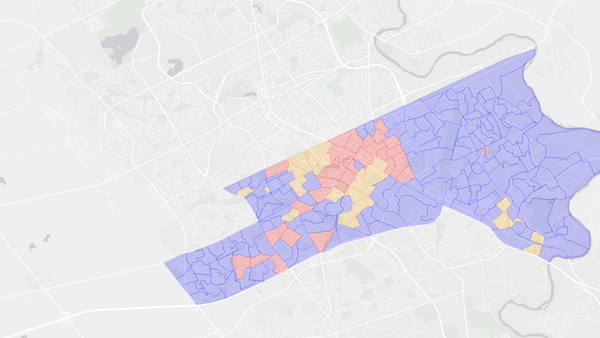
Kitchener—Waterloo, ON — 2011 Federal Election Results Map
Kitchener—Waterloo — 2011 Election Results
📌 The Canadian federal electoral district of Kitchener—Waterloo was contested in the 2011 election.
🏆 Peter Braid, the Conservative candidate, won the riding with 27,039 votes (40.9% of the vote).
🥈 The runner-up was Andrew Telegdi (Liberal) with 24,895 votes (37.6%), defeated by a margin of 2,144 votes.
📊 Other notable candidates: Bill Brown (NDP-New Democratic Party, 16%).
Riding information
Auto generated. Flag an issue.Kitchener—Waterloo
Kitchener—Waterloo is an urban riding in southwestern Ontario covering the northern portion of the City of Kitchener and much of the City of Waterloo, in the heart of the Regional Municipality of Waterloo. The riding encompasses the two universities that anchor the region’s identity — the University of Waterloo and Wilfrid Laurier University — along with established residential neighbourhoods and the commercial corridors linking the twin cities.
Candidates
Peter Braid (Conservative) — The incumbent MP, first elected in 2008 in a narrow upset victory, Braid was born in Kitchener and built a career in the private sector before entering politics. He worked as a communications consultant, served as director of operations at Sun Life Financial, and was an account manager with Quarry Integrated Communications in Waterloo. He also worked in the constituency office of former Progressive Conservative MP Walter McLean and at the Immigration and Refugee Board.
Andrew Telegdi (Liberal) — Telegdi was born in Budapest, Hungary, and emigrated to Canada with his family in 1957 as a refugee following the 1956 Hungarian Revolution. He earned a Bachelor of Arts in psychology from the University of Waterloo, where he served two terms as president of the Federation of Students in the mid-1970s. Telegdi served on the City of Waterloo council from 1985 to 1993 and as a regional councillor for the Regional Municipality of Waterloo from 1988 to 1993. He was first elected to Parliament in 1993, representing the riding for five consecutive terms. He served as parliamentary secretary to the Minister of Citizenship and Immigration from 1998 to 2000 and chaired the Standing Committee on Citizenship and Immigration in 2005. Defeated in 2008, he was seeking to reclaim the seat.
Bill Brown (NDP) carried the party’s banner in the riding.
Cathy MacLellan (Green Party) also ran, having previously contested the riding for the Greens in 2008. Steven Bradley Scott (Pirate Party), Richard Walsh-Bowers (Independent), and Julian Ichim (Marxist-Leninist) also appeared on the ballot.
About the Riding
Kitchener—Waterloo sits at the centre of one of Canada’s most dynamic technology corridors. In 2011, Research In Motion (the maker of BlackBerry) was the region’s dominant private-sector employer, with thousands of employees at its Waterloo headquarters. The company’s presence had catalyzed a broader ecosystem of technology startups and venture capital firms clustered around the University of Waterloo’s renowned engineering and computer science programs. Communitech, a tech industry hub, and the Accelerator Centre provided incubation space for emerging companies.
Beyond technology, the riding’s economy included the insurance and financial services sector, anchored by Sun Life Financial and Manulife operations, as well as the educational institutions themselves, which together employed thousands of faculty and staff. Wilfrid Laurier University and the University of Waterloo gave the riding a large student population and a younger demographic profile than the regional average. The Kitchener-Cambridge-Waterloo census metropolitan area had a population of approximately 477,000 as of the 2011 census.
Local issues heading into 2011 included the planned Ion rapid transit project linking Waterloo and Kitchener, affordability concerns related to the region’s rapid growth, and the economic uncertainty surrounding Research In Motion’s competitive challenges in the smartphone market. The riding’s mix of university-educated professionals, students, and established middle-class neighbourhoods made it one of the more competitive seats in the region.