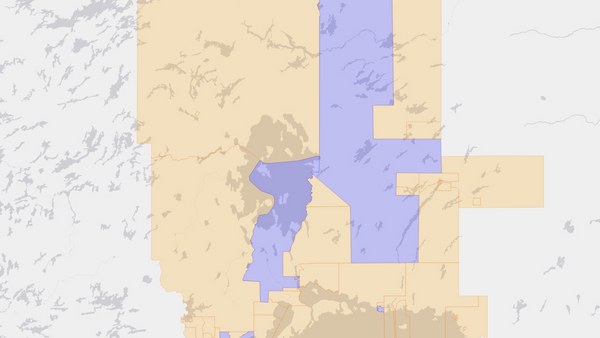
Thunder Bay—Rainy River, ON — 2011 Federal Election Results Map
Thunder Bay—Rainy River — 2011 Election Results
📌 The Canadian federal electoral district of Thunder Bay—Rainy River was contested in the 2011 election.
🏆 John Rafferty, the NDP-New Democratic Party candidate, won the riding with 18,019 votes (48.7% of the vote).
🥈 The runner-up was Moe Comuzzi-Stehmann (Conservative) with 10,050 votes (27.2%), defeated by a margin of 7,969 votes.
📊 Other notable candidates: Ken Boshcoff (Liberal, 22%).
Riding information
Auto generated. Flag an issue.Thunder Bay—Rainy River
Thunder Bay—Rainy River is a vast northwestern Ontario riding covering roughly 30,000 square kilometres. It includes the southern half of the city of Thunder Bay (south of Highway 11/17 and the Harbour Expressway) and extends westward along the Canada-United States border to Lake of the Woods. The riding takes in the towns of Fort Frances, Atikokan, and Rainy River, along with the municipalities of Neebing, Oliver Paipoonge, Emo, and numerous smaller townships and unorganized territories. Lake Superior forms the eastern boundary, while the Rainy River and the international border with Minnesota run along the south.
Candidates
John Rafferty (NDP) — Rafferty was first elected in Thunder Bay—Rainy River in 2008, defeating two-term Liberal incumbent Ken Boshcoff. Born in Wingham, Ontario, he had worked as a radio broadcaster at CKPR in Thunder Bay before leaving to start his own business producing voiceovers for educational and training videos. A persistent campaigner, Rafferty had run for the NDP federally in 2000, 2004, and 2006, and provincially in 2003 and 2007, before finally winning the seat in 2008.
Moe Comuzzi-Stehmann (Conservative) — Comuzzi-Stehmann was a Thunder Bay businesswoman who had been nominated as the Conservative candidate in August 2010. She held a bachelor of arts in political science from Lakehead University and had operated the local East Side Mario's franchise, run Pilot Food Services, and worked at car dealerships in both Thunder Bay and Ottawa.
Ken Boshcoff (Liberal) — Boshcoff was a lifelong Thunder Bay resident and long-time municipal politician. He held an honours degree in political science and economics from Lakehead University and a master's degree in environmental studies from York University. He served as a Thunder Bay city councillor from 1979 to 1997 and as mayor from 1997 to 2003, during which time he also served as president of the Association of Municipalities of Ontario. He represented the riding as MP from 2004 to 2008 before losing to Rafferty.
Ed Shields also stood as the Green Party candidate.
About the Riding
With a population of roughly 80,000, Thunder Bay—Rainy River combines a mid-sized urban centre with a vast rural and wilderness hinterland. The Thunder Bay portion of the riding is home to the city's industrial south side, including the port facilities on Lake Superior that make Thunder Bay a critical link in Canada's grain transportation system, handling western grain shipments bound for eastern markets and export. Bombardier Transportation operated a major railcar manufacturing plant in Thunder Bay, and the forestry sector, though diminished by mill closures in the preceding years, remained an important employer.
Fort Frances, the riding's second-largest community with roughly 8,000 residents, had been hard hit by the closure of the Abitibi-Consolidated pulp and paper mill in 2009, which eliminated hundreds of jobs. Atikokan, a former iron mining town, was transitioning toward tourism and had seen the conversion of its coal-fired generating station to biomass fuel. The riding includes several First Nations communities, and issues of Indigenous services, treaty rights, and remote community access were prominent.
Key concerns heading into 2011 included forestry sector job losses, the future of Bombardier's Thunder Bay plant, transportation infrastructure for remote communities, cross-border trade with Minnesota, and economic diversification in resource-dependent towns across the district.