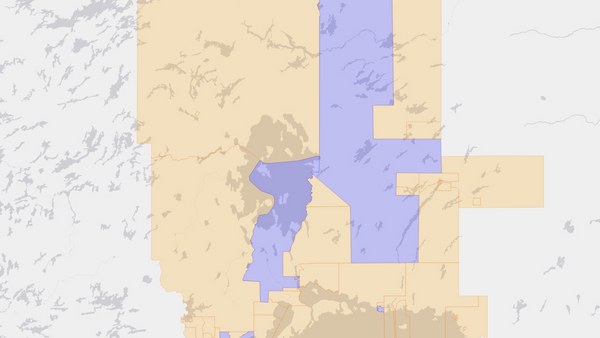
Algoma—Manitoulin—Kapuskasing, ON — 2011 Federal Election Results Map
Algoma—Manitoulin—Kapuskasing — 2011 Election Results
📌 The Canadian federal electoral district of Algoma—Manitoulin—Kapuskasing was contested in the 2011 election.
🏆 Carol Hughes, the NDP-New Democratic Party candidate, won the riding with 18,747 votes (52.3% of the vote).
🥈 The runner-up was Ray Sturgeon (Conservative) with 10,616 votes (29.6%), defeated by a margin of 8,131 votes.
📊 Other notable candidates: François Cloutier (Liberal, 15%).
Riding information
Auto generated. Flag an issue.Algoma—Manitoulin—Kapuskasing
Algoma—Manitoulin—Kapuskasing is a vast federal riding in northeastern Ontario, covering over 100,000 square kilometres of Canadian Shield terrain. The riding stretches from Manitoulin Island and the North Channel of Lake Huron in the south, through the Algoma highlands, northward to the communities along the Trans-Canada Highway and the Ontario Northland Railway corridor near Kapuskasing and Hearst.
Candidates
Carol Hughes (NDP) — The incumbent MP, Hughes had first won the seat in 2008 after two previous attempts in 2004 and 2006. Before entering politics, she worked as a staff representative for the Canadian Labour Congress. Originally from the region, Hughes had been encouraged to run again in 2008 by supporters she encountered while travelling through the riding. In her first term, she established herself as a voice for the riding’s resource-dependent communities and was seeking re-election in 2011.
Ray Sturgeon (Conservative) — Sturgeon was a defence industry consultant and senior partner at CFN Consultants, an Ottawa-based lobbying firm. His client list had included Lockheed Martin Aeronautics and BAE Systems. He had been registered as a lobbyist for Lockheed Martin, the manufacturer of the F-35 fighter jet, until December 2010, shortly before seeking the Conservative nomination in the riding.
François Cloutier (Liberal) — Cloutier carried the Liberal banner in the riding. Limited public biographical information was available about him heading into the 2011 campaign.
Lorraine A. Rekmans (Green Party) — Rekmans was a member of the Serpent River First Nation and was of Anishinaabe and French heritage. She had run as the Green candidate in the riding in 2008 as well. An author and advocate, she co-edited a publication documenting the impacts of uranium mining on Indigenous communities at Serpent River First Nation. She served as the Green Party’s critic for Aboriginal affairs.
About the Riding
Algoma—Manitoulin—Kapuskasing is one of Ontario’s largest ridings by area, encompassing more than 100 communities spread across a landscape of boreal forest, rock, lakes, and rivers. The riding has no single dominant urban centre; instead, its population is distributed among small and mid-sized towns including Elliot Lake, Espanola, Blind River, Chapleau, Kapuskasing, and Hearst, along with numerous First Nations communities.
The regional economy is built on natural resources. Forestry has historically been the backbone of communities like Kapuskasing and Hearst, with pulp and paper mills providing major employment, though the sector faced significant contraction in the years before 2011. Mining remains important, with operations extracting gold, base metals, and other minerals across the Algoma and Sudbury districts. Elliot Lake, once a major uranium-mining centre, had been transitioning toward retirement living and tourism. Espanola’s economy centres on its pulp mill.
Manitoulin Island, the world’s largest freshwater island, adds a distinct character to the riding with its mix of farming communities, First Nations reserves, and tourism. The island is accessible by bridge from the north and by ferry from Tobermory. The riding’s large Indigenous population and many First Nations communities make treaty rights, land claims, and access to services ongoing concerns.
Heading into 2011, the riding faced challenges related to forestry-sector job losses, aging infrastructure, access to healthcare in remote communities, and the economic diversification of towns historically dependent on single industries.