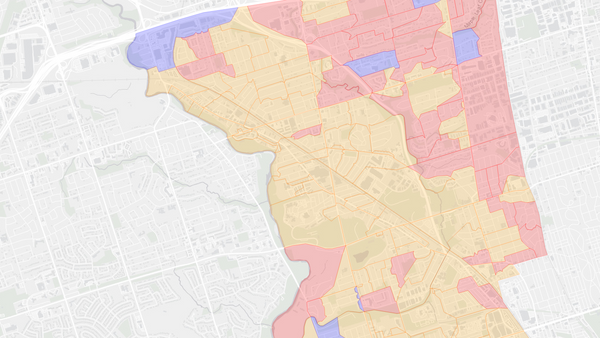
Etobicoke—Lakeshore, ON — 2011 Federal Election Results Map
Etobicoke—Lakeshore — 2011 Election Results
📌 The Canadian federal electoral district of Etobicoke—Lakeshore was contested in the 2011 election.
🏆 Bernard Trottier, the Conservative candidate, won the riding with 21,997 votes (40.3% of the vote).
🥈 The runner-up was Michael Ignatieff (Liberal) with 19,128 votes (35.1%), defeated by a margin of 2,869 votes.
📊 Other notable candidates: Michael Erickson (NDP-New Democratic Party, 20%).
Riding information
Auto generated. Flag an issue.Etobicoke—Lakeshore
Etobicoke—Lakeshore is a federal riding in southwestern Toronto stretching along the Lake Ontario shoreline. It encompasses the former lakeshore municipalities of Mimico, New Toronto, and Long Branch, as well as the neighbourhoods of Humber Bay Shores, Stonegate–Queensway, and Alderwood. The riding runs from the Humber River in the east along the waterfront to Etobicoke Creek in the west.
Candidates
Bernard Trottier (Conservative) — Trottier held engineering and business degrees, having earned a B.Sc. in Engineering from the University of Alberta in 1988 and an MBA from the Richard Ivey School of Business at the University of Western Ontario. Before entering politics, he worked as a business consultant in France and later joined IBM Global Business Services in Toronto as a senior consulting manager. He had also served as a Managing Partner at Gartner Inc., a global information technology research and advisory firm. Running in a riding held by the Leader of the Opposition, Trottier was widely viewed as an underdog candidate.
Michael Ignatieff (Liberal) — The incumbent MP and Leader of the Liberal Party of Canada and Leader of the Official Opposition. Born in Toronto, Ignatieff was educated at the University of Toronto and completed his doctorate in history at Harvard University in 1976. He built a distinguished international academic career with positions at Cambridge, Oxford, the London School of Economics, and Harvard, where he directed the Carr Center for Human Rights Policy at the Kennedy School. He was also an acclaimed author and broadcaster, with eighteen books to his name including works on human rights, political ethics, and a Booker Prize-nominated novel. He returned to Canada in 2005 to take up the Chancellor Jackman Visiting Professorship in Human Rights Policy at the University of Toronto, was first elected as MP for Etobicoke—Lakeshore in 2006, re-elected in 2008, and became Liberal leader in May 2009.
Michael Erickson (NDP) — Erickson was a bilingual high school teacher who grew up in Ottawa and moved to Toronto at 19. He had previously run for Toronto city council before joining the NDP in early 2011.
Dave Corail ran for the Green Party and Janice Murray for the Marxist-Leninist Party.
About the Riding
Etobicoke—Lakeshore is defined by its lakefront setting and its history as a string of independent towns that were absorbed into Metropolitan Toronto. Long Branch, New Toronto, and Mimico each retain distinct identities, with older housing stock, main street retail strips, and long-established community institutions. By contrast, Humber Bay Shores was undergoing rapid condominium development, with clusters of glass towers transforming the waterfront skyline.
The riding had a population of approximately 121,000 and was one of the most linguistically diverse in Canada. Slavic-language speakers—including Polish, Ukrainian, Russian, Serbian, and Croatian communities—made up roughly 15 percent of the population, the highest concentration of any federal riding in the country. Significant Italian, Portuguese, and Latin American communities also called the riding home.
Major transportation corridors include the Queensway (Highway 2), the Gardiner Expressway, and the Lakeshore GO Transit rail line, which provides commuter service through Mimico and Long Branch stations. Humber College's Lakeshore campus is a major institutional presence. The riding's economy is a mix of retail, light industrial activity along the rail corridor, and a growing service sector driven by the condominium boom. The 2011 contest drew national attention as the seat of the Liberal leader, making it a symbolic test of the party's strength in its traditional Toronto heartland.