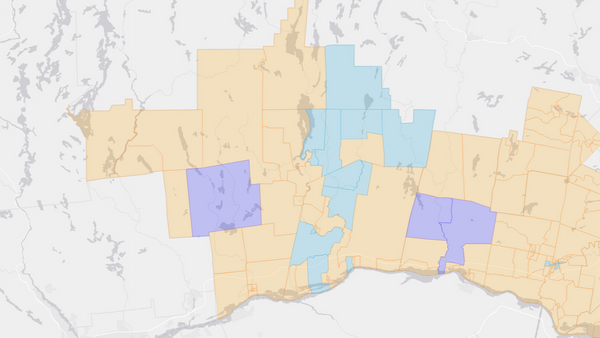
Pontiac, QC — 2011 Federal Election Results Map
Pontiac — 2011 Election Results
📌 The Canadian federal electoral district of Pontiac was contested in the 2011 election.
🏆 Mathieu Ravignat, the NDP-New Democratic Party candidate, won the riding with 22,376 votes (45.8% of the vote).
🥈 The runner-up was Lawrence Cannon (Conservative) with 14,441 votes (29.6%), defeated by a margin of 7,935 votes.
📊 Other notable candidates: Cindy Duncan McMillan (Liberal, 13%) and Maude Tremblay (Bloc Québécois, 10%).
Riding information
Auto generated. Flag an issue.Pontiac
Pontiac is a vast, largely rural riding in western Quebec stretching from the outskirts of Gatineau northward to the Cabonga Reservoir, with the Ottawa River forming its western boundary along the Ontario border. It encompasses part of the City of Gatineau, the regional county municipalities of Pontiac, Les Collines-de-l'Outaouais, and La Vallée-de-la-Gatineau, and includes communities such as Chelsea, Wakefield, Maniwaki, and Shawville. Much of Gatineau Park, the National Capital Region's major conservation area, lies within the riding's southern portion.
Candidates
Mathieu Ravignat (NDP) — Born in 1973 and raised in Gracefield, Quebec, and Orléans, Ontario, Ravignat held a master's degree in political science. He was of Belgian descent. He co-founded Local 2626 of the Canadian Union of Public Employees, representing student employees at the University of Ottawa. At the time of the 2011 election, he was working as a federal government researcher on Aboriginal and environmental issues. He had previously run as an independent candidate in the 1997 federal election. Ravignat was also the founder of the Daijiken Traditional Karate Association in Wakefield, Quebec.
Lawrence Cannon (Conservative) — Cannon had represented Pontiac since 2006 and was serving as Canada's Minister of Foreign Affairs, a post he assumed in October 2008 after previously serving as Minister of Transport, Infrastructure and Communities. Before entering federal politics, Cannon had a lengthy career in Quebec provincial politics as a member of the Quebec Liberal Party, winning election to the National Assembly for La Peltrie in 1985. In the provincial cabinet, he served as Minister of Communications from 1990 to 1994, where he oversaw implementation of Quebec's 911 emergency system and the provincial Privacy Act. He held an MBA from Université Laval and a bachelor's degree from Loyola College in Montreal. Earlier in his career, he served as executive assistant to Premier Robert Bourassa from 1971 to 1976.
Cindy Duncan McMillan (Liberal) — Duncan McMillan was a Carleton University graduate who co-owned a cattle farm on the shores of the Gatineau River. She had been active in agricultural organizations and had lived in the riding for over two decades. She had previously been the Liberal candidate in Pontiac in the 2008 federal election.
Maude Tremblay (Bloc Québécois), Louis-Philippe Mayrand (Green Party), and Benoit Legros (Marxist-Leninist) also contested the riding.
About the Riding
Pontiac is one of Quebec's geographically largest ridings, covering a territory that spans from suburban Gatineau Hills communities through Canadian Shield wilderness to remote forestry and mining country in the north. The population was approximately 93,000 as of the 2006 census. The riding is predominantly francophone, though anglophones — making up roughly a quarter of the population — are concentrated along the Ottawa River corridor from Aylmer to Sheenboro and along the Gatineau River from Chelsea to Maniwaki. The Kitigan Zibi Anishinabeg First Nation, located near Maniwaki, is one of the riding's significant Indigenous communities, with over thirteen percent of the riding's population reporting Aboriginal origin in the 2011 National Household Survey.
The economy varies sharply by area. The southern communities near Gatineau function as bedroom communities for federal public servants commuting to Ottawa. Further north, the economy depends on forestry, mining, and outdoor recreation. The Ottawa Valley's cultural heritage — a blend of Scottish, Irish, and French traditions — is celebrated at local fairs and festivals. Federal issues in 2011 included forestry sector struggles, infrastructure investment for rural roads and bridges, support for First Nations communities, and the future of the federal public service.