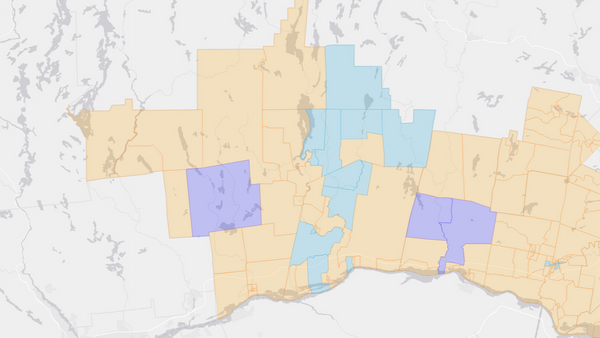
Abitibi—Témiscamingue, QC — 2011 Federal Election Results Map
Abitibi—Témiscamingue — 2011 Election Results
📌 The Canadian federal electoral district of Abitibi—Témiscamingue was contested in the 2011 election.
🏆 Christine Moore, the NDP-New Democratic Party candidate, won the riding with 24,763 votes (51.2% of the vote).
🥈 The runner-up was Marc Lemay (Bloc Québécois) with 15,258 votes (31.6%), defeated by a margin of 9,505 votes.
📊 Other notable candidates: Steven Hébert (Conservative, 10%) and Suzie Grenon (Liberal, 6%).
Riding information
Auto generated. Flag an issue.Abitibi—Témiscamingue
Stretching across the northwestern corner of Quebec, Abitibi—Témiscamingue encompasses a territory of over 33,000 square kilometres along the Ontario border. The riding centres on the city of Rouyn-Noranda and includes the towns of Amos, La Sarre, Ville-Marie, and Témiscaming, along with dozens of smaller municipalities and several Algonquin and Cree communities, including the Abitibiwinni First Nation at Pikogan near Amos.
Candidates
Christine Moore (NDP) — A nurse and former Canadian Forces medical technician, Moore served with the 52nd Field Ambulance reserve unit in Sherbrooke before completing a nursing diploma at the Cégep de l'Abitibi-Témiscamingue in 2008 and a Bachelor of Science in nursing from the Université du Québec en Abitibi-Témiscamingue (UQAT) in 2010. During her studies she completed a humanitarian internship in Senegal. She had run in the riding twice before for the NDP, in 2006 and 2008, finishing well back both times.
Marc Lemay (Bloc Québécois) — Born in Amos, Lemay was a lawyer who had represented Abitibi—Témiscamingue since the riding's creation in 2004, when he defeated Liberal incumbent Gilbert Barrette. In the House of Commons he served as the Bloc's critic for Indian Affairs and Northern Development, a portfolio with particular relevance given the riding's significant Indigenous population. He was seeking his third term.
Steven Hébert (Conservative) — Originally from Val-d'Or, Hébert was a young political operative who had been working for the Conservative Party in Ottawa. He carried the Conservative banner in the riding for the 2011 campaign.
Suzie Grenon (Liberal) — Grenon stood as the Liberal candidate in a riding where the party had struggled since losing the seat in 2004.
Patrick Rochon (Green Party) — Rochon represented the Green Party in the contest.
About the Riding
Abitibi—Témiscamingue is defined by its resource economy. The riding sits within the geologically rich Abitibi greenstone belt, a gold- and copper-bearing formation that has sustained mining activity in the broader region since the 1920s. Rouyn-Noranda, known as the national copper capital, was home to the Horne copper smelter operated by Xstrata (now Glencore), one of the region's largest employers. Major mining companies including Agnico Eagle maintained operations in the area.
Beyond mining, the region's economy rested on forestry, agriculture, and a growing tourism sector centred on outdoor recreation — fishing, hunting, and winter sports drew visitors to the region's extensive boreal forests and lake systems. The Université du Québec en Abitibi-Témiscamingue, with campuses in Rouyn-Noranda and Val-d'Or, was the region's main post-secondary institution and a significant local employer.
The riding's population of approximately 103,000 was dispersed across a vast territory, making transportation infrastructure and access to federal services ongoing concerns. The region's Indigenous communities, including Algonquin nations in the south and Cree communities in the northern reaches, gave questions of Aboriginal affairs and resource development particular local resonance. Commodity prices, federal investment in northern infrastructure, and forestry-sector support were key issues heading into 2011.