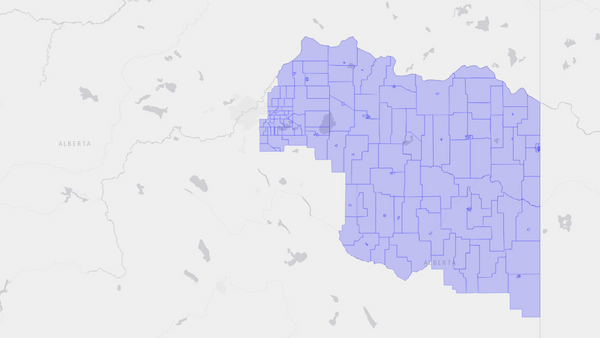
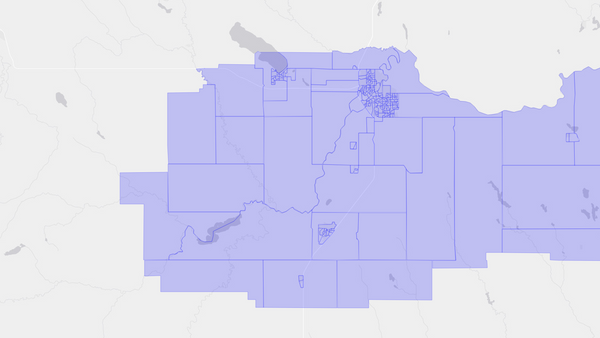
Crowfoot, AB — 2008 Federal Election Results Map
Crowfoot — 2008 Election Results
📌 The Canadian federal electoral district of Crowfoot was contested in the 2008 election.
🏆 Kevin Sorenson, the Conservative candidate, won the riding with 39,342 votes (82.0% of the vote).
🥈 The runner-up was Ellen Parker (NDP-New Democratic Party) with 3,783 votes (7.9%), defeated by a margin of 35,559 votes.
📊 Other notable candidates: Kaitlin Kettenbach (Green Party, 6%).
Riding information
Auto generated. Flag an issue.Crowfoot
Few constituencies covered more ground. Crowfoot spread across roughly 42,800 square kilometres of central and east-central Alberta, reaching from Camrose and the aspen parkland in the north down through Stettler, Coronation and Hanna to the dryland grain country of the Special Areas, and westward through Three Hills, Trochu and Drumheller to Wheatland County on the approaches to Calgary. The riding was named for Crowfoot, the nineteenth-century Siksika chief.
Candidates
Kevin Sorenson (Conservative) — Born in 1958 and a farmer near Killam in east-central Alberta, Sorenson had represented Crowfoot since 2000, first for the Canadian Alliance and then for the Conservatives after the 2003 merger. From May 2006 he chaired the Commons Standing Committee on Foreign Affairs and International Development. He was seeking a fourth term.
Ellen Parker (NDP) — An educator based in Camrose, Parker held a bachelor of education in home economics from the University of Alberta and had coordinated the Camrose and Area Further Education Council. She was a founding member of the city's Waste Reduction Action Committee and sat on Camrose's recycling committee. This was her third consecutive campaign in the riding, after 2004 and 2006.
Kaitlin Kettenbach (Green) — Kettenbach worked as a contractor and lived in Rockyford, a village in Wheatland County east of Calgary. The Green Party had no organisational base in the constituency.
Sharon L. Howe (Liberal) — Semi-retired and living in Calgary, Howe stood for the Liberals.
About the Riding
Camrose, with 15,620 residents at the 2006 census, was the largest centre and the riding's institutional hub, home to the University of Alberta's Augustana Campus, which had joined the university in 2004 after decades as a Lutheran college. Drumheller, counted at 7,932, drew its living from the badlands: the Royal Tyrrell Museum of Palaeontology and the hoodoos of the Red Deer River valley pulled hundreds of thousands of visitors a year. Stettler, Three Hills, Hanna, Coronation and Consort served as the service centres for the farms around them. At the western end, Strathmore and Chestermere sat close enough to Calgary to be filling with commuters.
Grain and cattle set the tone of the local economy. Wheat, barley and canola dominated the cropland, and 2008 had brought both unusually strong world grain prices and a punishing rise in the cost of fuel, fertiliser and machinery. Cattle producers were in worse shape. The herd had never fully recovered from the border closures that followed the 2003 BSE case, a dollar near parity had cut export margins, and mandatory American country-of-origin labelling took effect on 30 September, two weeks before the vote, threatening the flow of Canadian feeder cattle into United States feedlots. Grain marketing was equally live: the Federal Court had struck down the government's attempt to remove barley from the Canadian Wheat Board's single desk in 2007, and the question remained unresolved.
Energy was the other pillar. Shallow gas wells and the service companies that maintained them dotted the eastern half of the riding, and falling oil and gas prices through the autumn threatened drilling programs and the seasonal work they supported. Depopulation of the smallest hamlets, distances to hospital care, and the cost of maintaining rural roads and schools framed most of the local conversation. The riding's sheer size was itself a campaign problem: reaching voters meant covering the distance from the parkland to the Saskatchewan boundary and back.