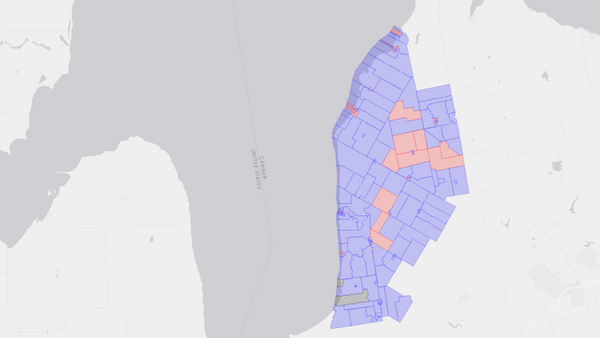
Sault Ste. Marie, ON — 2008 Federal Election Results Map
Sault Ste. Marie — 2008 Election Results
📌 The Canadian federal electoral district of Sault Ste. Marie was contested in the 2008 election.
🏆 Tony Martin, the NDP-New Democratic Party candidate, won the riding with 16,572 votes (40.4% of the vote).
🥈 The runner-up was Cameron Ross (Conservative) with 15,461 votes (37.7%), defeated by a margin of 1,111 votes.
📊 Other notable candidates: Paul Bichler (Liberal, 17%).
Riding information
Auto generated. Flag an issue.Sault Ste. Marie
Nearly everyone in this riding lived inside one city. Sault Ste. Marie sits at the rapids where Lake Superior spills into the St. Marys River, facing its American namesake across the water; the district around it added Prince Township, the Garden River and Batchewana First Nation reserves, and a ribbon of unorganized Algoma territory running north along the Lake Superior shore toward the Montreal River.
Candidates
Tony Martin (NDP) — Martin held the seat, won in 2004 and defended in 2006, and had been the provincial member for Sault Ste. Marie from 1990 to 2003. Born in Drogheda, Ireland, and raised in Wawa, he took an arts degree at Laurentian University in 1974, worked as a pastoral assistant at Blessed Sacrament Parish through the 1980s, sat as a Catholic school board trustee, founded the city's soup kitchen and ran Transcend Homes, a local workers' co-operative builder. Appointed Deputy Speaker at Queen's Park in 1999, he resigned the chair in December 2000 over the Harris government's record on poverty. In Ottawa he handled social policy, human resources and FedNor for his caucus, and on 25 September 2008 he released the party's northern Ontario platform at the Canadian Bushplane Heritage Centre.
Cameron Ross (Conservative) — Ross was chief executive of Algoma Mutual Insurance, after some thirty-five years in uniform in the regular army and then the Reserve Force. He rose to lieutenant-colonel, served overseas in Cyprus and Bosnia and on NATO duty in Germany, commanded the 49th (Sault Ste. Marie) Field Regiment, Royal Canadian Artillery, and afterwards was deputy commander of 33 Canadian Brigade Group. On 8 October, six days before the vote, Mayor John Rowswell publicly endorsed him.
Paul Bichler (Liberal) — Bichler owned a laundromat. Ken Dryden came to the Sault during the campaign to speak for him at the local Liberal committee rooms.
Luke Macmichael (Green) — A Sault native with a computer engineering degree from Queen's University, Macmichael spent two years as a missionary in Hokkaido, Japan, then came home to Essar Steel Algoma, working three years in information technology before moving into human resources. He volunteered with the environmental group Clean North and ran the local Project Porchlight campaign, which distributed about 8,000 compact fluorescent bulbs across the city.
Cory McLeod stood for the First Peoples National Party and Mike Taffarel, a steelworker, for the Marxist-Leninist Party.
About the Riding
Steel was both the anchor and the anxiety. The mill founded as Algoma Steel had been bought in 2007 by India's Essar Global and renamed Essar Steel Algoma; with roughly 3,000 on the payroll it was easily the largest private employer in the community, and the union local's relationship with a distant parent was a live subject during the campaign.
Forestry supplied the more precarious half of the industrial story. St. Marys Paper, a century-old supercalendered mill on the waterfront, had filed for creditor protection in October 2006 and restarted under new ownership in June 2007, running with very little margin for error. Softwood lumber terms, FedNor funding and power costs for northern mills were standard fare on the doorstep.
Public institutions and the border carried much of the rest. Algoma University received its own charter in 2008, becoming a degree-granting university after decades as an affiliated college; Sault College, the Sault Area Hospital and the Ontario Lottery and Gaming Corporation, whose head office is downtown, were all large employers. New American document requirements for land crossings, due to take effect on 1 June 2009, worried operators who depended on Michigan visitors. The city's age profile ran well above the national average, the residue of years of young people leaving for work elsewhere.