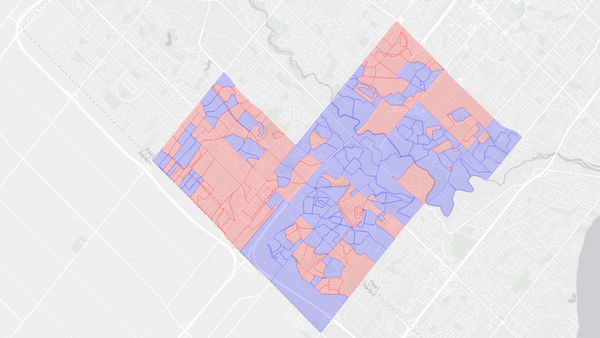
Mississauga South, ON — 2008 Federal Election Results Map
Mississauga South — 2008 Election Results
📌 The Canadian federal electoral district of Mississauga South was contested in the 2008 election.
🏆 Paul Szabo, the Liberal candidate, won the riding with 20,518 votes (44.2% of the vote).
🥈 The runner-up was Hugh Arrison (Conservative) with 18,366 votes (39.6%), defeated by a margin of 2,152 votes.
📊 Other notable candidates: Matt Turner (NDP-New Democratic Party, 9%) and Richard Laushway (Green Party, 7%).
Riding information
Auto generated. Flag an issue.Mississauga South
Mississauga South was the city's waterfront seat, roughly 92 square kilometres running along Lake Ontario from the Etobicoke Creek boundary west to the Oakville line. Its inland edge followed Dundas Street West, Erin Mills Parkway, the Queen Elizabeth Way, Hurontario Street and the Queensway East. It gathered up Lakeview, Mineola, Port Credit, Lorne Park, Sheridan, Sheridan Park, Clarkson and the Southdown industrial lands, along with the southern parts of Erindale and Cooksville.
Candidates
Paul Szabo (Liberal) — Born in Toronto in 1948, Szabo took a Bachelor of Science at the University of Western Ontario in 1970, articled at Price Waterhouse and earned his chartered accountant designation in 1973, then added an MBA from York in 1975. His corporate career ran through Heede International as controller, TransCanada PipeLines as director of finance and United Co-operatives of Ontario as corporate treasurer before he opened his own accounting practice in Mississauga in 1990. Elected in 1993, he served as parliamentary secretary to the minister of public works and government services from 2000 to 2003. A social conservative within the Liberal caucus, he wrote six monographs on family and social policy, among them books on child poverty, domestic violence, fetal alcohol syndrome and the ethics of stem cell research. In the 39th Parliament he chaired the Commons access to information, privacy and ethics committee, which through 2007 and 2008 examined the dealings between Brian Mulroney and Karlheinz Schreiber.
Hugh Arrison (Conservative) — A chartered financial planner living in Mississauga, Arrison won a contested Conservative nomination in June 2008 and entered the campaign as a first-time candidate.
Matt Turner (NDP) — Turner, a Mississauga resident, worked as a barista.
Richard Laushway (Green Party) — An information technology analyst from Mississauga.
About the Riding
Nothing else in Mississauga looks much like this. Port Credit was a working harbour town before it was folded into the city, and it still has its harbour where the Credit empties into the lake, a lighthouse-shaped landmark on the pier and a walkable stretch of Lakeshore Road. Clarkson and Lorne Park grew up as separate villages too, the first around its rail station, the second under an old canopy of trees.
The riding's eastern end told a harder story in 2008. The Lakeview Generating Station had come into service in 1962 and reached 2,400 megawatts by 1968, at which point it was the largest thermal-electric plant in the world. It stopped burning coal on 30 April 2005. Its four stacks — the "Four Sisters," visible from Burlington to downtown Toronto — were imploded on 12 June 2006, and the powerhouse came down a year later. What to do with hundreds of hectares of cleared lakefront was the single largest planning question in the riding, and residents' associations had already spent years pressing for public waterfront access rather than industrial reuse.
Further west, the Sheridan Park research campus — some 340 acres on Southdown Road, built by industry in the 1960s and closed to manufacturing by its own covenants — housed corporate research in energy, chemicals and materials, while the Southdown lands held cement and heavy industry near the lake. The Queen Elizabeth Way and the Lakeshore West GO line carried the commuting traffic, and service levels on that line were a recurring local demand.
Szabo had won here five times running, holding together an unusual coalition of lakefront wealth and modest inland neighbourhoods. The Conservatives regarded the seat as winnable — it had a long Progressive Conservative history before 1993 — and the financial turmoil that arrived mid-campaign sharpened the economic argument on both sides.